

According to advertising icon Les Binet, good ads resist creative fatigue because of the "wear-in effect" – actually getting more effective the more they’re seen.
It's easy for us to get sick of our own messaging. How often do you see your own ads each week? From production, to reviews, to analysis, your messages are deeply ingrained in your head. They start to feel stale, and you start to worry your audience is going to get sick of the message.
There’s an urge to change things up, to experiment, to search for that new message that will make ROAS jump and CPMs fall. Realistically, by the time you’re sick of your message, a potential buyer is hearing it for the first time. And that first impression is less impactful than the 5th, 10th or 15th impression.
According to advertising icon Les Binet, good ads don’t wear out, they wear in – getting more effective the more they’re seen.
Message saturation is not the problem. If anything, it should be the goal.
Let's explore the idea⬇️
Exit the echo chamber
Did you know that some people don’t analyze copy when they get an ad on their feed, study the visuals, or click through to explore the funnel and see if the landing page matches the CTA?
So weird, right?
As marketers, we’re dissecting our ads and analyzing each frame. Our customers are not. You don’t have to worry about your customers getting sick of your message, the bigger concern is whether they remember it at all.
Studies on brand recall suggest it takes at least five to seven brand impressions for a consumer to remember a message. Meta tries to keep frequency at a healthy level to avoid creative fatigue, so you likely need multiple creatives to get to seven impressions.
All of this just to be remembered, not even to convert.
The power of consistency
Consistent messaging works. Look at the results of this study by System1:
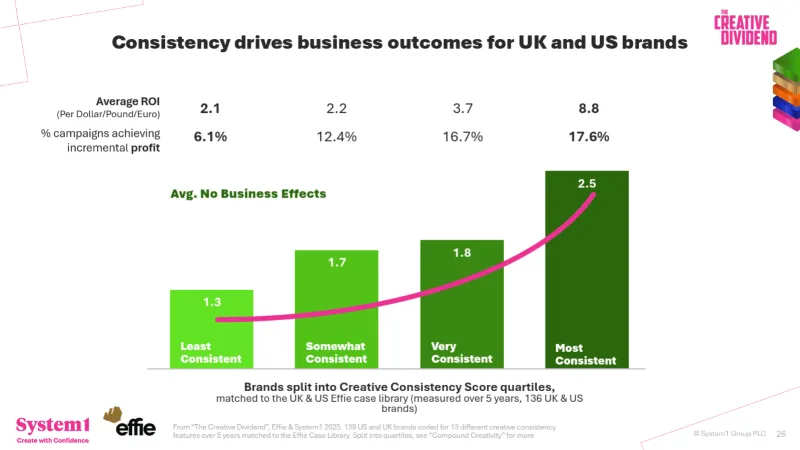
The most consistent brands earn an average ROI of 8.8, while the least consistent sit at 2.1. That’s a huge gap.
Have you ever heard that the brand that wins is the one that makes it easiest to buy?
Consistent, persistent messaging makes your brand easier to remember. Being easier to remember makes the decision-making process easier, which makes converting easier.
Combining consistency and creativity
How can you be creative if you’re going to repeat the same message over and over?
Repetition and creativity are more compatible than you might think. Repetition allows you to start with one theme and put different spins on it.
The Simpsons has been running since 1989 with the same episode formula, and they’ve managed to churn out 790 different stories.
You can do the same thing with ads. If you've watched TV anytime in the last 20 years, you can probably guess what this Gecko is about to tell you.

Geico’s '15 minutes could save you 15%' slogan is synonymous with their brand. They run it in nearly every ad on TV, and as you can see here they’re running it in Meta as well.
They’ve been using this slogan for more than 20 years, and they’re still finding new ways to get that message across. If they haven’t worn out their message yet, the rest of us don’t need to worry.
DTC and the C is for consistent
It’s Thumbstop, so of course we’re going to talk about a DTC example (or two).
Liquid Death is a super consistent DTC brand. They’ve run some pretty over-the-top promotions, including:
- A death metal album whose lyrics are all hate comments they’ve received
- A super bowl commercial that was meant to look like a bunch of kids were drinking beer
- Selling limited edition cans with Ozzy Osbourne’s DNA on them so you can clone him someday
Alone these seem like random gimmicks, but each one feels like Liquid Death. They’re a brand built on having a consistent identity. The product could be copied by anyone; the brand is one of one.
If you take a scroll through their brand’s ad library, you’ll see their slogan, “Murder your thirst,” in at least half their ads. It even shows up in their testimonials, which shows their customers remember it.
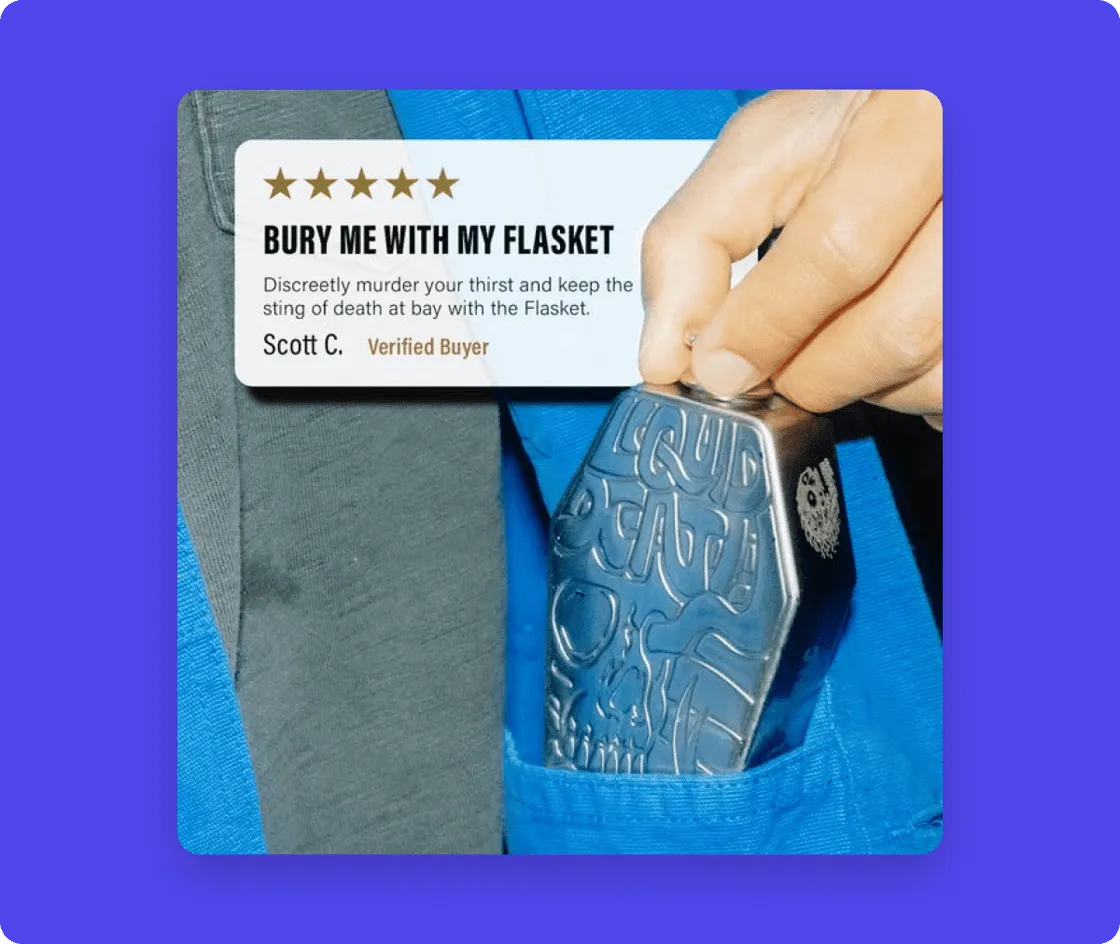
Considering the speed and volume they ship ads with, that’s a ton of different ads and a very consistent message. It’s not as tangible as Geico’s 15% slogan, but it’s memorable and fits the brand.
Modular messaging
You don’t necessarily need to run the exact same message to be consistent. In fact, if you look at some of the strongest DTC brands, they use selling points as sub-messages which all feed up to their core identity.
Let’s use The Ridge as an example. Their core message is 'a better wallet', and they have a number of selling points that connect to that message.
Durability is a big one you see in their ad account:
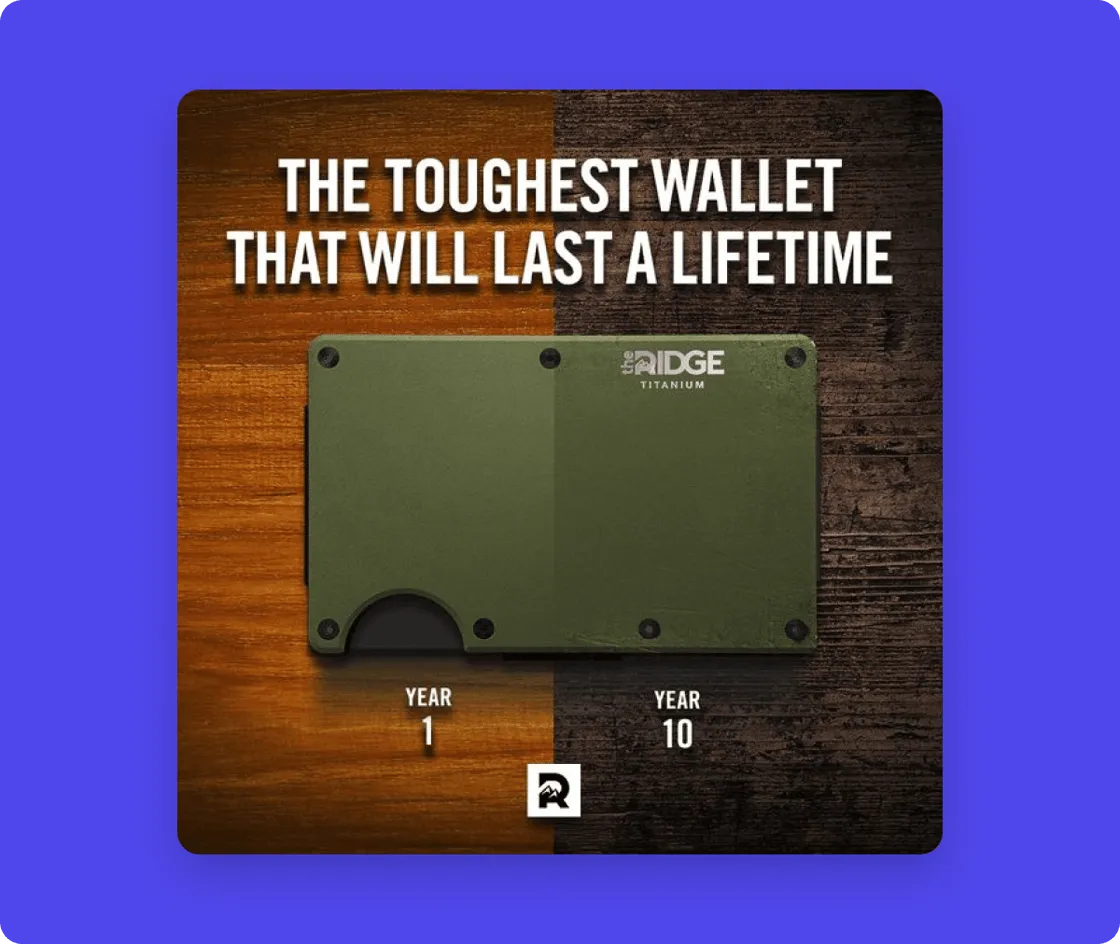
Another “sub-message” they run a lot is about size – cutting down from a bulky wallet to their slim, minimalist design.

Scanning their Meta ad library, those are the two I see the most. They also mention the modular design a fair amount, the RFID-blocking, the lifetime warranty, smaller features like that.
They all boil down to this being a better wallet. Ridge knows their core message and even if they lean into a specific selling point, it always connects back to that message.
Ultra-consistent.
FAQs
How often should I refresh my messaging?
Focus on creative iteration rather than complete overhauls. Studies show consistent brands achieve 4x higher ROI (8.8 vs 2.1) than brands that frequently change messaging. Instead of refreshing creative when you're personally tired of it, refresh when performance metrics actually decline or when you've exhausted your testing iterations on a core message.
How many times does someone need to see an ad before they remember it?
Research on brand recall suggests 5-7 impressions minimum for a consumer to remember your message. This is just for recall, not conversion. Given that Meta aims to keep frequency at healthy levels to avoid creative fatigue, you'll likely need multiple creative variations to reach seven impressions per user.
Can you test new creative without losing brand consistency?
Yes, through modular messaging. Brands like The Ridge demonstrate this by maintaining a core message ("a better wallet") while testing different sub-messages (durability, size, RFID-blocking). Each variation connects back to the central value proposition, allowing for creative testing within a consistent brand framework.
Key takeaways:
Consistent brands earn an average ROI of 8.8 compared to 2.1 for inconsistent brands, according to System1 research. Your audience needs 5-7 impressions just to remember your brand, not convert. Focus creative testing on variations of core messages rather than completely new directions. When you're tired of your messaging, your customers are likely just starting to remember it.