SS

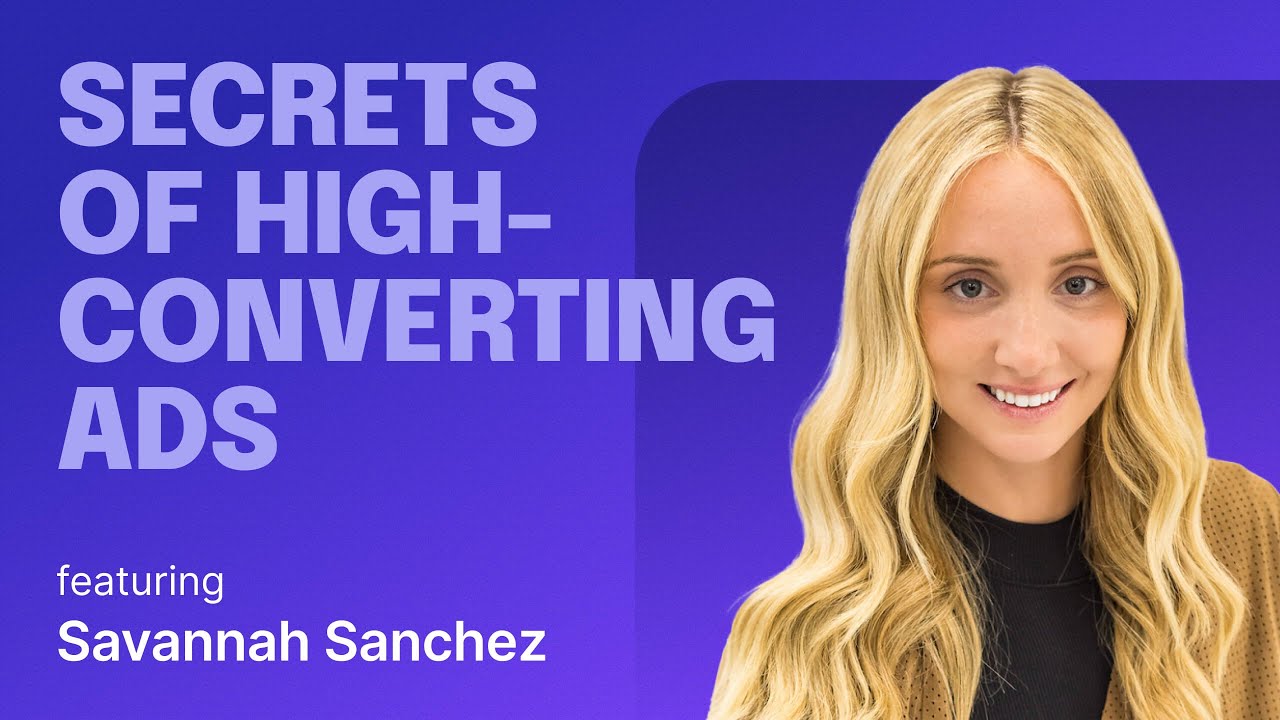
Savannah Sanchez

Founder · The Social Savannah

Savannah Sanchez runs The Social Savannah, an agency that ships 200+ Meta and TikTok ads per week for roughly 50 brands using an internal team of 40 creators and 10 editors. She is distinctive for rejecting AI-generated ads in favor of high-volume, authentic UGC — and for turning creative production into an industrial-scale weekly process with standardized briefs, checklists, and a strict separation of Strategist, Creator, and Editor roles.

Distinctive beliefs, repeated across talks

How Savannah Sanchez thinks about creative strategy

01

Anti-AI, Pro-Human Authenticity

While other agencies lean into AI avatars and AI-generated UGC, Savannah is going the opposite direction — leaning harder into real creators, real testimonials, and out-of-the-box human creativity. Her Motion data consistently shows AI ads underperforming, and she argues AI scripts sound generic and follow the same formulas. The positioning sharpened from 2024 skepticism to an explicit 2025–2026 stance that '2024 was the year of how can we use AI; 2025 is how do we not sound like AI or look like AI.'

"I don't use AI in my ad creative production process."

"One good ad is worth a thousand bad AI ads."

"I feel like 2024 was the year of how can we use AI and 2025 is now how do we not sound like AI or look like AI."

02

Three Roles, Never One Person

High-performing ads require three distinct specialists — Strategist, Creator (raw footage only), and Editor — and combining them degrades output. Creators should never edit in CapCut, strategists should never star in ads, and editors should never invent strategy. This is a hard rule she enforces across 50 clients and uses to train her team, and she frames combining the roles as an early-career mistake she personally made in 2020.

"You essentially need three positions to create high-performing ads. Number one, you need the strategist. Next, you need your creator. And then the editor."

"Remember these are three different jobs and I recommend not to combine them. Don't leave strategy to the creators/editors, and don't force your strategist to star in the ad and edit on CapCut."

"I'm a big believer of let the creators do what they do best, which is creating raw content."

03

The Hook Is 90% Of The Work

Nearly all creative effort should go into the first three seconds, not the body of the ad. Meta only recognizes a new variation when the visual is different in the first 3–5 seconds — text-only changes don't count. Her iteration methodology is to hold the ad body constant and only swap hooks, which she treats as the single highest-leverage variable a creative strategist controls.

"I really think the hook is the most important part of the ad in that first three seconds."

"If you're just changing the text on top, Facebook doesn't really see it as a different variation. You really want the visual aspect to be different."

"The most important variable that you can change in your ad is the hook itself."

04

Ad Length Should Match Audience Age

A heuristic she's stated repeatedly and that surprises audiences every time: the length of your ad in seconds should roughly match the age of your target demographic. 18-year-olds get 10–15 second ads; 30-year-olds get 30-second ads; 60-year-olds will watch a 60-second infomercial-style ad. Older audiences specifically want longer, more educational content with heavy social proof, and are one of the most underserved demographics on Meta.

"The age of your target demographic should be the length of your ad."

"If you're targeting 18 to 34, your ad length should be 18 to 34 seconds and you have those super quick cuts."

"The 40-to-60-year-old age range is one of the most underserved demographics, but they have money and they have time."

05

Speed And Volume Beat Polish

Paid social creative is a volume game, not a polish game. She ships on a strict Mon–Tue film, Wed–Thu edit, Fri deliver cadence. She openly pushes back on the idea of month-long studio shoots with actors and cameras, and mocks the word 'on brand.' The agency ships 200+ ads weekly at under $320 each — the value is in iteration velocity, not production value. Clients who spend $10–$50 on an ad and try to judge it get shut down: give it 4x AOV first.

"Speed is really the name of the game with paid social creative."

"We produce hundreds of ads per week, all for less than $320 per ad including influencer whitelisting access."

"On brand — my most hated word."

06

Research And Steal, Don't Invent

She's explicit that she's not a creative genius — she's a great researcher. Roughly 80% of her ads come from adapting an existing ad example or an organic TikTok trend; only 20% are net-new ideas. She rejects the pressure to invent from scratch and argues most marketers fail by trying to come up with brilliant ideas alone instead of studying competitors and organic feeds. Increasingly in 2025–2026, she's pulling inspiration from organic TikTok trends over ad libraries.

"I'm really good at researching and stealing ideas."

"Maybe 80% of the stuff we're producing is based off of an ad example I've seen or an organic TikTok... reserve 10% of your brain space for coming up with new ideas."

"I'm drawing more inspiration from organic TikTok trends for cool edits and things to do versus looking at other ad libraries."

07

Long-Term Creator Relationships Beat Transactional UGC

Her moat is that some of her creators have been on her team since 2021. She refuses to treat creators as one-off transactions because trained, loyal creators produce better content, accept scripts faster, and can be trusted to improvise. She negotiates full usage rights from day one because tracking expiration across 40 creators is operationally impossible. The pipeline also flows the other way — she hires creative strategists from her pool of creators, because people who've been behind the camera understand hooks better than anyone.

"Treat your creators better than any other agency."

"I need full rights. That's in the contract from day one."

"The best place to find creative strategists is someone who has been behind the camera and done it themselves."

Citation-ready quotes from across the corpus

Savannah Sanchez's most cited quotes

"I feel like 2024 was the year of how can we use AI and 2025 is now how do we not sound like AI or look like AI."

Her characterization of how brand requests have shifted year-over-year, arguing the industry has already overcorrected toward AI.

"If the Motion data showed me that AI content worked better, I would be doing the AI content, but it's just not the case."

Her defense against accusations that her anti-AI stance is ideological rather than data-driven.

"Slack and email are not project management tools. I'll say that again, louder for the people in the back."

Her PSA on operational discipline when producing 200+ ads per week across 50 clients.

"If you're just changing the text on top, Facebook doesn't really see it as a different variation. You really want the visual aspect to be different."

On how Meta's Andromeda update treats creative variations — visual distinctness in the first 3–5 seconds is required.

"I really think the hook is the most important part of the ad in that first three seconds."

Core tenet she returns to across every talk — the first 3 seconds are where 90% of creative effort should go.

"I'm a big believer of let the creators do what they do best, which is creating raw content."

On why creators should never edit and should only provide raw footage — an early-career mistake she made in 2020 that she now won't allow on her team.

"I need full rights. That's in the contract from day one."

On creator contracts at scale — tracking partial usage rights across 40 creators is operationally impossible, so she won't work with creators who won't grant full rights.

"This is a performance-based business. Clients are working with me on a month-to-month basis, and if my ads aren't performing, then I'm getting the boot."

On why creative reporting via Motion is non-negotiable for her agency workflow — she's retained or fired on weekly performance.

"A lot of big brands don't just put all of their eggs in one basket... whoever can create the best ads, game on."

On how large brands like Fabletics run her agency, Narrative, and TubeScience in parallel and use Motion tagging to compare performance.

"Sometimes there's just a little bit of algorithm magic."

On a BlendJet ad made in 2020 that remained the top performer for years despite dozens of iterations — her admission that winning ads aren't fully reverse-engineerable.

"Don't film in your closet. You need to be out in some good lighting."

A representative example of her uncompromising creator QC checklist — lighting is a non-negotiable she catches in footage review before edits begin.


Named methodologies Savannah has introduced or articulated

Savannah Sanchez's frameworks

Three Essential Positions

The three distinct roles required to produce high-performing ads at volume: Strategist → Creator (raw footage only) → Editor. Each is a separate specialty and combining them degrades output. This is the organizational backbone of how Savannah runs a team of 40 creators and 10 editors producing 200+ ads/week.

  1. Strategist: research data, write scripts, brief creators and editors, QC final ad
  2. Creator: provide raw footage only, no editing, no strategy
  3. Editor: take raw content and direction, execute final edit

Creative Testing Framework

Her weekly testing structure for brands spending $30k–$100k/month: two overarching ad inspirations per week, each with two written hook variations and two opening visual variations. Critically, the visual — not just the text — must be distinct in the first 3–5 seconds or Meta won't treat it as a new variation.

  1. 2 Overarching Ad Inspirations per week
  2. 2 Written Hook Variations per inspiration
  3. 2 Opening Visual Variations per hook (visual must differ in first 3–5 sec)

Andromeda Creative Adaptation

Her creative playbook adjustments in response to Meta's Andromeda update: Meta is now measuring relevance of an ad to each individual more granularly, so brands need to cover more bases. She argues Andromeda 'is not as scary as it seems' — the adjustments are about breadth, not complexity.

  1. More persona/avatar testing
  2. More distinct visual hook variations (not just text changes)
  3. Diverse value drivers in scripts
  4. Tap into different motivations to purchase
  5. Draw more inspiration from organic TikTok trends than ad libraries

Weekly Ad Production Timeline

The repeating weekly schedule her agency uses to ship 4–12 ads per client every Friday. Treats paid social as a continuous conveyor belt rather than a project-based workflow.

  1. Monday: Filming
  2. Tuesday: Filming
  3. Wednesday: Editing
  4. Thursday: Editing
  5. Friday: Client receives 4–12 ads (package-dependent)

Performance Booster Checklist

Self-review questions Savannah requires every ad pass before client delivery, focused on engagement drivers rather than production quality. The 'Take Pride' step is the key gut-check — would the client be genuinely proud of this ad, and is it better than the inspiration it was built from?

  1. Hook engagement (first 3 seconds)
  2. Pacing (minimum ~3 seconds between frames, snappy jump cuts)
  3. Storyline (hook → story → CTA)
  4. Human desires addressed
  5. Visual focus (where do eyes go first?)
  6. Take Pride (is yours better than the inspiration?)

The Perfect Ad Checklist

A 12-point pre-send checklist Savannah runs every ad through before delivery. Different ads score differently on different dimensions — not every ad needs 10/10 everywhere, but the account as a whole should cover all twelve.

  1. Attention-grabbing hook
  2. High-quality visuals (good lighting)
  3. Authenticity and relatability
  4. Product visible in first 2 seconds
  5. Clear problem-solution narrative
  6. Compelling product demonstration
  7. Fast-paced edits (≤2 sec per scene)
  8. Testimonials and social proof
  9. Subtle feature highlights (not a feature list)
  10. Emotional appeal
  11. Strong call to action
  12. Humor, skits, or surprises
The framings Savannah keeps returning to

Savannah Sanchez's signature questions

11 talks in Motion's library

All Savannah Sanchez talks