MC

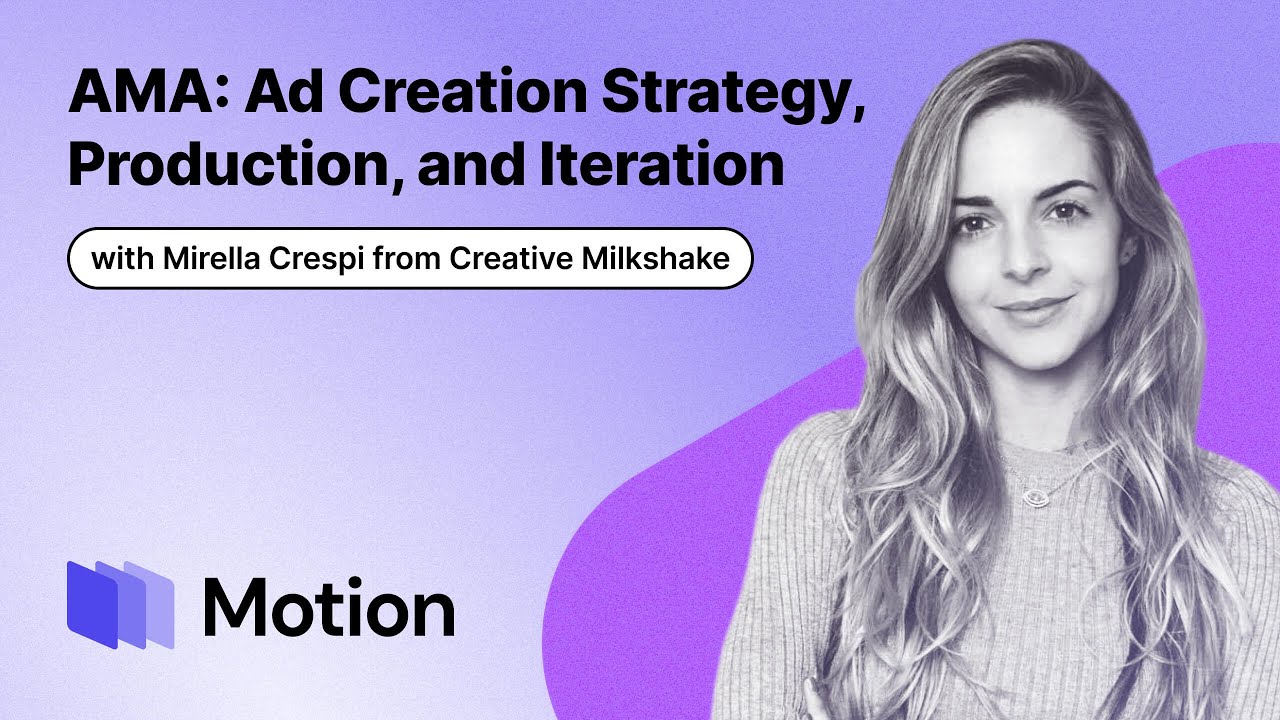
Mirella Crespi

Founder · Creative Milkshake

Mirella Crespi runs Creative Milkshake, a performance creative studio that ships 2,000+ ads a month in eight languages for brands like Amazon, Unilever, True Classic, and Maëlys. A media buyer by training, she thinks about creative production as an industrial system — shared glossaries, tagged naming conventions, multi-agent AI org charts — and is building Ad Creative Academy, the first certification program she describes as bridging traditional creative strategy with AI-powered execution.

Distinctive beliefs, repeated across talks

How Mirella Crespi thinks about creative strategy

01

Creative Is Your Targeting

Because Meta and TikTok auctions serve similar creatives to similar audiences, the creative itself is the targeting mechanism. This means diversity — across concept, hook, format, persona, execution — is not aesthetic, it's how you unlock new audience pools. Small iterations on one creative don't count as diversification; the algorithm treats them as the same ad.

02

Diversify Before You Scale

Increasing ad volume without diversifying across the five pillars (message, format, execution, placement, best practices) and the three POVs (Brand, Customer, Expert) is wasted spend. Meta and TikTok are 'content-eating beasts' — they need variety to find audiences, not more of the same. Testing the same formula at higher volume just saturates your core audience.

"Both Meta and TikTok are content-eating beasts."

"There is no point in just increasing the quantity of ads… The best way to think about it is to diversify and then scale."

"Spend does not equal reach."

03

Sound-First, Not Sound-Last

Sound used to be an afterthought layered on at the end of production; now it should be the starting point of ideation. She builds ads from an audio concept outward — 'what does confidence sound like?' — and treats the hook as an 'ear stopper,' not just a visual scroll stopper. She claims bespoke sound can lower CPAs by up to 50% on Meta and TikTok based on her agency's client tests.

"Think of the hook as the ear stopper."

"Creating videos with bespoke sound can lower CPAs by up to 50%."

"Taking a sound-first approach to creatives has been not only so fun but so effective."

04

Traditional UGC Is Dying; Native-First Wins

The scripted UGC formula of 'this has changed my life' is oversaturated and people are numb to it. What works now is content that blends into the discovery feed — funny, entertaining, or educational — and content that doesn't look like an ad at all. The future is either truly authentic customer content or well-crafted 'native-first' content designed to match how the platform organically creates, not influencer-mimic unboxings.

"Traditional UGC… is slowly dying. What is working now is content that blends into the discovery feeds."

"People are so numb to UGC content nowadays — all the ads look the same."

"UGC as we kind of know it in the last few years — I think that is dead and dying."

05

AI Augments, Doesn't Replace — But Only If You Rebuild

She rejects both 'AI will do it all' hype and AI skepticism. AI is a co-pilot, not the boss: creative strategists should position themselves above agents, build personal agents to automate busy work, and refine their creative judgment and taste as the differentiator. But this requires fundamentally rebuilding SOPs — she gives her 30-person team a paid 'AI Day' each month, and scrapped 2025 workflows entering 2026 because 'this is broken, let's just go build a new one.'

"We cannot carry the same SOPs from 2025 into 2026."

"You're not going to be replaced by AI — you're going to be replaced by people that know how to use AI really well."

"Treat the machine as a co-pilot, never the boss."

06

Brands Charge More Because They're Brands

Pure direct-response scarcity-and-urgency is 'a race to the bottom.' Brands that invest in brand-building alongside DR don't have to fight as hard on price or offers. You need both — strong direct response to win on paid social, and a real brand to make every sale easier — but most performance teams neglect the brand half entirely.

"Brands that actually have a brand, they can charge like a lot more and they don't have to like work so hard to try and get that sale."

"The more prevalent that AI content becomes, the more we are going to crave the real, the human, the authentic."

"Your brand story can live in your organic socials… in your packaging and a personalized note."

07

Authenticity In Advertising Is Mostly Theater

She pushes back on the moral panic around AI avatars by pointing out that 'UGC' in paid social is already scripted, paid actors — a commercial shot in the language of the platform. The question isn't authentic vs. inauthentic; it's whether brands disclose properly (paid actor, AI-generated avatar, simulated imagery) and whether the storytelling is good. Animation studios are accepted; AI-generated content will be too once audiences acclimate.

"Isn't that already inauthentic?"

"It's just a commercial. But because it is done in the language of the platform… it feels authentic."

"If you are using [AI avatars] for advertising, do not use the existing AI avatars. Create your own."

Citation-ready quotes from across the corpus

Mirella Crespi's most cited quotes

"Traditional UGC… is slowly dying. What is working now is content that blends into the discovery feeds."

Her prediction that influencer-mimicking UGC is over and native, discovery-feed-style content is the future.

"The more prevalent that AI content becomes, the more we are going to crave the real, the human, the authentic."

Her counter-intuitive take that as AI saturates feeds, the premium on authentic human storytelling goes up, not down.

"Treat the machine as a co-pilot, never the boss."

Advice to creative team members on positioning themselves above AI agents in the workflow.

"It's just a commercial. But because it is done in the language of the platform… it feels authentic."

Puncturing the 'authenticity' debate around AI avatars — all paid-social UGC is already scripted commercial work.

"Every ad creative is a hypothesis that needs to be tested."

Her foundational principle for structuring creative production as experimentation, not one-off output.

Named methodologies Mirella has introduced or articulated

Mirella Crespi's frameworks

Creative Diversification Guide

A five-pillar checklist she uses to QA every creative strategy: Message (emotional motivators, human desires, promotions), Formats (statics, short/long video, carousels, catalogs), Execution (lo-fi UGC vs. hi-fi polished), Placements (Meta/TikTok/YouTube placement-specific), and Best Practices (concept + design checklist). Used as a shared team glossary to ensure coverage across all dimensions.

Three POVs (Brand, Customer, Expert)

Every creative should come from one of three voices: Brand POV (polished, follows brand guidelines, founder/tutorial/celebrity/product-explainer), Customer POV (native, ugly, comedy skits, talking products, street interviews, styling reels), or Expert POV (publisher's voice, podcasts, VSLs, mock news articles). Diversifying across all three is non-negotiable for scaling.

AI-Powered Creative Sprint

Rapid-signal testing using AI-generated static variations before committing to video production. Cycle: Concept Development → AI-Generated Image Variations → Human Instinct Gut Check → Test & Validate (look for signals, not full CPA thresholds — these are 'scratch pads of ideas') → Iterate winners → Brief into full video production.

Multi-Agent AI Org Chart

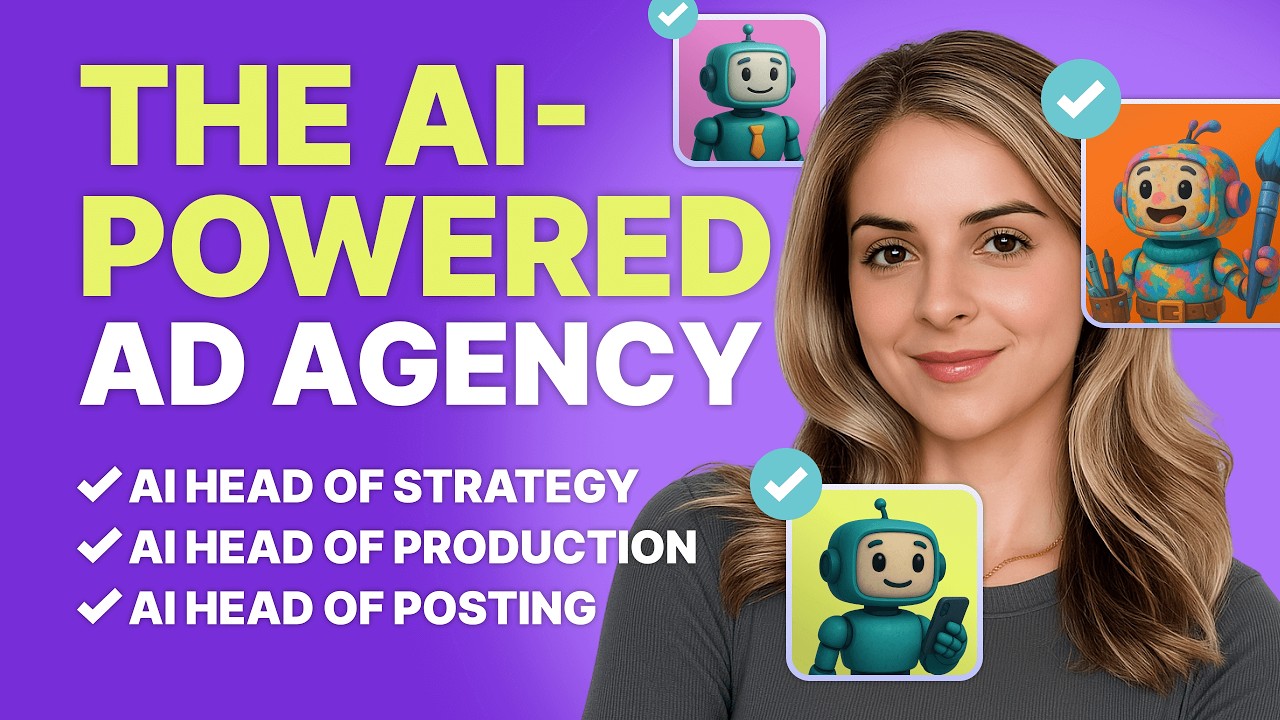
A three-department structure for AI agents mirroring a creative team: AI Head of Strategy (Research, Ideation, Copywriting), AI Head of Production (Image, Video, Audio), and AI Head of Post (Editing, QA). Each has its own tool stack (ChatGPT, Perplexity, Midjourney, Runway, ElevenLabs, CapCut, etc.). Creative strategists should build agents to automate their busy work and manage them like direct reports.

Video Techniques Database

A shared team repository (DM chat + Notion) where the team saves every interesting transition, sound, effect, or camera trick seen in organic content. GIFs are pulled directly into storyboards so paid-ad creative borrows native production techniques rather than defaulting to AIDA-style DR visuals.

Compliance Disclaimer Table

A reference table mapping ad situations to required FTC disclaimers: actor playing a customer → 'Paid Actor. Not a Customer.'; dramatized scenario → 'Paid Actor Portrayal. Results may vary.'; AI avatar delivering testimonial → 'AI-Generated Avatar.'; AI b-roll visualizing product benefits → 'Simulated Imagery.' Text must be high-contrast and visible.

The framings Mirella keeps returning to

Mirella Crespi's signature questions

9 talks in Motion's library

All Mirella Crespi talks