

# Ad summary
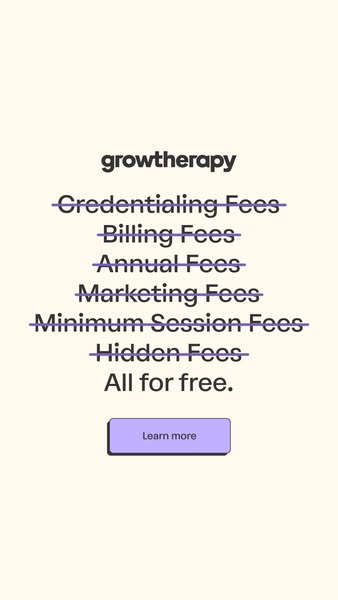
This ad for Growtherapy highlights the fact that they do not have credentialing fees, billing fees, annual fees, marketing fees, minimum session fees, or hidden fees.
# Brand positioning
Growtherapy is presented as a transparent and therapist-friendly platform that eliminates the common financial burdens associated with traditional therapy practices. By explicitly stating "All for free," the brand positions itself as a champion for therapists, removing financial barriers and fostering a supportive environment. This approach suggests a commitment to simplicity and fairness, contrasting with industry norms that often involve complex fee structures. The brand's positioning is both functional, offering a cost-free platform, and emotional, appealing to therapists seeking a stress-free and supportive professional environment.
# Product
Growtherapy is a platform for therapists that eliminates many of the common fees associated with traditional therapy practices. The ad explicitly states that credentialing fees, billing fees, annual fees, marketing fees, minimum session fees, and hidden fees are all free. This is for therapists who are looking for a platform that is transparent and does not have hidden costs. The ad addresses the purchase barrier of high fees by stating that all of the fees are free.
# Visual style
The ad has a clean and minimalist visual style. It features a light color palette, simple typography, and a clear layout. The use of crossed-out text and a prominent call-to-action button helps to draw the viewer's attention to the key message.
# Hooks
Headline: All for free.
# Benefits
- [object Object]
# Features
- [object Object]
- [object Object]
- [object Object]
- [object Object]
- [object Object]
- [object Object]
# Call to action
Learn more
# Point of view
- [object Object]
# Storyline
- The ad starts by listing several common fees that therapists often encounter, such as credentialing fees, billing fees, and annual fees. This is intended to highlight the financial burdens that therapists face. The brand is telling this part of the story.
- The ad then crosses out each of these fees, visually representing their elimination. This is intended to emphasize the cost savings that therapists can achieve by using Growtherapy. The brand is telling this part of the story.
- The ad concludes by stating "All for free," reinforcing the message that Growtherapy eliminates all of these fees. This is intended to provide a clear and concise summary of the platform's value proposition. The brand is telling this part of the story.