

# Ad summary
This ad features Matt Willis and Jake Humphrey in a clip from their podcast. The podcast guest shares his experience with hiding his struggles and the positive impact that therapy had on his life and mental health. The clip highlights BetterHelp as a solution.
# Brand positioning
BetterHelp is presented as a platform offering mental health support and therapy services. The brand aims to occupy a space in the consumer's mind as a reliable resource for those struggling with their mental health. It promotes a lifestyle of openness and seeking help. BetterHelp is positioned as a service that breaks down the barriers to therapy, making it more accessible. The brand positioning is both functional, providing access to therapy, and emotional, promoting self-awareness and mental well-being.
# Product
BetterHelp is presented as an online platform that offers access to licensed therapists and mental health support. It is designed for individuals who are struggling with their mental health and seeking professional help. The platform addresses the purchase barriers by offering a convenient and accessible way to connect with therapists. The ad shows how the product is worth trying or buying by showcasing the positive impact that therapy had on the guest's life.
# Visual style
The ad uses a podcast-style format, which gives it a casual and authentic feel. The editing style consists of quick cuts. The production quality is polished but maintains a natural feel. The pacing is consistent throughout the ad, matching the rhythm of the speaker's voice.
# Benefits
- [object Object]
- [object Object]
# Features
- [object Object]
- [object Object]
# Call to action
None used.
# Point of view
- [object Object]
# Storyline
- 00:00–00:03 The ad begins with a question posed to the podcast guests.
- 00:03–00:10 The man with grey hair responds he has a PhD in hiding his struggles, but he also says it eventually tips over and gets to be too much.
- 00:10–00:20 He says that he spent his whole life trying to hide from everything and when he thinks about drinking and using, everything about his behavior was wanting to hide away.
- 00:20–00:26 He expresses that he just didn't want to be present in anything. He thought he was really good at hiding it.
- 00:26–00:35 He admits that hiding didn't serve him at all and he was never truthful or honest about anything and he didn't know what that even was.
- 00:35–00:40 He then states it wasn't until he started therapy that he stopped performing.
- 00:40–00:45 It was a performance act of him being alright, killing it, and doing alright.
- 00:45–00:50 He says that he was this wacky guy and feeding into these ideas of what other people wanted him to be.
- 00:50–00:56 The man states it wasn't until he started therapy that he really started asking himself how he feels.
- 00:56–00:59 The ad concludes by displaying the slogan to stop performing and start opening up along with the website address for BetterHelp.

How BetterHelp Advertises on Meta
Refreshed 4 months ago · Weekly refresh cadence
BetterHelp runs 573 active ads on Meta, shipping ~48 new creatives per week. Their library leans on Screen Recording15%, Testimonial13%, and Headline7%. Recently, betterhelp is leaning hard into podcast integrations with Matt Willis and Jake Humphrey to normalize therapy for men struggling with emotional expression and outdated masculinity frameworks, while simultaneously pushing their app features like the Mood Tracker and between-session messaging as differentiators beyond the basic therapy match. There's a clear through-line around destigmatization through relatability, using real therapist testimonials, customer stories, and calming affirmation-style creative that positions therapy not as crisis intervention but as accessible self-care infrastructure, with AARP partnership ads targeting an older demographic with privacy and discount messaging.
Indexed by Motion's Inspo Library.
The 20 Most Recent BetterHelp Ads on Meta
# Ad summary
This ad features a clip from the podcast 'On The Mend,' hosted by Matt Willis and Jake Humphrey. They discuss personal challenges with expressing their feelings. The ad uses this conversation to highlight the value of therapy and promotes BetterHelp as a supportive resource.
# Brand positioning
BetterHelp is presented as a resource that can help individuals overcome the challenges of expressing their feelings and dealing with mental health. The brand aligns with values of self-improvement, emotional well-being, and destigmatizing mental health care. BetterHelp is functional in its approach, providing tools and access to therapy for improving mental health, but it also touches on the emotional aspect of feeling understood and supported.
# Product
BetterHelp is an online therapy platform that connects users with licensed therapists for mental health support. The platform addresses the challenge of being open and honest about one's feelings, particularly when things feel 'heavy' or overwhelming. The ad suggests that BetterHelp is designed for people who struggle with sharing their problems and feelings with loved ones, due to feeling like a burden, and that BetterHelp can provide a safe space to talk and receive support without these perceived burdens.
# Visual style
The ad uses a polished podcast recording style with simple cuts between speakers, creating a natural, conversational feel. The production quality is clean and professional, with well-lit, static shots. The pacing is dictated by the natural rhythm of the conversation, with a shift to text on a green background at the end. Audio-visual sync is smooth, with cuts aligning with pauses in speech or changes in speaker.
# Benefits
- [object Object]
- [object Object]
- [object Object]
# Features
- [object Object]
- [object Object]
- [object Object]
# Call to action
www.betterhelp.com
# Point of view
- [object Object]
# Storyline
- 00:00–00:04 Matt Willis mentions having moments, even recently, where he has felt like he was hiding how he was feeling.
- 00:04–00:09 Willis elaborates on the specific feelings he hides, such as feeling overwhelmed or like things are getting 'a bit heavy' and 'a bit hard.'
- 00:09–00:13 Willis shares that there's still a part of him that doesn't want to tell the people he loves when he's struggling.
- 00:14–00:17 Jake Humphrey continues the story, explaining that his wife, Harriet, often notices when he is quiet or distant.
- 00:17–00:22 Humphrey says the truth is that he's thinking about a million things that are worrying him.
- 00:22–00:26 Humphrey explains that despite this, there's still a voice in his head telling him, 'But it's not her problem.'
- 00:26–00:26 Willis empathizes with Humphrey and says that is exactly how he feels.
- 00:26–00:33 Humphrey describes his struggle as having to 'lay there and deal with it,' and that his wife will ask why he doesn't tell her things.
- 00:33–00:41 Humphrey explains that he doesn't intentionally avoid telling her. He says, 'There's no intentional, I don't go to my my brain doesn't go, I really want to tell you this, but I'm going to decide not to tell you.'
- 00:41–00:50 Humphrey concludes that he doesn't even realize that he's not telling anyone, that 'it's not an intentional hiding away of information, not a purposely lying.'
- 00:50–00:57 The ad's text overlay then says: 'SAY IT LOUDER. You're not a burden. We want to hear it. www.betterhelp.com'

# Ad summary
This ad for AARP features a green backdrop with text that highlights the discreet nature of the brand's online therapy service.
# Brand positioning
AARP is an organization that serves people age 50 and older. The brand aims to occupy a space in the consumer's mind as a supportive resource, and promotes values of community, security, and access. This ad continues that thread by promoting the online therapy services that it offers by BetterHelp.
# Product
The ad features the online therapy service offered through AARP by BetterHelp. The service provides confidential and discreet access to therapy. This online format addresses the barriers to traditional therapy, such as privacy concerns, by ensuring that individuals can seek help without drawing attention to themselves.
# Visual style
The ad uses a minimalist visual style with a clean and calming color palette. The design is simple and direct, focusing on the message of discretion and ease of access. The overall impression is professional and reassuring.
# Hooks
Headline: Your Therapy stays discreet
# Benefits
- [object Object]
# Features
- [object Object]
# Call to action
None used.
# Point of view
- [object Object]
# Storyline
- The ad emphasizes discretion as the key benefit of the AARP's therapy service. This message, delivered directly, aims to reassure potential users who may be hesitant due to privacy concerns.
# Ad summary
This ad promotes BetterHelp's Mood Tracker, which helps users notice patterns. The ad states that the mood tracker, in turn, allows the therapist to actually work with them, giving users support that does not stop when the call does.
# Brand positioning
BetterHelp is presented as a modern and accessible platform for online therapy. It aims to occupy the space of convenient and continuous mental health support, emphasizing that therapy extends beyond scheduled sessions. BetterHelp aligns with a value of proactive self-care, offering tools like a mood tracker to facilitate ongoing engagement with one's mental well-being. The brand pushes against the traditional norm of therapy being confined to fixed appointments, positioning itself as a flexible, always-available resource. The brand's positioning is functional, emphasizing the practicality and continuous support it offers.
# Product
BetterHelp's Mood Tracker is a feature within the BetterHelp app designed to help users monitor and understand their emotional patterns between therapy sessions. It is for individuals actively engaged in or considering therapy, particularly those seeking continuous support. The mood tracker allows users to log their feelings and identify potential triggers, which can then be shared with their therapist. This helps users track their feelings in between sessions, and it provides ongoing support that extends beyond traditional therapy sessions. It is a tool that allows you and your therapist to work together by helping you notice patterns. The ad addresses the potential purchase barrier of therapy being limited to scheduled sessions by offering continuous support through the app.
# Visual style
The ad has a polished, modern aesthetic. The editing style includes quick cuts and smooth transitions. The production quality is akin to a polished commercial, which supports the brand's intended tone of professionalism and accessibility. The pacing is consistent at around 100 BPM. There are moments where the visuals sync with the music beats.
# Benefits
- [object Object]
- [object Object]
- [object Object]
# Features
- [object Object]
- [object Object]
# Call to action
Sign up today at betterhelp.com
# Point of view
- [object Object]
# Storyline
- 00:00–00:02 00:00–00:02 The ad opens with a person lying on a couch, looking at their phone. The voiceover states, "A lot can happen between therapy sessions." This sets the stage for the problem that therapy sessions are limited while life continues in between, presenting the BetterHelp solution in response.
- 00:02–00:04 00:02–00:04 A phone screen is shown as the user selects a mood on BetterHelp's Mood Tracker. The voiceover states, "BetterHelp's Mood Tracker helps you notice patterns." The brand introduces the mood tracker as a tool to proactively monitor one's emotional state, showing how BetterHelp can bridge the gaps between therapy sessions and is positioned as the brand.
- 00:04–00:08 00:04–00:08 The camera shows someone typing in a text box that says, "It feels like no one is on my team." The voiceover says, "So you and your therapist can actually work with them." The user is encouraged to share their data with their therapist.
- 00:08–00:12 00:08–00:12 The woman is then shown smiling while video chatting on a laptop. The voiceover states, "BetterHelp gives you more than just sessions, it's support that doesn't stop when the call does." This builds on the preceding concept by emphasizing the ongoing support offered by BetterHelp. It encourages the viewer to value the continued help the app can provide.
- 00:12–00:15 00:12–00:15 The screen transitions to the brand logo and the voiceover says, "Sign up today at betterhelp.com." This encourages the user to visit the website to sign up for BetterHelp. The screen is from the brand's POV.
# Ad summary
A customer describes the benefits of using the BetterHelp app to track her mood, journal, and reach out to her therapist in between appointments.
# Brand positioning
BetterHelp is presented as a service that provides mental health support that is flexible and fits into your everyday life. They offer users multiple ways to connect with their therapists, including video sessions and messaging, as well as features like mood tracking and group sessions. The brand promotes values of accessibility, convenience, and personalized support. It pushes against the traditional norm of therapy being only about 'fixing' something, presenting it instead as a means of self-understanding and ongoing support.
# Product
BetterHelp is a service that provides online mental health support through a mobile app or computer. It is for people who want to prioritize their mental health and understand themselves better. The service offers a range of features, including the ability to track your mood day to day, journal when something comes up, join group sessions with people going through similar things, and message a therapist directly between appointments. The key USP is that support goes further beyond your sessions because it fits into your everyday life.
# Visual style
The ad has a clean, modern aesthetic with natural lighting and muted tones. It incorporates a mix of static shots and quick cuts. The production quality is high, with a focus on showcasing the product in a relatable and accessible way. The cuts are timed to voiceover lines.
# Benefits
- [object Object]
- [object Object]
- [object Object]
# Features
- [object Object]
- [object Object]
- [object Object]
- [object Object]
# Call to action
Go to betterhelp.com to get started today
# Point of view
- [object Object]
# Storyline
- 00:00–00:03 00:00–00:03 Therapy doesn't have to just be about fixing something that's wrong.
- 00:03–00:07 00:03–00:07 A lot of people keep going because they start to actually understand themselves better.
- 00:07–00:10 00:07–00:10 With BetterHelp, support goes further...
- 00:10–00:13 00:10–00:13 Beyond your sessions, you can track your mood day to day,
- 00:13–00:15 00:13–00:15 journal when something comes up,
- 00:15–00:18 00:15–00:18 and even join group sessions with people going through similar things.
- 00:18–00:22 00:18–00:22 And if you need to reach your therapist between appointments, you can message them directly.
- 00:22–00:25 00:22–00:25 It's the kind of support that fits into your everyday life.
- 00:25–00:27 00:25–00:27 Get started with BetterHelp.
# Ad summary
This ad features Matt Willis and Jake Humphrey of High Performance discussing mental health, specifically intrusive thoughts. Matt shares his personal experience with intrusive thoughts in the early 2000s and how seeking help from a psychologist was beneficial. The ad highlights that conversations about mental health issues were not common during that time and emphasizes the importance of seeking help when needed. It concludes with a message about not letting thoughts define oneself and directs viewers to the BetterHelp website.
# Brand positioning
BetterHelp is an online therapy platform that aims to normalize and destigmatize mental health support. The brand is presented as a modern solution that fills a gap for accessible mental healthcare, especially for those who might not have had resources available in the past. By partnering with public figures like Matt Willis to share their personal experiences, BetterHelp seeks to break down misconceptions about therapy and encourage open conversations about mental health. The brand aligns with a tone of empathy, encouragement, and empowerment, promoting mental wellness as an essential part of overall well-being. It challenges the historical norm of silence around mental health issues, and positions itself as a functional resource to overcome this barrier.
# Product
BetterHelp is an online therapy platform designed to provide accessible and convenient mental health support. The platform connects individuals with licensed therapists through a variety of communication methods, including messaging, video, and phone sessions. This service is for anyone experiencing mental health challenges, as stated by Matt Willis in the ad, and it addresses barriers to traditional therapy such as geographical limitations, scheduling conflicts, and the stigma associated with seeking help. BetterHelp positions itself as a solution to finding support and emphasizes the importance of not letting negative thoughts define oneself.
# Visual style
The ad features a polished, studio-lit aesthetic with smooth transitions and static shots. It has a hybrid production quality, blending the personal feel of a testimonial with the higher production values of commercial content. The pacing is consistent throughout, with no quick cuts or rapid edits. The audio-visual sync is smooth, with cuts and voiceover timed to maintain a steady flow.
# Benefits
- [object Object]
- [object Object]
- [object Object]
- [object Object]
- [object Object]
# Features
- [object Object]
- [object Object]
- [object Object]
# Call to action
www.betterhelp.com
# Point of view
- [object Object]
# Storyline
- 00:00–00:04 The ad starts by introducing the topic of intrusive thoughts with Matt Willis and Jake Humphrey of High Performance.
- 00:04–00:15 Matt shares his experience with intrusive thoughts in the early 2000s and how he thought that horrendous things were going to happen and that he was going to do the horrendous thing. The intention is to establish the personal connection and the severity of the mental health issue.
- 00:15–00:19 Matt notes that BetterHelp and similar conversations were not available during that time, highlighting the importance of current resources. The message is to contrast the past lack of resources with the present availability, emphasizing progress in mental health awareness.
- 00:19–00:39 Matt describes finding a psychologist through an advert in the back of a newspaper, which led to an existential period. It conveys a sense of discovery and the impact of finding help.
- 00:39–00:50 Matt states that it was 20 years ago, and he hasn't had a flare-up or a recurrence. He feels mentally exceptional, emphasizing the long-term benefits of seeking help. It communicates a positive outcome and reinforces the value of the product.
- 00:50–00:57 The ad concludes with a message to not let thoughts define oneself and provides a link to BetterHelp. The final screen aims to inspire and direct viewers to take action.
# Ad summary
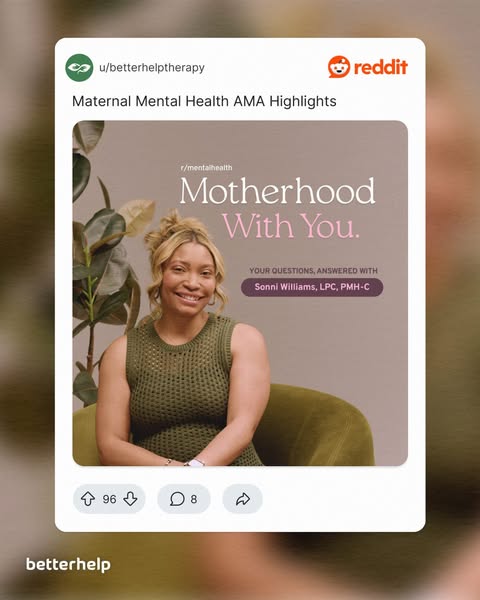
This ad is for BetterHelp and features a post from Reddit in which Sonni Williams, LPC, PMH-C, answers maternal mental health questions.
# Brand positioning
BetterHelp is presented as a mental health resource offering therapy and support, particularly for maternal mental health. It aligns with values of accessibility and community engagement, as evidenced by its presence on platforms like Reddit and the AMA (Ask Me Anything) format used. It aims to occupy a space in the consumer's mind as a reliable, expert-backed source of information and support for mental well-being, positioning itself as a modern and accessible option for those seeking mental health assistance.
# Product
The ad promotes the expertise and resources available through BetterHelp, focusing on maternal mental health. It features Sonni Williams, a Licensed Professional Counselor (LPC) and Psychiatric Mental Health Counselor (PMH-C), answering questions in an "Ask Me Anything" (AMA) format on Reddit. The product is for individuals seeking mental health guidance, specifically mothers or those interested in maternal mental health. The unique selling point is the accessibility of expert advice and support through an online platform, with Sonni Williams' credentials adding credibility and trust. The use case is for individuals seeking information, advice, and support related to maternal mental health concerns.
# Visual style
The ad features a clean and modern visual style, likely produced with high-quality studio photography. The image treatment includes subtle color grading and background blurring, creating a soft and inviting aesthetic. The typography is clean and legible, and the layout is well-organized with clear visual hierarchy. The style appears native to social media platforms, particularly mimicking the look and feel of a Reddit post.
# Hooks
Headline: Maternal Mental Health AMA Highlights
# Benefits
- [object Object]
- [object Object]
# Features
- [object Object]
- [object Object]
# Call to action
None used.
# Point of view
- [object Object]
# Storyline
- The Reddit post is highlighted, setting the stage for a discussion on maternal mental health. The brand introduces the AMA, a direct and interactive way to engage the audience, and the platform positions itself as an accessible and relevant source for mental health discussions.
- The post's title emphasizes the topic of "Maternal Mental Health AMA Highlights", signaling that the content will be focused on answering questions related to motherhood and mental well-being. Reddit introduces what the discussion is about.
- The AMA is promoted as an opportunity to have questions answered by Sonni Williams, LPC, PMH-C, emphasizing the expertise available and encouraging users to seek advice. The brand highlights the value of having their questions answered by an expert.
# Ad summary
The ad features Matt Willis and Jake Humphrey from the "On the Mend" podcast, in partnership with BetterHelp and High Performance. They discuss the experience of hiding feelings and the struggle to share personal challenges with loved ones, addressing the reluctance to burden others. The ad promotes BetterHelp as a solution, encouraging viewers to speak louder and emphasizes that they are not a burden.
# Brand positioning
BetterHelp is presented as a supportive and accessible platform for individuals facing mental and emotional challenges. The brand positions itself as a resource for overcoming the tendency to hide feelings, emphasizing the importance of open communication and seeking help when needed. BetterHelp aligns with values of emotional well-being, communication, and support, pushing against the norm of keeping struggles private. Its positioning is functional, offering a practical service for mental health, and emotional, aiming to provide relief and support.
# Product
BetterHelp is an online platform that provides access to licensed therapists and mental health support. The platform is for individuals who struggle with sharing their feelings and experiences with others. BetterHelp addresses the reluctance to burden loved ones with personal challenges, positioning itself as a safe space for open communication and emotional support. It presents itself as a solution for those who find it difficult to express themselves, promoting the idea that seeking help is a sign of strength, not weakness. The ad encourages viewers to overcome the fear of burdening others and embrace the opportunity to speak louder about their struggles through better help.
# Visual style
The ad has a polished, professional aesthetic, resembling a high-quality podcast recording. The editing style is smooth, with static shots and no noticeable jump cuts. The production quality is high, giving it a commercial feel. The visual motif is consistent close-up shots of the speakers in a podcast studio. The pacing is moderate, matching the rhythm of the spoken dialogue.
# Benefits
- [object Object]
- [object Object]
- [object Object]
- [object Object]
# Features
- [object Object]
- [object Object]
- [object Object]
# Call to action
www.betterhelp.com
# Point of view
- [object Object]
# Storyline
- 00:00–00:13 00:00–00:13: Matt Willis shares that he has moments where he hides how he's feeling when he feels overwhelmed or when things are getting heavy. The message conveyed is that even those who seem strong or successful can struggle with sharing their emotions. The perspective is from Matt Willis, as he speaks about his personal experiences. The tone is confessional, creating a sense of vulnerability and relatability.
- 00:13–00:17 00:13–00:17: Jake Humphrey describes how his wife notices when he is quiet or distant, highlighting the challenge of hiding emotions from loved ones. The message conveyed is that suppressing feelings can be noticeable to others, even if unintentional. The perspective is from Jake Humphrey, as he shares a common experience in relationships. The tone is observational, pointing out the subtle cues that indicate emotional withdrawal.
- 00:17–00:23 00:17–00:23: Jake continues, stating he is thinking of a million things that are worrying him, with a voice in his head saying it's not her problem. The message conveyed is the internal struggle of wanting to protect loved ones from personal burdens. The perspective is from Jake Humphrey, expressing the thought process behind withholding information. The tone is reflective, capturing the tension between sharing and protecting.
- 00:23–00:33 00:23–00:33: Jake explains that he doesn't want to burden those close to him. The message conveyed is the desire to avoid adding stress or worry to the lives of loved ones, revealing a common motivation for hiding feelings. The perspective is from Jake Humphrey, articulating his reasons for withholding information. The tone is empathetic, acknowledging the concern for others' well-being.
- 00:33–00:49 00:33–00:49: Jake clarifies that he doesn't intentionally decide not to share, he just doesn't realize he should or could. The message conveyed is that hiding feelings can be an unconscious habit rather than a deliberate choice. The perspective is from Jake Humphrey, differentiating between intentional and unintentional withholding. The tone is explanatory, providing insight into the automatic nature of suppressing emotions.
- 00:49–00:57 00:49–00:57: Text overlay: "SAY IT LOUDER. You're not a burden. We want to hear it. www.betterhelp.com". The message is that sharing is encouraged, and people are not a burden. It comes from the brand's perspective, promoting a message of support and accessibility.
# Ad summary
This ad for BetterHelp features a calming video of waves at sunset with superimposed text about personal growth and self-care, culminating in a call to action to visit BetterHelp's website.
# Brand positioning
BetterHelp is presented as a provider of online therapy services. The ad emphasizes themes of personal growth, emotional honesty, and seeking help, positioning the brand as a supportive resource for individuals navigating mental health challenges. BetterHelp aligns with values of self-improvement, vulnerability, and proactive mental healthcare. The brand pushes against the norm of struggling alone, encouraging users to seek professional support. The brand positioning is emotional, focusing on the benefits of therapy for self-discovery and well-being.
# Product
BetterHelp is an online therapy platform designed to provide accessible and convenient mental health support. The ad doesn't explicitly detail the services, but implies that it is for individuals seeking personal growth and emotional well-being. The product is presented as a means to achieve personal honesty, peace, and the ability to ask for help. The ad suggests that BetterHelp addresses the purchase barrier of accessibility or stigma associated with traditional therapy. It encourages viewers to take the first step toward improving their mental health by seeking help through the platform.
# Visual style
The ad has a calming and serene aesthetic. The use of natural light, combined with a slow pace, creates a sense of peace and tranquility. The editing style is simple, with a static shot of the ocean followed by a static end screen. The production quality appears polished, but not overly commercial, supporting the intended tone of sincerity and emotional support. The ad has a low cuts per minute.
# Benefits
- [object Object]
- [object Object]
- [object Object]
- [object Object]
- [object Object]
# Features
- [object Object]
- [object Object]
# Call to action
Go to betterhelp.com to get started today
# Point of view
- [object Object]
- [object Object]
# Storyline
- 00:00–00:07 The ad displays a serene ocean scene with text overlays that offer personal affirmations related to mental health. These affirmations are paired with the word 'hallelujah' at the end of each line.
- 00:00–00:07 This text is designed to resonate with viewers who may be struggling with emotional challenges, and offers simple coping strategies or affirmations.
- 00:00–00:07 The perspective is from an omniscient narrator sharing affirmations with the audience. The tone is gentle and inspiring, aiming to uplift and encourage viewers to seek help.
- 00:07–00:10 Following this sequence, the ad transitions to a screen displaying the BetterHelp logo and a call to action.
- 00:07–00:10 This informs the audience that BetterHelp can help them to achieve these goals.
- 00:07–00:10 The perspective shifts to that of the brand, clearly defining its offering.
# Ad summary
This ad from BetterHelp shows two women discussing emotions as they relate to an analogy of a pressure cooker. They suggest it is important to release the valve and let the steam out, so to speak, by having someone to talk to.
# Brand positioning
BetterHelp aims to occupy the space in the consumer's mind as a place for individuals to connect with the assistance and support they need to address and cope with their emotions. The brand aligns with values of open communication, mental wellness, and self-improvement. BetterHelp pushes against the stigma around seeking help for mental health, presenting it as a normal and accessible resource for everyday individuals. Their brand positioning is both functional, providing access to therapy, and emotional, fostering a sense of support and understanding.
# Product
BetterHelp is an online therapy platform designed to provide individuals with access to licensed therapists through various communication methods, including messaging, video, and phone sessions. It is designed for anyone seeking mental health support, regardless of their location or schedule. BetterHelp helps individuals find a therapist to talk with to acknowledge how they're feeling and accept help. The platform addresses purchase barriers by providing a convenient, affordable, and discreet way to access therapy from the comfort of one's own home. It emphasizes the importance of mental and emotional well-being, presenting therapy as a proactive step towards personal growth and resilience.
# Visual style
The ad has a simple, clean aesthetic with natural lighting. The editing style includes quick cuts and static shots. The production quality is polished. This supports the intended tone by appearing as a realistic podcast session.
# Benefits
- [object Object]
- [object Object]
- [object Object]
- [object Object]
- [object Object]
- [object Object]
- [object Object]
# Features
- [object Object]
- [object Object]
- [object Object]
- [object Object]
- [object Object]
# Call to action
None used.
# Point of view
- [object Object]
# Storyline
- 00:00–00:05 The speaker introduces the topic of emotions and suggests viewing them like a pressure cooker or instant pot, establishing an analogy to explain how they work and must be addressed.
- 00:05–00:11 The speaker continues with the pressure cooker analogy, suggesting it is important to slowly release the valve and let some steam out, or else the thing's going to explode. This connects to the overall topic of mental health because it implies that emotions must be addressed, or else they will explode.
- 00:11–00:14 The second speaker confirms that she has used this analogy before. This builds validation of the analogy and the overall topic being discussed.
- 00:15–00:16 The first speaker jokes about the other confirming that she has used the analogy before. This creates a light and relatable tone.
- 00:17–00:24 The first speaker continues with the idea of addressing feelings and emotions. She claims that they're going to bubble up and pop up in ways that are far less helpful if one does not acknowledge or talk about those feelings.
- 00:24–00:28 The speaker pivots to the concept of releasing the valve, asking, "How do we release that valve?" This is a direct transition to how BetterHelp can help people.
- 00:28–00:36 The speaker discusses options for releasing the valve. She claims that, for some people, it is just about having the opportunity to talk with someone who gets it and is willing to listen.
- 00:36–00:45 The speaker continues with the concept of releasing the valve, discussing options like getting a break of some kind or having a family member step in, even if they can't do the caregiving as well, they can still bring over a meal.
- 00:46–00:54 The speaker concludes that small acts can make a big difference in being able to acknowledge how we're feeling and accept help. This creates a resolution that leads to the product.
- 00:54–00:57 The speaker recognizes it can be challenging, offering a final sentiment of relatability and understanding.
# Ad summary
This BetterHelp ad features men on the "High Performance" podcast discussing the state of masculinity today. They discuss what they see as the problem men face in modern society and how masculinity needs to be updated. The ad ends with a supportive quote to help men and the BetterHelp website.
# Brand positioning
BetterHelp is an online therapy platform that aims to provide accessible and convenient mental health support. The brand is presented as a modern solution to mental health care, focusing on inclusivity and breaking down stigmas. BetterHelp associates itself with personal growth and self-improvement. Positioning itself as a resource for those seeking guidance and support, the brand is functional in providing therapy services, but also emotional by aligning with values of empowerment, understanding, and accessibility.
# Product
BetterHelp is a platform that connects individuals with licensed therapists for online therapy sessions. The platform offers a convenient and accessible way to receive mental health support from the comfort of one's own home. It is intended for individuals seeking guidance, support, and professional help to address various mental health challenges. BetterHelp provides a range of services, including individual therapy, couples therapy, and group therapy. It can assist with conditions, such as anxiety, depression, relationship issues, stress, and self-esteem. BetterHelp aims to break down barriers to mental health care by offering affordable and accessible therapy options.
# Visual style
The ad has a polished feel. It consists mainly of static shots of the speakers in a podcast. The editing is basic, with quick cuts to change between the speakers. The transitions are simple cuts. The pacing is moderate and consistent with the dialogue.
# Benefits
- [object Object]
- [object Object]
# Features
- [object Object]
- [object Object]
# Call to action
None used.
# Point of view
- [object Object]
# Storyline
- 00:00–00:03 A man asks the other speakers if they think men are feeling lost about their place.
- 00:03–00:11 Another man says that the job description has changed, but no one has given them the new script.
- 00:11–00:15 The same man states that men are not quite sure what their place in the world is anymore.
- 00:15–00:26 The man continues that while this is not for everyone, it is a looming concern that men do not really know where their place in the world is.
- 00:26–00:38 Another speaker says that what they have done is that they have said that masculinity from 100 years ago is toxic and anytime that men show any masculine traits, it is toxic, but it is not true.
- 00:38–00:47 The speaker closes by saying that the reality is that masculinity and the role of a man has changed and they are trying to work out where they are at.
- 00:47–00:53 The message shifts to an inspirational message.
# Ad summary
This ad uses a slow-motion shot of waves lapping on a beach as the backdrop for text about BetterHelp. The text positions BetterHelp as a service that works with your insurance and can help you find the right therapist.
# Brand positioning
BetterHelp is presented as a modern and accessible platform that connects individuals with licensed therapists, emphasizing convenience and affordability. It aims to normalize seeking mental health support, positioning itself as a service that integrates seamlessly into users' lives, working with their insurance and offering affordable copays. The brand promotes a functional approach by highlighting the ease of accessing therapy.
# Product
BetterHelp is a telehealth platform providing access to licensed therapists via online sessions. The ad highlights that BetterHelp therapists in your area are now accepting insurance, with an average copay of $19, making therapy more accessible and affordable. It addresses a potential purchase barrier by explicitly stating its compatibility with insurance, seeking to make therapy a realistic option for a broader audience. The platform aims to find the 'right therapist' for users, implying personalized care and support.
# Visual style
The ad uses a cinematic, calming aesthetic with a slow-motion shot of waves. Editing is minimal, emphasizing a serene tone with smooth transitions.
# Benefits
- [object Object]
- [object Object]
# Features
- [object Object]
- [object Object]
- [object Object]
# Call to action
None used.
# Point of view
- [object Object]
# Storyline
- 00:00–00:07 The ad opens with waves lapping on a shore. The text overlay states the theme of the ad.
- 00:07–00:09 The ad shows the BetterHelp logo and text about accepting insurance.
# Ad summary
This ad features Rebekah Wolff, a real BetterHelp therapist, discussing the importance of providing a safe space for clients, as well as the value of BetterHelp as a counseling option. Rebekah shares her perspective on how BetterHelp assists people with common issues like grief, anxiety, and depression, emphasizing that these are relatable experiences that should not be stigmatized.
# Brand positioning
BetterHelp aims to occupy the space of accessible and convenient mental healthcare. It aligns with values of empathy, support, and destigmatization of mental health issues. By featuring real therapists and emphasizing the relatability of common struggles, BetterHelp positions itself as a supportive and approachable platform for those seeking help. The brand pushes against the traditional barriers to therapy, such as cost and accessibility, offering a functional solution that is also emotionally supportive.
# Product
BetterHelp is presented as a platform that provides accessible online therapy to meet people at their needs. It's designed for individuals experiencing grief, death, anxiety, and depression. BetterHelp offers a safe space for clients to feel seen and supported. The platform addresses the common shame associated with mental health issues, positioning itself as a destigmatizing and supportive solution. It is presented as a convenient and effective means for people to receive counseling and support, emphasizing that individuals are not alone and there are people who want to hear them.
# Visual style
The ad has a polished, professional aesthetic. The editing style is mostly static shots with occasional close-ups to emphasize the speaker's points. The production quality is high, giving it a commercial feel. The pacing is moderate, with cuts timed to the speaker's pauses and key points.
# Benefits
- [object Object]
- [object Object]
- [object Object]
- [object Object]
# Features
- [object Object]
- [object Object]
- [object Object]
# Call to action
Get started at betterhelp.com
# Point of view
- [object Object]
# Storyline
- 00:00–00:02 The ad opens with a shot of Rebekah Wolff, a BetterHelp therapist, getting ready for a photoshoot. The intention is to introduce her in a professional setting. This shot establishes her credibility and signals that she is a legitimate representative of BetterHelp, from the brand's perspective.
- 00:02–00:07 00:02–00:07 Rebekah states that being with her clients means giving them a space to feel safe and to be seen in their existence. This conveys BetterHelp’s core value of providing a supportive and understanding environment. The message is delivered from Rebekah’s perspective, framed as a therapist who cares about her clients' well-being, and it establishes trust with the viewer by highlighting the therapeutic benefits of the platform.
- 00:07–00:11 00:07–00:11 Rebekah explains that many people go through grief, death, anxiety, and depression, emphasizing that these issues are relatable. This normalizes the experiences of potential users and reduces the stigma associated with seeking help. She speaks from the perspective of a therapist who understands the common struggles of her clients.
- 00:11–00:16 00:11–00:16 Continuing from the previous point, Rebekah states that there is nothing to be ashamed about. She then pivots to say that BetterHelp is there to meet people at their needs. This transition introduces BetterHelp as a solution to the aforementioned problems, presented as a caring and supportive resource.
- 00:16–00:23 00:16–00:23 Rebekah describes how she supports her clients by letting them know she’s there for them. She emphasizes that they are not alone and that there are people who want to hear them. She's reinforcing the emotional benefits of therapy and conveying BetterHelp's commitment to providing accessible and supportive care.
- 00:23–00:27 00:23–00:27 Rebekah concludes by saying she loves BetterHelp and that it’s been the best place of counseling she has worked for. This final statement solidifies her endorsement of the platform and provides a positive conclusion to her testimonial.
# Ad summary
This BetterHelp ad is a testimonial focusing on how asking for help through therapy can improve one's quality of life.
# Brand positioning
The brand BetterHelp is presented as a way to improve your mental health and have a safe space to be fully honest. The brand is positioning itself to be a safe and comfortable way to seek therapy for anyone who may need it. The brand promotes being honest and seeking help to improve your overall mental health, which is an emotional approach to therapy.
# Product
The product is BetterHelp, which is a therapy service for anyone needing mental health assistance. The ad states that using BetterHelp can help you stop shrinking yourself to keep the peace, ask for help instead of pushing through and be fully honest in therapy. The ad addresses the purchase barrier of thinking you do not need help and pushes against the thought of dealing with mental health issues by yourself.
# Visual style
The ad's aesthetic is UGC. It is recorded on a cell phone. The editing is simple with one quick cut at the end. The overall tone of the ad is relaxing and calm, using nature and a calming soundtrack to bring in the viewer.
# Benefits
- [object Object]
- [object Object]
- [object Object]
# Features
- [object Object]
- [object Object]
# Call to action
Go to betterhelp.com to get started today
# Point of view
- [object Object]
# Storyline
- 00:00–00:07 The ad begins with text overlayed on a seascape video.
- 00:00–00:07 The text is a testimonial about how therapy has helped improve the user's life.
- 00:07–00:10 The ad cuts to the BetterHelp logo with a CTA.
# Ad summary
This ad for BetterHelp features two therapists discussing the common misconception that therapy cannot help, highlighting the parallel process where the therapeutic relationship aids in improving personal connections. The therapists emphasize that therapy teaches valuable communication and assertiveness skills, which are often not taught in schools. The ad promotes the idea that therapy can lead to lighter and healthier relationships by focusing on self-care and self-awareness.
# Brand positioning
BetterHelp is presented as a modern and accessible platform for online therapy. The brand is positioning itself as a provider of mental health services that addresses the common misconception that therapy can't help. The therapists featured in the ad highlight the practical benefits of therapy, such as improved communication skills, assertiveness, and self-care, emphasizing that these skills are often not taught in schools. BetterHelp aims to normalize and destigmatize therapy by showing real therapists discussing the value of building healthy relationships with oneself and others, aligning with a lifestyle that prioritizes mental and emotional well-being.
# Product
BetterHelp is an online therapy platform that provides access to licensed therapists through virtual sessions. The platform offers a way to develop healthier relationships by teaching communication skills, assertiveness, and self-care, which are often lacking in formal education. It aims to provide tools and guidance for personal growth and improved relationships, emphasizing that developing a strong relationship with a therapist can mirror and positively influence relationships outside of therapy. By addressing the common misconception that therapy cannot help, BetterHelp encourages viewers to consider the benefits of therapy for enhancing their overall well-being and interpersonal skills.
# Visual style
The ad has a clean and professional aesthetic, with a hybrid production quality that mixes expert interviews with a soft, branded feel. The editing style includes quick cuts between the speakers. The pacing is moderate, and the audio-visual sync is smooth, with text overlays timed to emphasize key points. There are a few static shots but mostly medium shots. The visuals are simple and not distracting.
# Benefits
- [object Object]
- [object Object]
- [object Object]
- [object Object]
- [object Object]
- [object Object]
# Features
- [object Object]
- [object Object]
- [object Object]
# Call to action
None used.
# Point of view
- [object Object]
# Storyline
- 00:00–00:04 Dr. Sreela Roy Greene, a licensed therapist for BetterHelp, addresses a common skepticism toward therapy.
- 00:04–00:11 Dr. Greene introduces the concept of a parallel between the relationship with a therapist and relationships outside the therapy room, setting up the central theme of the ad.
- 00:11–00:17 Jillian Turecki, a relationship expert and NY Times bestselling author, shares how her clients have integrated therapeutic communication styles into their personal lives, providing real-world validation.
- 00:18–00:30 Dr. Greene highlights the parallel process by stating the relationship one develops with their therapist transfers to relationships in their personal lives.
- 00:30–00:37 Dr. Greene emphasizes that healthy communication and assertiveness are not typically taught in school.
- 00:37–00:43 The ad closes with a call to "Feel Lighter in your relationships" and promotes BetterHelp as a tool to discover the power of therapy.
# Ad summary
This ad for BetterHelp features a Black woman sharing her positive experience with therapy. She explains how BetterHelp has allowed her to truly be herself again and provides her with continued support. The ad aims to encourage viewers to try BetterHelp as a means of accessing therapy.
# Brand positioning
BetterHelp is presented as a supportive and accessible online therapy platform that prioritizes the well-being of its clients. The brand positions itself as a resource for individuals seeking mental health support and continuous care. It offers a service that allows people to reconnect with their authentic selves and maintain a sense of well-being through ongoing therapeutic assistance.
# Product
The advertised product is BetterHelp's online therapy service, which provides users with access to therapists through a digital platform. It is intended for individuals seeking support in maintaining their mental health and regaining a sense of self. The service provides continuous support, allowing users to "really be" themselves again. The ad addresses the need for accessible therapy by offering a convenient and ongoing means of mental health care.
# Visual style
The ad has a polished yet personal aesthetic, leaning towards a commercial feel with a focus on the individual sharing their experience. The editing style consists of static shots and smooth transitions, contributing to a straightforward and easy-to-follow narrative. Production quality is high, striking a balance between a UGC testimonial and a polished ad. The pacing remains consistent throughout, maintaining a steady rhythm that supports the message being conveyed.
# Benefits
- [object Object]
# Features
- [object Object]
# Call to action
Match with a therapist at betterhelp.com
# Point of view
- [object Object]
# Storyline
- 00:00–00:01 A woman is getting makeup applied.
- 00:02–00:05 00:02–00:05: Paulina Baker, identified as a real BetterHelp client, encourages viewers to try therapy based on her "lived experience." The message conveys that therapy can be a beneficial and transformative experience.
- 00:05–00:08 00:05–00:08: Paulina emphasizes how therapy has allowed her to "really be" herself again, portraying a positive outcome and personal restoration. The intention is to highlight the potential for self-discovery and authenticity through therapy.
- 00:08–00:12 00:08–00:12: Paulina concludes by expressing her gratitude for the "continued support" she receives with BetterHelp, reinforcing the idea of ongoing care and assistance. This aims to assure viewers that BetterHelp offers a reliable and sustained support system for their mental health needs.
# Ad summary
This ad for AARP Online Therapy by BetterHelp highlights how the service can help its members get matched with a therapist online and save 30%.
# Brand positioning
AARP Online Therapy by BetterHelp positions itself as a convenient and affordable service for AARP members seeking mental health support. The brand aligns with values of care, accessibility, and future-focused well-being, helping AARP members take care of their minds, now and in the future. It emphasizes the ability to match members with therapists online, pushing against the norms of traditional, in-person therapy and potentially addressing barriers related to access and cost. The brand positioning is both functional, providing a service that is simple to access, and emotional, promoting the sense of well-being and peace of mind that comes from mental health care.
# Product
AARP Online Therapy by BetterHelp is an online platform that provides mental health support to AARP members. The service matches members with licensed therapists for virtual therapy sessions. As stated in the ad, AARP members can match with a therapist online and save 30%. The product is for those who have never received therapy through BetterHelp and whose insurance cannot be combined with the offer. It is implied to be a convenient and accessible alternative to traditional, in-person therapy, especially for those who may have difficulty accessing or affording traditional therapy. The ad conveys that this service is worth trying or buying because it offers a special discount for AARP members and the convenience of online access.
# Visual style
The ad has a polished aesthetic with static shots and smooth transitions. The production quality appears to be high-end, creating a clean and professional tone. The pacing is slow and steady, allowing viewers to fully absorb the message. The visuals and text are in sync, enhancing the overall clarity and impact.
# Benefits
- [object Object]
- [object Object]
# Features
- [object Object]
- [object Object]
- [object Object]
# Call to action
None used.
# Point of view
- [object Object]
# Storyline
- 00:00–00:02 The ad opens with a serene visual and text overlay.
- 00:02–00:05 It then transitions into explaining the offer and its accessibility.

# Ad summary
An image ad featuring a person in a tranquil state with the text overlay 'When Life Gets Heavy...' implying the product can assist in relaxation or stress relief.
# Brand positioning
Based on the ad, the brand positions itself as a provider of relief and tranquility in the face of life's challenges. It is implied that their products or services align with values of calm, self-care, and emotional well-being. The brand seeks to occupy a space in the consumer's mind as a source of comfort and support during stressful times. It moves away from the norm of high-energy, fast-paced solutions and instead aligns with a more emotional and soothing approach.
# Product
The product being advertised is not explicitly shown; however, it is implied to be something that provides relief or comfort when life gets heavy. The ad aims to address purchase barriers related to skepticism about stress-relief solutions, by creating an emotional connection with the viewer first. The product is intended for individuals experiencing stress or challenges in their lives, seeking moments of peace and calm.
# Visual style
The ad utilizes a soft and tranquil visual style with a focus on creating a serene atmosphere. The production quality appears to be high with professional photography, enhanced by subtle image treatment and color grading.
# Hooks
Headline: When Life Gets Heavy...
# Benefits
- [object Object]
# Features
- [object Object]
# Call to action
None used.
# Point of view
- [object Object]
# Storyline
- The ad opens with a close-up visual of a serene individual, suggesting a feeling of calm and inner peace. The brand is conveying the message to its potential customers to associate this feeling of calm to their product offering.
- Text overlay 'When Life Gets Heavy...' This headline introduces a universally relatable problem, hooking the viewer by acknowledging their potential struggles. The brand then intends to convey a message of relatability.
# Ad summary
This ad promotes BetterHelp with an affirmation-like message about seeking help. The visuals show ocean waves as text overlays scroll upward.
# Brand positioning
BetterHelp is presented as a resource that supports mental wellness by connecting users with licensed therapists through an online platform. The brand's positioning centers on empowerment, hope, and the importance of asking for help rather than struggling alone. The message focuses on emotional well-being and destigmatizing mental health support, suggesting a move away from traditional, in-person therapy norms by offering accessible, convenient online services.
# Product
BetterHelp is a platform that connects users with licensed and accredited therapists. The service helps overcome emotional challenges by making therapy more accessible and convenient through online communication. The ad aims to lower the barriers to seeking therapy by highlighting feelings of relief and empowerment associated with asking for help and being seen. The functional benefits of the product include the ability to connect with a therapist from anywhere, making it a practical solution for those who might not otherwise seek traditional therapy.
# Visual style
The ad has a calming, peaceful aesthetic. The ocean visuals evoke tranquility, while the simple text overlays add clarity. The editing style is minimal, with a focus on static shots and slow transitions. The production quality appears to be a hybrid of UGC and polished commercial elements. The pacing is relaxed, supporting the ad's message of seeking help.
# Benefits
- [object Object]
- [object Object]
- [object Object]
- [object Object]
# Features
- [object Object]
- [object Object]
- [object Object]
# Call to action
Go to betterhelp.com
to get started today
# Point of view
- [object Object]
- [object Object]
# Storyline
- 00:00–00:07 The ad opens with a calming ocean view, setting a peaceful tone.
- 00:00–00:07 00:00–00:07 On-screen text appears and scrolls upward, affirming positive emotional states related to seeking help. The tone is uplifting and hopeful, aiming to resonate with viewers who may be struggling with emotional challenges. The perspective is from someone who has experienced these positive changes.
- 00:07–00:09 00:07–00:09 The BetterHelp logo appears on a solid green background, accompanied by a call to action to visit their website. This provides a clear next step for viewers interested in seeking help. The brand's perspective is evident here, as they directly encourage viewers to engage with their services.
# Ad summary
This ad from BetterHelp features a serene shot of waves washing onto a beach along with text that reads, "stopped holding it all in, hallelujah, asked for help, hallelujah, finally feel seen, hallelujah." The ad then transitions to a dark green screen with the BetterHelp logo and the text, "Go to betterhelp.com to get started today."
# Brand positioning
BetterHelp aims to occupy the online therapy space, offering accessible and convenient mental health support. The brand is positioning itself as a source of relief and positive change. The brand is aligned with values of self-care and well-being. It offers a functional service through a digital platform, focusing on simplicity and ease of access to mental health resources.
# Product
BetterHelp is an online therapy platform designed to connect users with licensed therapists through a website or app. It offers a convenient way to access mental health support from the comfort of one's own home. The platform allows users to communicate with therapists via messaging, video, or phone. It aims to address barriers to traditional therapy, such as cost, accessibility, and stigma. By offering a range of communication methods and a user-friendly interface, BetterHelp is portrayed as a practical and accessible solution for anyone seeking mental health support.
# Visual style
The ad has a serene and calming aesthetic. The editing is minimal, with static shots and smooth transitions. The production quality is simple and straightforward. The pacing is slow and relaxed. The music is synchronized with the text overlay, creating a sense of peace and reflection.
# Benefits
- [object Object]
- [object Object]
- [object Object]
# Features
- [object Object]
# Call to action
Go to betterhelp.com
to get started today
# Point of view
- [object Object]
- [object Object]
# Storyline
- 00:00–00:07 The ad begins with a calm, ocean waves lapping the shore.
- 00:00–00:07 Overlaid text appears sharing a personal turning point.
- 00:07–00:10 The ad shifts to BetterHelp branding with a clear call to action to start therapy.
How Other Health & Wellness Brands Advertise on Meta
Peer brands in Motion's library — click any brand to see their creative strategy, live ads, and AI breakdowns.