
# Ad summary
The ad showcases the use of Gemini AI in Chrome to streamline wedding planning by sending an email to a wedding planner regarding finding bakeries that can make a specific cake.
# Brand positioning
Google Chrome, as presented in the ad, aims to position itself as a user-friendly and innovative browser that enhances productivity through the integration of Gemini AI. The brand aligns with the values of simplicity and efficiency, offering solutions to everyday tasks such as wedding planning. Google Chrome differentiates itself by incorporating advanced AI technology directly within its platform, contrasting with traditional browsers that require external tools. This positions the brand as both functional and forward-thinking.
# Product
Gemini AI in Chrome is presented as an integrated tool designed to simplify complex tasks, as demonstrated by its application in wedding planning. The AI enables users to quickly send emails to wedding planners asking which bakeries can make a specific cake. It is designed for individuals who seek efficiency and convenience in managing their tasks. Key features highlighted in the ad include the ability to quickly generate and send emails to wedding planners to find bakeries that can make the cake, thus saving time and effort. This addresses the purchase barrier of time consumption associated with wedding planning, making it easier and more manageable.
# Visual style
The ad has a clean, modern aesthetic with a polished commercial feel. The editing style is simple with static shots, designed to focus on the product features. The pacing is slow, ensuring the viewer has time to read the on-screen text and observe the actions. The audio-visual sync is present as the actions align with the transitions.
# Benefits
- [object Object]
- [object Object]
- [object Object]
# Features
- [object Object]
- [object Object]
- [object Object]
# Call to action
None used.
# Point of view
- [object Object]
# Storyline
- 00:00–00:02 The ad opens with a static image showcasing a Chrome window with a wedding cake image, while the on-screen text states “Wedding planning made easy with Gemini in Chrome.”
- 00:02–00:05 A cursor appears and clicks the “Ask Gemini” feature, which pulls up a tab stating, “Sharing 1 tab.” It then formulates an email to the wedding planner asking which bakeries can make the cake.
How Google Chrome Advertises on Meta
Refreshed 4 months ago · Weekly refresh cadence
Google Chrome runs 22 active ads on Meta, shipping ~10 new creatives per week. Their library leans on Screen Recording30%, Demo19%, and ChatGPT11%. Recently, chrome is pushing a dual message split between Gemini AI integration and fundamental browser benefits. The Gemini ads demonstrate hyper-specific use cases (wedding planning, festival shopping, studying, packing) where the AI acts as a persistent, helpful memory layer inside the browser, positioning chrome as an intelligent assistant rather than just a tool. Meanwhile, a parallel track of more traditional feature ads hammers basic table stakes (speed, security, password management, auto-updates) suggesting they're simultaneously converting skeptics with AI innovation while defending market share with reliability messaging.
Indexed by Motion's Inspo Library.
The 20 Most Recent Google Chrome Ads on Meta
# Ad summary
This ad promotes the Gemini AI feature in the Chrome browser. The ad shows how Gemini can help users make packing easier by recommending backpacks for their specific needs.
# Brand positioning
This ad showcases the Gemini AI feature, seamlessly integrated into the Google Chrome browser, aiming to simplify decision-making through AI assistance. The brand positions itself as a modern, innovative tool that enhances the browsing experience by providing intelligent recommendations and insights directly within the browser. The ad highlights Gemini's functional utility by demonstrating how it can analyze web content and provide tailored suggestions, aligning with a tech-savvy, problem-solving approach to meet user needs.
# Product
The ad promotes the Gemini AI feature, an integrated AI assistant in the Google Chrome browser designed to simplify decision-making and enhance the browsing experience. Gemini analyzes web content and provides tailored recommendations based on user-specified parameters, such as identifying the best backpacks for a weekend trip to Yosemite in June. This AI feature offers a practical, functional solution to the common problem of information overload and decision fatigue, making it easier for users to find the best products or information for their specific needs. The ad addresses the purchase barrier of indecision by offering quick, reliable suggestions tailored to the user's unique context.
# Visual style
The ad features a clean, minimalist aesthetic with a focus on functionality and ease of use. The visual style is simple and straightforward, emphasizing the utility of the Gemini AI feature within the Chrome browser. The editing style consists of static shots and smooth transitions, creating a polished commercial feel. The pacing is moderate, allowing viewers to easily follow the steps demonstrated in the ad.
# Benefits
- [object Object]
- [object Object]
- [object Object]
- [object Object]
# Features
- [object Object]
- [object Object]
# Call to action
None used.
# Point of view
- [object Object]
# Storyline
- 00:00–00:01 The ad begins with a text overlay showcasing the core proposition: "Make packing easier with Gemini in Chrome."
- 00:01–00:02 A user interacts with the Chrome browser, specifically using the "Ask Gemini" feature.
- 00:02–00:06 A question is typed into Gemini: "Which of these backpacks is good for a weekend in Yosemite in June?"
# Ad summary
The ad showcases Google Chrome's Gemini AI integration. A young woman describes losing a tab while shopping for a festival outfit. She asks Gemini in Chrome to find the fringe jacket she was looking at. Gemini remembers and brings her back to the exact product page, allowing her to complete her look.
# Brand positioning
The Google Chrome browser is positioned as an indispensable tool for online shopping, designed to seamlessly support users in rediscovering lost items and curating their desired looks. The brand showcases its commitment to personalized experiences and user-friendly solutions that streamline the shopping journey, emphasizing ease of use and time-saving convenience. Chrome presents itself as more than just a browser; it's a helpful assistant that understands and remembers user preferences, ultimately enhancing the online shopping experience.
# Product
Gemini in Chrome is presented as an integrated AI assistant designed to streamline online shopping by addressing the common frustration of lost tabs. The ad focuses on Gemini's ability to recall past browsing activity. When the user asks it to find a specific item she was previously viewing, Gemini quickly retrieves the product page. This eliminates the need to manually retrace steps or conduct new searches. By remembering a user's browsing history, Gemini ensures that shoppers can easily revisit desired items and complete their purchases, all within the Chrome browser. The core benefit lies in its ability to save time and reduce frustration by simplifying the online shopping experience.
# Visual style
The ad has a UGC-style feel with a mix of selfie shots and screen recordings. The editing is a mix of static shots and quick cuts. The production quality is casual and supports the friendly, relatable tone.
# Benefits
- [object Object]
- [object Object]
# Features
- [object Object]
# Call to action
None used.
# Point of view
- [object Object]
# Storyline
- 00:00–00:03 The ad begins with a young woman talking about putting together her festival outfit.
- 00:00–00:03 She explains that she saw the perfect top last week to complete the outfit, creating a sense of anticipation for the final look.
- 00:03–00:05 The woman describes losing the tab where she found the top, presenting a problem that many online shoppers can relate to, adding a moment of frustration that sets up the solution.
- 00:05–00:06 The woman introduces Gemini in Chrome as the solution, creating a shift in tone from frustration to relief and highlighting the product's value.
- 00:06–00:09 She explains how she asked Gemini to find the fringe jacket she was looking at. The perspective shifts to a simulated screen recording, showing how the user interacts with Gemini.
- 00:09–00:11 Gemini remembers her request and quickly retrieves the item, emphasizing the speed and efficiency of the tool.
- 00:11–00:12 The woman expresses her satisfaction with Gemini's ability to recall the item.
- 00:12–00:15 She styles the jacket with the rest of her outfit and expresses her appreciation for Chrome, creating a positive brand association and ending on a lighthearted note.
# Ad summary
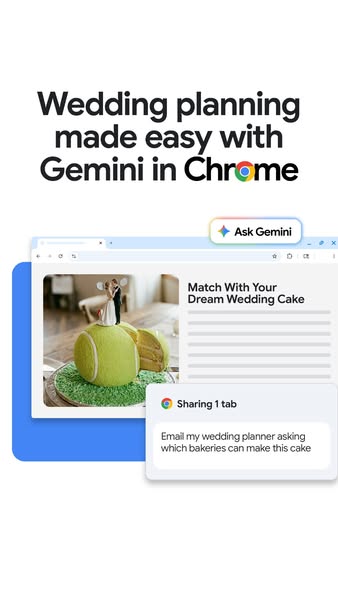
This ad promotes Gemini AI tool integrated into Google Chrome to assist with wedding planning. It shows a screenshot of a Chrome browser window with a search result for wedding cake ideas, and Gemini provides suggestions to contact a wedding planner for bakeries to make the cake.
# Brand positioning
This ad showcases Gemini, Google's AI assistant. It is positioned as a helpful tool that simplifies tasks within Google Chrome. The ad focuses on Gemini's functional ability to assist in wedding planning, highlighting its efficiency and integration within the existing Google ecosystem. The brand aligns with a user-friendly approach, offering practical solutions for everyday problems and providing an emotional sense of ease and convenience to its users.
# Product
This ad features Gemini, an AI tool within Google Chrome, designed to simplify wedding planning. It works by suggesting actions related to the user's current search. The ad showcases how Gemini can assist in finding vendors, specifically bakeries, by automatically generating an email request to the user's wedding planner. The key selling point is the ease and speed with which Gemini can handle tasks, removing the need for manual email composition and saving the user time.
# Visual style
The visual style of the ad is clean and simple, resembling a product demo. It uses a screenshot of Google Chrome to visually demonstrate the integration of the Gemini AI assistant. The color palette is mainly white with light blue accents. The image is well-lit and focuses on clarity.
# Hooks
Headline: Wedding planning made easy with Gemini in Chrome
# Benefits
- [object Object]
# Features
- [object Object]
- [object Object]
# Call to action
None used.
# Point of view
- [object Object]
- [object Object]
# Storyline
- The ad opens by stating, "Wedding planning made easy with Gemini in Chrome," immediately setting the stage for what problem it will solve. The brand is telling the audience that using Gemini makes wedding planning easier.
- Next, the ad shows a screenshot of a Chrome browser window open to a Google Search result for, "Match With Your Dream Wedding Cake." This is included to demonstrate a common scenario that users might encounter when planning a wedding. The ad assumes a customer perspective as it shows a realistic scenario the target audience would encounter.
- Lastly, the ad features a message bubble that reads, "Email my wedding planner asking which bakeries can make this cake." This highlights the AI's ability to suggest relevant actions based on the user's search. The brand shows how the user will be able to use Gemini to easily send the message to the wedding planner.
# Ad summary
In this Google Chrome ad, a content creator shows how she uses Gemini in Chrome to mock up designs before she creates them.
# Brand positioning
Google Chrome is presented as an innovative tool for content creators, particularly those who value efficiency and design validation. The ad positions Chrome as a shortcut, emphasizing that it allows users to quickly prototype and visualize their ideas, thereby eliminating guesswork and streamlining the creative process. By featuring Gemini, Chrome showcases its advanced capabilities, aiming to be seen as a cutting-edge, essential tool for designers and creators who want to optimize their workflow and enhance their creative output.
# Product
Gemini in Chrome is highlighted as a shortcut for content creators to prototype and visualize designs quickly, thus eliminating guesswork and saving time. The ad shows how Gemini can be used to reimagine photos and create design mockups. Karen demonstrates its capabilities by asking Gemini to reimagine a photo with a cardboard microphone, followed by generating different cardboard mic designs. The ad emphasizes Gemini's ability to help creators stop second-guessing their designs and get straight to making them, with Chrome's Gemini feature presented as a means to iterate more efficiently.
# Visual style
The ad has a casual and accessible aesthetic. It is a hybrid between UGC and commercial. It has natural lighting and mostly static shots. The cuts are timed to the audio and are quick. The pacing is consistent throughout the ad.
# Benefits
- [object Object]
- [object Object]
- [object Object]
# Features
- [object Object]
- [object Object]
# Call to action
None used.
# Point of view
- [object Object]
# Storyline
- 00:00–00:06 00:00–00:06 Karen states that it's harder than ever to stand out on social media, because you can go viral and still be forgettable. The scene is shot on a rooftop in San Francisco with row houses in the background. The perspective is from Karen's viewpoint as she sits on a stool. The tone is presented as a humorous and straightforward take on the challenges of content creation.
- 00:06–00:10 00:06–00:10 Karen transitions from the rooftop to an apartment balcony while she states that what you need is a visual signature, something in your videos that people will recognize instantly. This is a response to the previous segment about struggling to stand out on social media. The tone is confident, suggesting a solution to the problem of being forgettable.
- 00:10–00:14 00:10–00:14 Karen introduces her cardboard microphone as her own visual signature and says, "Let me show you how I made it using Chrome." The setting changes to an indoor studio and it's intended to draw the audience into a tutorial.
- 00:14–00:21 00:14–00:21 Karen shows her old microphone, then states that she wanted a more unique one, so she made one out of cardboard. This sets up the reason behind making the cardboard microphone—Karen sought to be more unique. The tone is presented casually.
- 00:21–00:26 00:21–00:26 Karen explains that she didn't know if her cardboard microphone would look good, so she used the Gemini in Chrome. The tone is intended to show that Karen is overcoming a fear of making something that would look cheap, by presenting the feature as a tool to mitigate that fear. The perspective is from Karen's POV as she sits at her desk.
- 00:26–00:34 00:26–00:34 Karen uses the Gemini feature in Chrome to mock up how she would look with a microphone made out of cardboard. She expresses delight at the result and says, "Great!". This is a response to the previous segment about the worry that it would look cheap; Gemini assuages that fear. The tone is portrayed as relief and excitement, now confident in the design.
- 00:34–00:38 00:34–00:38 Karen demonstrates how to use Gemini to generate a dozen different cardboard mic designs. The tone is excitement; now confident in the design, Karen is expanding her vision.
- 00:38–00:55 00:38–00:55 Karen is working on her microphone build, consulting Gemini along the way. The perspective is from Karen's POV as she researches the components and methods for making the cardboard microphone. The tone is informative and lighthearted, which keeps the tutorial feeling casual and engaging.
- 00:55–01:00 00:55–01:00 Karen is holding up her cardboard microphone, stating that it turned out exactly how she imagined, before tossing a white cloth into the air to reveal her cardboard microphone. This is in direct response to the earlier fear of not knowing if it would look good. The tone is celebratory and successful.
- 01:00–01:11 01:00–01:11 Karen tests the cardboard microphone, saying, "Moment of truth, does it work? Check, check, check, testing, audio testing, hey, not bad!" The tone is comedic and joyful. There is a sense of accomplishment that the cardboard microphone works.
- 01:11–01:19 01:11–01:19 Karen gives a shout out to Google Chrome, saying it's her shortcut for prototyping and stop second-guessing her designs. She ends by encouraging the viewer to just get straight to making their own designs. The setting changes to a balcony with row houses visible in the background. The tone is encouraging.
# Ad summary
The ad promotes Chrome's Gemini feature, showing how it helps a student quickly turn pages of study notes into a catchy song.
# Brand positioning
The Chrome brand, as featured in the ad, is presented as an innovative web browser that aims to simplify complex tasks through the use of AI. Chrome's positioning centers around enhancing productivity and learning through its built-in Gemini feature, which caters to users seeking efficient and creative solutions for managing information. The brand aligns with a modern, tech-forward lifestyle, emphasizing functionality and ease of use. Chrome's approach pushes against the traditional norm of passively consuming information, instead positioning itself as an active tool that empowers users to interact with and transform content.
# Product
The advertised product is the Gemini feature within the Chrome web browser, designed to simplify the process of understanding and memorizing large quantities of information. It is for students and anyone dealing with extensive reading material. The Gemini feature can transform key points from pages of text into song lyrics, aiding memorization. This product is a USP, making studying easier and more engaging. The ad highlights a study session as a use occasion, specifically dealing with the daunting task of reviewing 200 pages on the history of pirates. The ad addresses the purchase barrier of tedious studying by showcasing the efficiency and creativity of the Gemini feature.
# Visual style
The ad has a UGC (User-Generated Content) feel with bright, natural lighting, resembling a casual and relatable video. The editing style incorporates quick cuts to maintain a fast pace and jump cuts to transition between scenes. The production quality feels somewhat scrappy, contributing to the authentic and relatable tone that is designed to resonate with a younger audience. The pacing is quick, with cuts timed to match the rhythm of the music and speech, enhancing the audio-visual sync and overall engagement.
# Benefits
- [object Object]
- [object Object]
# Features
- [object Object]
# Call to action
None used.
# Point of view
- [object Object]
# Storyline
- 00:00–00:02 A student, Dawn, expresses her frustration with having to study 200 pages about the history of pirates.
- 00:03–00:04 Dawn reveals that learning the material is "cake with Gemini in Chrome,". This implies that it has alleviated her stress.
- 00:05–00:07 Dawn narrates that Gemini turns what she needs to know into lyrics she can memorize. This reinforces the benefit of the feature.
- 00:08–00:15 Dawn then sings the lyrics, which she says that Gemini made, demonstrating how easily she can memorize the material. This showcases a solution to Dawn's initial frustration.
# Ad summary
This ad demonstrates using Gemini in Chrome to help plan a wedding. The ad shows a user finding inspiration for their wedding cake from a photo on a webpage, and then using Gemini to draft an email to the wedding planner.
# Brand positioning
This ad is for Google Chrome. The brand is presented as a tool that helps users be productive and efficient in their daily lives, specifically through its AI assistant, Gemini. Chrome with Gemini is being positioned as an innovative tool that simplifies wedding planning. This positioning is functional, emphasizing the efficiency and ease it brings to the user.
# Product
This ad features Gemini, an AI assistant built into the Chrome browser. It is designed to help users with various tasks. In this case, Gemini is used to draft an email to a wedding planner. The ad highlights Gemini's ability to streamline wedding planning. Gemini works within the browser to assist with tasks such as email composition, making it convenient for users.
# Visual style
The ad has a clean and simple visual style. The editing style is static with a slow reveal. The production quality is polished, with a focus on clearly demonstrating the product's features. The pacing is slow and deliberate, with each shot held long enough for the viewer to fully understand the action being shown.
# Benefits
- [object Object]
- [object Object]
- [object Object]
# Features
- [object Object]
- [object Object]
- [object Object]
# Call to action
None used.
# Point of view
- [object Object]
# Storyline
- 00:00–00:02 00:00–00:02 The ad opens with a browser window displaying a webpage with a photo of a wedding cake. The user's cursor hovers over the "Ask Gemini" button in the browser. This moment sets the scene for how the AI assistant will be used.
- 00:02–00:05 00:02–00:05 A dialog box appears on the screen which shows the user drafting an email with Gemini's help to send to their wedding planner. This demonstrates the product's functionality.
# Ad summary
This ad demonstrates how to use the Gemini AI inside of Chrome to find the perfect run club. It shows a user asking which clubs are good for meeting new people and then shows the AI returning the most popular club in the area.
# Brand positioning
Gemini AI by Google is presented as an integrated feature within the Chrome browser, positioned to enhance the user's browsing experience through intelligent assistance. The ad highlights Gemini's functional role in simplifying decision-making, such as finding a running club that fits specific social needs. The brand adopts a functional positioning, emphasizing efficiency and convenience in everyday tasks. By showcasing Gemini directly within a familiar browser, the brand aims to normalize AI integration, making it accessible and user-friendly for a broad audience. Google's brand aligns with problem-solving and convenience, using AI to streamline search and selection processes.
# Product
The product featured is the Gemini AI, accessible directly through the Chrome browser. It functions as an intelligent assistant that helps users sift through information and make decisions more efficiently. In this ad, the user is looking for a running club and asks Gemini which clubs are good for meeting new people. Gemini processes information from multiple tabs to provide a recommendation, streamlining the decision-making process. The ad also showcases Gemini's integration within Chrome, emphasizing its accessibility and user-friendly design. It highlights how Gemini simplifies everyday tasks by quickly providing relevant answers and suggestions, effectively addressing the challenge of information overload.
# Visual style
The ad has a clean and minimalist aesthetic with bright, solid colors and simple graphics. The editing style is straightforward, with static shots and clear transitions. The production quality is polished, with a focus on presenting a user-friendly interface and a clear visual message. The pacing is moderate, with a focus on displaying the product's functionality in a concise manner.
# Benefits
- [object Object]
- [object Object]
- [object Object]
# Features
- [object Object]
- [object Object]
- [object Object]
# Call to action
None used.
# Point of view
- [object Object]
# Storyline
- 00:00–00:02 The ad begins by introducing the problem of finding the right run club. This sets the stage for showcasing how Gemini in Chrome can simplify the search process, highlighting the potential for enhanced browsing experiences.
- 00:02–00:04 The user selects the Gemini extension in Chrome and poses the question, 'Which of these run clubs is good for meeting new people?' This demonstrates Gemini’s interactive functionality and its ability to assist users with specific queries.
- 00:04–00:06 Gemini quickly returns a suggestion: 'Silver Track Run Club is the most popular in your area for meeting new people.' This highlights Gemini's efficient response and its ability to provide relevant and useful information.
- 00:06–00:07 The ad concludes by showing the solution in action, reinforcing the idea that Gemini in Chrome can simplify decision-making and enhance the browsing experience.
# Ad summary
The ad promotes Google Chrome by highlighting its speed, password security, and automatic updates through quick visuals and text overlays.
# Brand positioning
Google Chrome is presented as a functional and reliable browser for everyday internet use. The brand positions itself as a fast and secure option, emphasizing simplicity and ease of use. The visuals and language are straightforward, focusing on the browser's practical benefits without delving into emotional appeals or lifestyle associations. The brand leverages its Google association to instill trust and signal technical competence, following category norms by highlighting performance and security features but aiming for simplicity in its presentation.
# Product
Google Chrome is a web browser designed for speed and security. The ad emphasizes its function as a fast browser built by Google, incorporating secure password autofill and automatic security updates. The product is implicitly for anyone who uses the internet and requires a reliable browser, but focuses on users who value security and efficiency. These elements are presented as key selling points, addressing potential concerns about browsing speed and data security. The ad focuses on convincing the viewer that Chrome is a worthwhile option due to its combination of speed, security, and automatic maintenance, making it a practical choice for daily web browsing.
# Visual style
The ad has a clean and simple aesthetic with a focus on functionality. The editing style includes quick cuts and static shots. The production quality is polished, aligning with a commercial feel. The pacing is moderate, and cuts are timed to the music beats.
# Benefits
- [object Object]
- [object Object]
- [object Object]
# Features
- [object Object]
- [object Object]
- [object Object]
# Call to action
Download now
# Point of view
- [object Object]
# Storyline
- 00:00–00:02 The screen displays the Chrome logo.
- 00:01–00:03 Text appears saying '3 reasons to make Chrome your browser' on a white background with the Chrome logo.
- 00:03–00:08 A woman is shown in a dark room using a laptop. Text overlays appear with checkmarks to highlight features: 'Fast browser built by Google,' 'Secure password autofill,' and 'Automatic security updates'.
- 00:08–00:09 The screen returns to a white background with the Chrome logo.
- 00:09–00:10 Text reads: 'Get Chrome for your computer', along with a button to 'Download now'.
# Ad summary
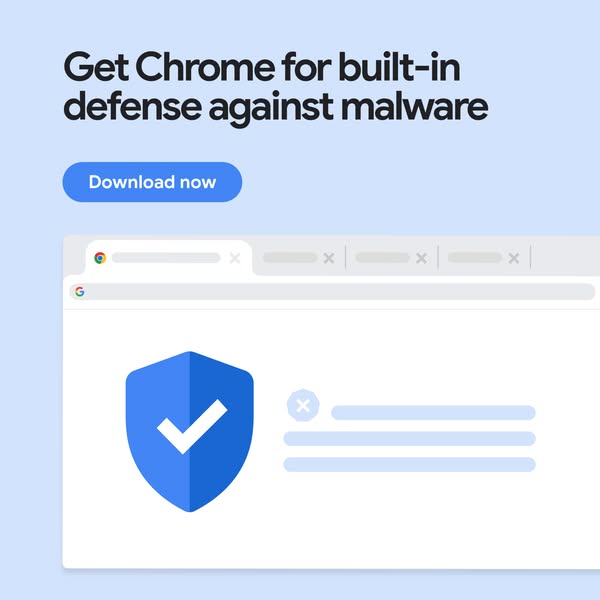
This ad for Google Chrome highlights its built-in defense against malware, encouraging users to download the browser for enhanced online security. The ad features a clean, minimalist design with a focus on the browser's security features.
# Brand positioning
Google Chrome is presented as a user-friendly and secure web browser. The brand is positioning itself as a provider of built-in defense against malware, emphasizing its commitment to protecting users from online threats. The ad promotes a sense of security and reliability, suggesting that users can trust Chrome to safeguard their online experience. This functional positioning caters to users concerned about online security, without making grandiose claims about competitor shortcomings.
# Product
The advertised product is the Google Chrome web browser, a free software application that enables users to access and navigate the internet. The ad spotlights Chrome's built-in defense against malware, which aims to protect users from harmful software and online threats. It works by integrating security features directly into the browser, providing automatic protection without requiring additional software. The USPs are the built-in nature of the security feature and the protection from malware. The visual focuses on a browser interface with a shield icon, implying that Chrome provides a protective barrier against online threats. The call to action encourages users to download Chrome, addressing a potential barrier to adoption by offering the product for free.
# Visual style
The ad features a clean and minimalist design with a focus on functionality. It uses a light blue and white color scheme, creating a sense of trust and security. The browser interface and shield icon are rendered in a flat, modern style, making the ad feel accessible and user-friendly. The overall impression is professional and uncluttered, emphasizing the key message about malware defense.
# Hooks
Headline: Get Chrome for built-in defense against malware
# Benefits
- [object Object]
# Features
- [object Object]
# Call to action
Download now
# Point of view
- [object Object]
# Storyline
- The ad starts by stating that Chrome offers a built-in defense against malware. This is meant to immediately grab the viewer's attention by highlighting a key benefit of the browser. The brand is stating this benefit.
- Next, a 'Download now' button is presented. This prompts the viewer to take immediate action. The brand is directing the viewer to download the product.
- The main visual shows a browser interface with a security shield. This reinforces the message of protection and security provided by Chrome. The viewer is seeing a visual representation of the browser's security features.
# Ad summary
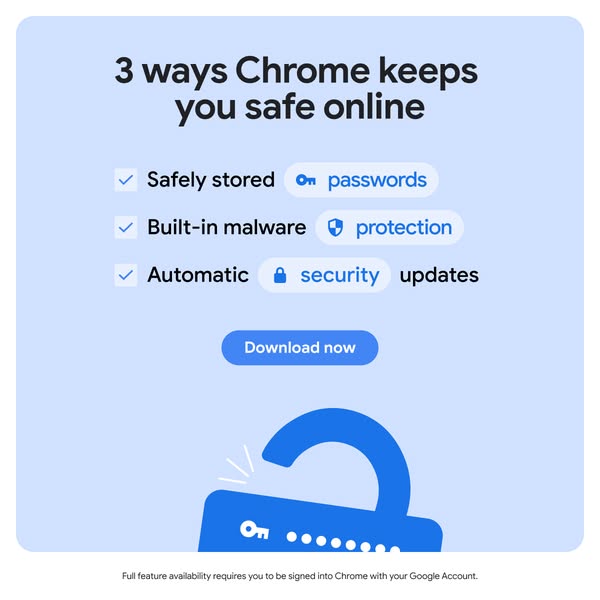
This ad showcases Chrome and highlights three ways it keeps you safe online. It mentions the safekeeping of passwords, built-in malware protection, and automatic security updates.
# Brand positioning
Chrome aims to be seen as a secure and reliable web browser. The brand emphasizes the importance of online safety and positions itself as a protector of its users' data and privacy. Chrome presents itself as a functional and trustworthy tool for anyone navigating the internet, especially appealing to users who are concerned about online threats and value convenience.
# Product
The ad promotes Chrome, a web browser that prioritizes user safety. Chrome features a password storage system, built-in malware protection, and automatic security updates. The ad highlights these features as key reasons to choose Chrome over other browsers, focusing on its security advantages to address potential user concerns about online threats and data breaches. The goal is to position Chrome as the safest choice for online browsing, making it worth trying or buying for individuals concerned about online security.
# Visual style
The ad has a clean and modern design with a light blue and white color scheme. The layout is simple, featuring bullet points and a clear call-to-action button. The overall aesthetic is functional and trustworthy, emphasizing Chrome's security features in an easy-to-understand way.
# Hooks
Headline: 3 ways Chrome keeps you safe online
# Benefits
- [object Object]
# Features
- [object Object]
- [object Object]
- [object Object]
# Call to action
Download now
# Point of view
- [object Object]
# Storyline
- The ad starts with the main message: '3 ways Chrome keeps you safe online', immediately grabbing attention and setting the tone for what is to follow, told from the brand's perspective.
- The ad illustrates three key features, using a check mark for each feature - 'Safely stored passwords', 'Built-in malware protection', and 'Automatic security updates', listing the benefits to the user and describing why Chrome is superior to other browsers, told from the brand's perspective.
- Finally, the ad includes a 'Download now' button at the bottom of the list and an illustration of an unlocked padlock, enticing the user to download Chrome and assuring them that their privacy is safe, told from the brand's perspective.
# Ad summary
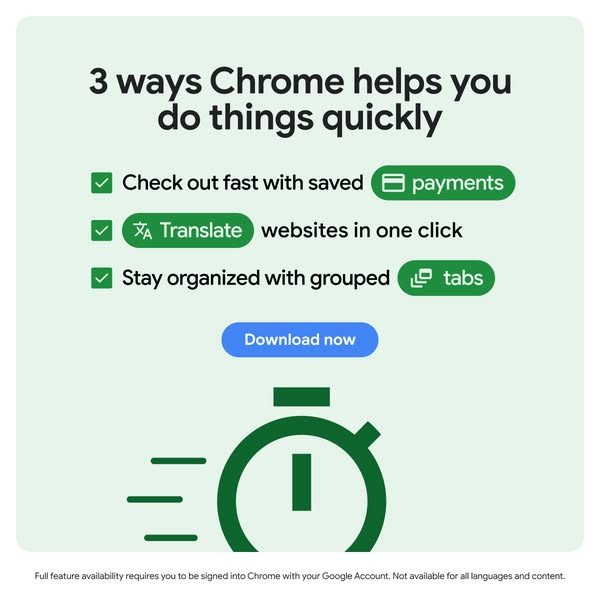
The ad illustrates three benefits of using the Chrome browser: fast checkout with saved payments, website translation in one click, and grouped tabs for organization.
# Brand positioning
Google's Chrome browser is positioned as a solution for users seeking enhanced speed and organization in their online activities. The ad highlights Chrome's ability to streamline processes like online payments, website translation, and tab management. By promoting these features, Chrome aims to be seen as a browser that simplifies and accelerates everyday online tasks, making it appealing to users who value efficiency and convenience. The brand aligns with a functional approach, focusing on how its features directly improve the user's browsing experience, rather than emphasizing emotional or lifestyle-based appeals.
# Product
The ad promotes the Chrome browser, highlighting three key features. First, it offers fast checkout with saved payments, streamlining online transactions. Second, it provides one-click website translation, enabling users to quickly access content in different languages. Third, it facilitates organization with grouped tabs, helping users manage multiple open pages efficiently. These features are presented as ways to save time and enhance productivity. The ad addresses the pain points of slow checkout processes, language barriers, and cluttered browsing experiences, presenting Chrome as a user-friendly solution that simplifies these tasks.
# Visual style
The ad has a clean and minimalist aesthetic, using a light green background to convey a sense of simplicity and ease of use. The overall design is highly polished with a focus on legibility, utilizing clear typography and intuitive icons. The image treatment is flat and modern, aligning with current design trends for web-based applications. The color palette is soft and inviting, making the ad visually accessible and non-intrusive. The use of a single illustrative icon reinforces the themes of speed and efficiency.
# Hooks
Headline: 3 ways Chrome helps you do things quickly
# Benefits
- [object Object]
- [object Object]
# Features
- [object Object]
- [object Object]
- [object Object]
# Call to action
Download now
# Point of view
- [object Object]
# Storyline
- The ad opens by stating "3 ways Chrome helps you do things quickly," immediately setting the focus on efficiency and user benefit. The brand is presenting Chrome as a time-saving solution for various online tasks, positioning it as a tool that enhances productivity and convenience.
- The ad lists the features “Check out fast with saved payments,” “Translate websites in one click,” and “Stay organized with grouped tabs" to clarify the specific benefits that Chrome offers to enhance speed and efficiency. The ad is showcasing concrete solutions to common online frustrations, emphasizing Chrome's ability to simplify and accelerate user experiences.
- The ad concludes with a blue "Download now" button, prompting the viewer to take immediate action and install Chrome. The ad is aiming to drive user adoption and increase the Chrome user base, positioning the product as readily accessible and beneficial.
# Ad summary
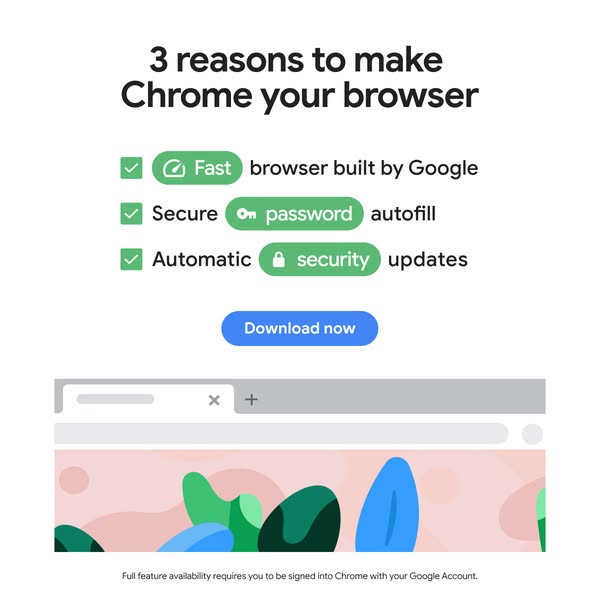
The Google Chrome ad highlights its key features such as speed, security, and automatic updates using a visually clean and simple design to attract new users.
# Brand positioning
Google Chrome is presented as a modern, reliable, and secure internet browser, built by Google, that prioritizes speed and user security. The brand's positioning in the market aims to occupy the space of a go-to browser for daily web browsing needs. It aligns with values of efficiency, convenience, and safety, emphasizing features like automatic password autofill and security updates. It pushes against competitor behaviors by highlighting essential functions like speed and security, making it clear why customers should choose Chrome as their primary browser.
# Product
The ad features Google Chrome, a web browser developed by Google. It is for anyone who wants a fast, secure, and automatically updated internet browsing experience. The ad explicitly highlights Chrome's features such as speed, security with password autofill, and automatic security updates. The main USP is Chrome's reliability and convenience of being a 'browser built by Google.' There are no specific use occasions shown. The ad addresses purchase barriers by emphasizing its speed and security features, trying to alleviate concerns about performance and privacy.
# Visual style
The ad has a clean, minimalist visual style with a focus on clarity and simplicity. The production quality is highly polished, with a well-organized grid layout, a platform-native style, and clear typography integration. The image treatment involves simple color grading, background removal, and soft lighting to create a professional and trustworthy look. The visual elements are designed to be easily scannable, making the ad attention-grabbing in a busy feed.
# Hooks
Headline: 3 reasons to make Chrome your browser
# Benefits
- [object Object]
- [object Object]
- [object Object]
# Features
- [object Object]
- [object Object]
- [object Object]
# Call to action
Download now
# Point of view
- [object Object]
# Storyline
- The ad begins by asking the question, '3 reasons to make Chrome your browser' setting the stage for the following benefits. This question is included to introduce the key benefits of using the Chrome Browser, intending to entice the audience to consider it as their preferred browser. This is being told from the brand's perspective.
- The ad lists three key features: 'Fast browser built by Google', 'Secure password autofill', and 'Automatic security updates'. These features are included to showcase the main benefits of using Chrome, emphasizing speed, security, and convenience. This part of the story is told from the brand's perspective.
- The ad includes a 'Download now' button to encourage immediate action. This CTA is included to prompt viewers to download Chrome, converting interest into a download. This part of the story is told from the brand's perspective.
- Finally, a visual of the Chrome browser is shown. The visual is included to ground the viewer and give an image reference to the product being discussed. The visual is being told from the brand's perspective.
# Ad summary
The ad demonstrates three ways Google Chrome keeps users safe online: storing passwords, built-in malware protection, and automatic security updates. It then shows a CTA to download Google Chrome for your computer.
# Brand positioning
Google Chrome is presented as a reliable and essential tool for internet browsing, prioritizing user safety and security. The ad highlights its built-in security features, positioning it as a proactive guardian against online threats. By focusing on safety features like password protection, malware defense, and automatic updates, Chrome aims to occupy the space of a secure and dependable browser in the user's mind. The brand adopts a functional approach, emphasizing practicality and peace of mind over lifestyle or emotional associations. The brand does not explicitly compare to competitors.
# Product
The ad promotes Google Chrome, the internet browser, focusing on its safety and security features. It highlights three key aspects: safely storing passwords, built-in malware protection, and automatic security updates. These features are designed to protect users from online threats and ensure a secure browsing experience. The browser is for anyone who uses the internet and wants to maintain online safety. The ad communicates that Chrome is worth trying because it provides a secure and hassle-free internet experience with its built-in protections and automatic updates.
# Visual style
The ad has a clean and simple aesthetic. The editing is straightforward with quick cuts between each feature. The production quality is polished, fitting a commercial style and tone. The visuals are designed to be informative and clear, focusing on the essential elements of Google Chrome's security features. The pacing is moderate, with each feature presented for a brief duration. The cuts are timed to match the beat of the music.
# Benefits
- [object Object]
# Features
- [object Object]
- [object Object]
- [object Object]
# Call to action
Download now
# Point of view
- [object Object]
# Storyline
- 00:00–00:01 The ad starts with the Google Chrome logo.
- 00:01–00:02 The ad transitions to a text overlay stating, "3 ways Google Chrome keeps you safe online," setting the stage for the features that will be highlighted.
- 00:03–00:04 The first safety feature, "Safely store passwords," is introduced with a visual of a padlock opening, which symbolizes security and access.
- 00:05–00:06 The second feature, "Built-in malware protection," is presented with the same padlock visual, emphasizing continuous protection.
- 00:07–00:08 The third feature, "Automatic security updates," is shown with the same padlock visual, highlighting the effortless and automatic nature of Chrome's security.
- 00:09–00:10 The ad shifts focus to a direct call to action to download the browser with the text overlay "Get Chrome for your computer" and a button labeled "Download now."
# Ad summary
This ad promotes Google Chrome by presenting three key reasons to choose it as your browser: its speed, security, and automatic updates. It uses clean visuals and text overlays to communicate these benefits.
# Brand positioning
Chrome is presented as Google's web browser that emphasizes speed, security, and user-friendliness. The brand aligns with functional values, focusing on efficiency and safety in the digital experience. It aims to occupy the space of a reliable and up-to-date browsing solution. By focusing on essential features like password autofill and security updates, Chrome positions itself as a secure and convenient choice, ignoring unnecessary complexities.
# Product
Google Chrome is a web browser that offers a fast browsing experience. It provides secure password autofill, ensuring user data is protected. The browser also features automatic security updates, which keeps it up to date with the latest protections. The advertisement highlights these features as reasons to switch to or continue using Chrome for secure and efficient web browsing.
# Visual style
The ad has a clean, modern aesthetic with a focus on simplicity and clarity. The editing style is straightforward with static shots and clear text overlays. The production quality is polished, indicating a professional commercial style aimed at conveying trust and reliability. The pacing is consistent and moderate, ensuring the message is easily digestible. Text and visuals are synchronized to emphasize key points.
# Benefits
- [object Object]
- [object Object]
- [object Object]
# Features
- [object Object]
- [object Object]
- [object Object]
# Call to action
Download now
# Point of view
- [object Object]
# Storyline
- 00:00–00:01 The ad starts with the Chrome logo displayed on a white background.
- 00:01–00:02 00:01–00:02: The text overlay appears, introducing the main topic of the ad: “3 reasons to make Chrome your browser.”
- 00:02–00:04 00:02–00:04: The first reason is presented: “Fast browser built by Google.” The visual shows a Chrome browser interface with a colorful floral background.
- 00:04–00:05 00:04–00:05: The second reason is shown: “Secure password autofill.” The background of the Chrome browser interface remains the same.
- 00:05–00:07 00:05–00:07: The third reason is presented: “Automatic security updates.” The visual of the browser remains consistent.
- 00:07–00:09 00:07–00:09: The ad transitions back to the Chrome logo, emphasizing brand recognition.
- 00:09–00:10 00:09–00:10: The final call to action is displayed: “Get Chrome for your computer” along with a “Download now” button.
# Ad summary
This ad demonstrates the usage of Gemini in Chrome for planning a wedding, specifically for finding bakeries that can make a certain cake. It shows how Gemini can be used to email the wedding planner to ask which bakeries can make this cake.
# Brand positioning
This ad presents Google Chrome as a helpful tool for planning a wedding. The brand aims to occupy a space in the consumer's mind as a simple and functional aid in wedding planning. It aligns with values of convenience and efficiency. The brand appears to be pushing against the norm that wedding planning is difficult. The brand positioning is functional, offering a simple solution to help plan a wedding.
# Product
This ad features the Gemini AI assistant within the Google Chrome browser, showing how it can simplify wedding planning. Gemini helps users find specific information about wedding cakes and communicates with wedding planners. A user is shown using Gemini to send an email to a wedding planner asking which bakeries can make a specific cake, addressing the purchase barrier of figuring out how to start a wedding planning project. The Gemini AI is worth trying or buying because it will simplify a person's wedding planning process.
# Visual style
The ad has a polished aesthetic with a clean, minimalist design. It uses static shots and smooth transitions to maintain a professional feel. The production quality is high-end, presenting a sleek and modern image that aligns with the brand's identity. The pacing is steady, with cuts timed to emphasize key features and actions.
# Benefits
- [object Object]
# Features
- [object Object]
- [object Object]
# Call to action
None used.
# Point of view
- [object Object]
# Storyline
- 00:00–00:02 The screen shows a Google Chrome window with a search result for a wedding cake.
- 00:02–00:03 The cursor clicks the 'Ask Gemini' button.
- 00:03–00:15 A window pops up showing a user is asking Gemini to email their wedding planner to find out which bakeries can make that specific wedding cake.
# Ad summary
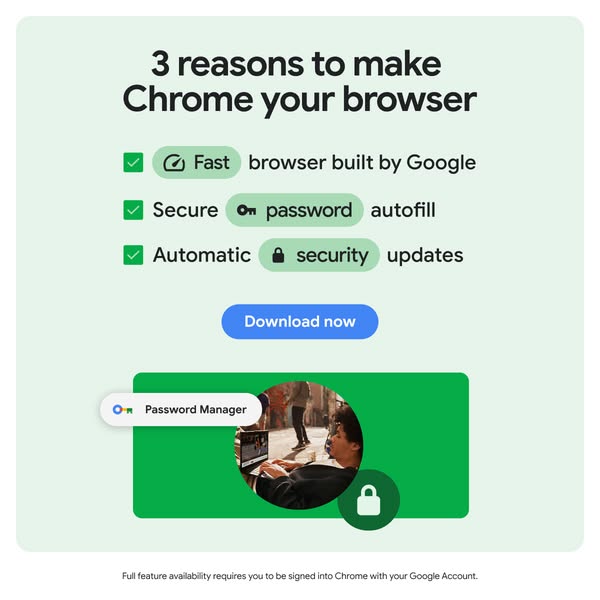
This ad is for Chrome. It lists three reasons to use Chrome as your browser and includes a download button.
# Brand positioning
Chrome is presented as a leading web browser, emphasized by being 'built by Google'. The positioning is functional, focusing on performance, security, and user convenience through automatic updates. By highlighting features like password autofill and built-in security, Chrome aims to establish itself as a reliable choice in the browser market.
# Product
The ad promotes Chrome as a web browser developed by Google, positioning it as a secure and efficient choice for users. It focuses on three key benefits: speed, security, and automatic updates. Chrome's password autofill feature and security updates are highlighted as key components, enhancing user convenience and safety. The ad encourages users to download Chrome to experience these features firsthand, emphasizing the need to be signed into a Google account for full feature availability.
# Visual style
The ad uses a clean and modern visual style with a light color palette, simple shapes, and clear typography. It combines graphic elements like checkmarks and a lock icon with a real-life image to convey both the functional and practical aspects of Chrome. The design is minimalist and focuses on direct messaging, aiming for easy scannability in a social media feed.
# Hooks
Headline: 3 reasons to make Chrome your browser
# Benefits
- [object Object]
- [object Object]
- [object Object]
- [object Object]
# Features
- [object Object]
- [object Object]
- [object Object]
# Call to action
Download now
# Point of view
- [object Object]
# Storyline
- The ad begins with a headline stating '3 reasons to make Chrome your browser,' to immediately grab attention and set the ad's agenda. The brand is telling the viewer what they will get out of using this product.
- Next, the ad lists the reasons why Chrome is the right browser to use. It starts with 'Fast browser built by Google', then 'Secure password autofill', and ends with 'Automatic security updates'. The brand is telling the viewer the features and benefits of using Chrome.
- The ad includes a button that states 'Download now' to encourage viewers to download the product. The brand is prompting the viewer to take action.
- The ad showcases Chrome's 'Password Manager' feature. It displays an image of a person using the password manager function. The brand is displaying another Chrome function.
# Ad summary
This ad presents three reasons to download the Chrome browser for your computer. The points mentioned are a fast browser built by Google, secure password autofill, and automatic security updates.
# Brand positioning
Google's Chrome aims to be viewed as a leading web browser that prioritizes speed, security, and user convenience. The brand emphasizes practical benefits such as fast browsing and automatic security updates, positioning itself as a reliable and efficient choice for users who value performance and safety online. It aligns with a functional and user-centric approach, focusing on simplifying the browsing experience.
# Product
The ad promotes the Chrome web browser, highlighting its key features and benefits. Chrome is portrayed as a fast and efficient browser built by Google, offering secure password autofill and automatic security updates. These features address concerns about speed, security, and convenience, positioning Chrome as a reliable and user-friendly choice for everyday browsing. The ad targets users who want a seamless and secure online experience, emphasizing the ease of use and peace of mind that Chrome provides.
# Visual style
The ad has a clean, minimalist aesthetic with a white background and vibrant use of brand colors. The editing style is straightforward, with static shots and clear text overlays. The production quality is polished, giving it a professional feel suitable for a corporate brand. The pacing is moderate, ensuring each point is clearly conveyed without feeling rushed.
# Benefits
- [object Object]
- [object Object]
- [object Object]
# Features
- [object Object]
- [object Object]
- [object Object]
# Call to action
Download now
# Point of view
- [object Object]
# Storyline
- 00:00–00:01 The ad begins with the Google Chrome logo.
- 00:01–00:02 00:01–00:02: The text, "3 reasons to make Chrome your browser," is displayed on the screen. This serves as the ad's introduction, setting the stage to highlight the advantages of choosing Chrome.
- 00:02–00:04 00:02–00:04: The first reason is presented: "Fast browser built by Google." This promotes Chrome's speed and reliability, with a green checkmark adding emphasis. A video in a green box shows a young man using a laptop outside, indicating real-world use.
- 00:04–00:07 00:04–00:07: The second reason appears: "Secure password autofill." An image of the Chrome password manager tool is displayed, reinforcing the security aspect. The video of the young man using the laptop continues in the background.
- 00:07–00:08 00:07–00:08: The third reason is shown: "Automatic security updates." A padlock graphic is added, further emphasizing Chrome's security features. The video of the young man using the laptop continues in the background.
- 00:08–00:09 00:08–00:09: The Google Chrome logo is displayed on screen.
- 00:09–00:10 00:09–00:10: The ad concludes with a call to action: "Get Chrome for your computer" and a "Download now" button. This encourages viewers to download the browser.
# Ad summary
This ad for Google Chrome on desktop lists three reasons to use the platform: quick checkout using saved payments, website translation in one click, and tab grouping for organization. It features a clean, minimal aesthetic with animated icons and text overlays.
# Brand positioning
Google Chrome is presented as a convenient and efficient internet browser. The brand emphasizes time-saving features and organizational tools. Positioning itself as a user-friendly browser, Chrome aims to simplify online tasks and enhance productivity. The ad aligns with functional benefits by highlighting performance and simplicity. There is a focus on helpful, built-in tools.
# Product
The ad promotes Google Chrome as a desktop browser. It highlights three main features. The first is the ability to "check out fast with saved payments," suggesting a streamlined online shopping experience. The second feature is "translate websites in one click," which removes language barriers. The final benefit is to "stay organized with grouped tabs," simplifying the management of multiple open pages. These features are presented as reasons to use Google Chrome and aim to make online activities easier and more efficient. The ad invites viewers to "Get helpful built-in tools with Google Chrome," and to "Download now."
# Visual style
The ad has a clean and minimalist aesthetic, using simple graphics and a white background. The editing style is straightforward, with quick cuts to display each point. The production quality is polished, giving it a commercial feel. The pacing is moderate, with cuts timed to the music. There is an audio-visual sync with text appearing and disappearing along with the music beats.
# Benefits
- [object Object]
- [object Object]
- [object Object]
- [object Object]
# Features
- [object Object]
- [object Object]
- [object Object]
- [object Object]
# Call to action
Download now
# Point of view
- [object Object]
# Storyline
- 00:00–00:01 The ad opens with the Google Chrome logo on a white background, immediately establishing the brand.
- 00:01–00:03 Text appears explaining the ad's purpose: to present three reasons for using Google Chrome on desktop, framing the content as informative and beneficial from the Brand's point of view.
- 00:03–00:05 The first reason is presented: "Check out fast with saved payments." A moving clock graphic emphasizes speed. The Brand is highlighting the browser's convenience and efficiency in handling online transactions.
- 00:05–00:06 Transitioning to the second reason, the same graphic is used but now alongside the text, "Translate websites in one click." The Brand is showing how the browser can simplify access to global content.
- 00:06–00:07 The third reason states: "Stay organized with grouped tabs." The Brand is emphasizing its organizational features.
- 00:08–00:10 The ad concludes with a final call to action, reinforcing the overall message of Google Chrome's helpful built-in tools and inviting viewers to download the browser, solidifying the Brand's intention to encourage adoption.

# Ad summary
This image ad promotes Chrome as a fast browser.
# Brand positioning
The Google Chrome brand is portrayed as a modern and efficient web browser. The brand positioning focuses on the speed of the browser, suggesting it enables a faster browsing experience. The visual metaphor of a rocket implies a high level of performance and efficiency. This brand is positioning itself as the go-to browser for users seeking a fast and seamless online experience.
# Product
This image ad promotes the Google Chrome web browser. The ad emphasizes the speed of Chrome through the tagline "Browse fast with Chrome" and the visual of a rocket. The browser window shown in the image highlights the ability to open multiple windows. The "Download now" button encourages immediate action, inviting users to experience the browser's speed firsthand. The absence of detailed product features or comparisons keeps the focus on Chrome's core value proposition: speed and efficiency in web browsing.
# Visual style
The ad features a minimalist design with flat vector graphics. The color palette is limited to green, white, grey and red. The use of simple shapes and clean lines gives the ad a modern, uncluttered look. The rocket icon represents the speed of Chrome. The overall visual style is clean and straightforward, with a focus on functionality and performance.
# Hooks
Headline: Browse fast with Chrome
# Benefits
- [object Object]
# Features
- [object Object]
# Call to action
Download now
# Point of view
- [object Object]
- [object Object]
- [object Object]
# Storyline
- The ad begins with the tagline "Browse fast with Chrome" to immediately convey the main value proposition. This message is delivered from the brand’s perspective to highlight the browser's speed and efficiency.
- Next, the ad presents a visual metaphor of a rocket moving at high speed, seen from the browser window’s perspective. This reinforces the message of speed and showcases the browser's performance capabilities.
- The ad concludes with a call to action, "Download now," prompting users to take immediate action. This message is delivered from the brand’s perspective and is designed to drive user acquisition by encouraging immediate download and usage of the Chrome browser.
How Other Technology Brands Advertise on Meta
Peer brands in Motion's library — click any brand to see their creative strategy, live ads, and AI breakdowns.