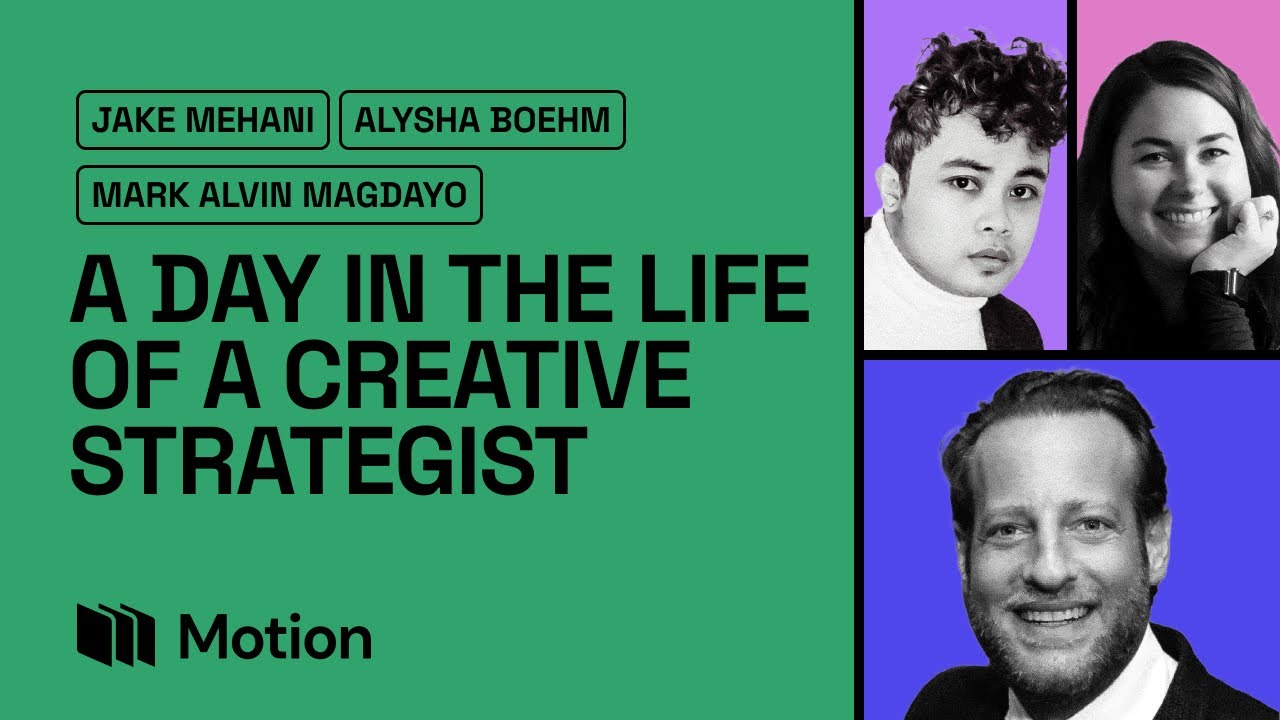
AB

Alysha Boehm

Creative Strategy Lead · Motion

Designer-turned-creative strategist who runs Motion's creative strategy function and led the development of their AI Tags taxonomy. Came up making Facebook ads at Pela and Kulin, elbowed her way into creative strategy after reading Motion's "Becoming a Creative Strategist" PDF, and now systemizes the role itself — translating how strategists think into product taxonomy and LLM context.

Distinctive beliefs, repeated across talks

How Alysha Boehm thinks about creative strategy

01

The strategist's job is leverage, not production

Alysha argues the creative strategist shouldn't be making most of the ads — their job is to make sure the right ads get made. When strategists spend all their time producing, they stop being the highest-leverage person on the team. This is a pushback against creative strategists who get sucked into execution and lose the analytical, directive part of the role.

"My job as a creative strategist actually isn't to make the ads. My job is to make sure that the right ads get made."

"The Creative Strategist should be the most leveraged person on your team. That means they can't be spending all their time on one thing (like making their own ads)."

"I spend the majority of my time analyzing, researching, then brief writing, in that order."

02

Perfection is the enemy of learning in 2026

Alysha is adamant that Meta now rewards volume and speed, so spending two weeks iterating with a creator on a single ad is a bad trade. A 'good enough' ad in market teaches you more than a 'perfect' ad in revisions. This cuts against the craft instinct of creative teams who want every ad polished before launch.

"Do not let perfection get in the way of launching an ad."

"In 2026, Meta rewards volume and speed, and the faster you can get that ad into the ad account, the sooner you're going to learn from it."

"Spending two weeks with a creator going back and forth on revisions for one ad is a very bad trade."

03

Ad families over iterations and hook swaps

Alysha pushes teams away from 'change the headline and call it a test' toward diverse creative tests rooted in one pain point but executed across multiple formats. She argues Meta's algorithm favors diverse creative, and over-indexing on granular metrics to justify tiny tweaks is an outdated habit. Her 'learned concepts' sit between small iterations and big swings — the middle ground she thinks most teams miss.

"Good creative testing relies on volume and variety."

"So instead of doing like a hook test, you're locking into one particular pain point, but you're demonstrating it in different formats in UGC if that makes sense."

"If I'm being fully honest, like, you never really know that anyway."

04

AI exposes bad strategy — it doesn't replace strategists

Alysha rejects the LinkedIn narrative that AI makes creative strategy easier. Her position: AI accelerates good strategists and exposes bad ones. You still need to master paid, organic, copywriting, consumer psychology, and media buying — and now prompt engineering too. The role got harder, not easier, because asset availability is no longer the bottleneck; your ideas are.

"If you're bad at your job, AI will just help you do a bad job faster."

"Asset availability is no longer the bottleneck, your ideas are."

"You are not just a Creative Strategist anymore, you are a prompt engineer."

05

Managing naming conventions manually is broken

Having lived inside agency naming convention spreadsheets, Alysha is blunt that the old way is 'heinous' — overcomplicated, full of ambiguous values, and breaks when multiple people touch it. Her argument for AI Tags is that a neutral LLM trained on creative strategy best practices is actually more consistent than humans, and disagreements often reveal things the human missed, not errors in the tag.

"Managing a naming convention system is actually heinous."

"The LLM that is tagging all of your creative is a neutral third party that's trained on creative strategy best practices."

"If your naming looks like a jigsaw puzzle or a zodiac letter, it's all good — we have manual tags and AI tags we can use."

06

Comments are a bigger goldmine than reviews

Most strategists mine reviews for customer language. Alysha argues ad comments are more valuable because they capture either people excited enough to post publicly or people with live objections — both surface messaging that actually moves the needle. This is a specific, contrarian take on where the best customer insight lives.

"If you look at reviews, it's people who've already bought your product. If you look at comments, it's either people excited enough to post publicly, or people with an objection — either way, it's a goldmine."

"Reviews is my favorite. I get everything I need from reviews."

07

Gut instinct is what AI can't replicate

Even as she systemizes and AI-tags the craft, Alysha carves out space for human intuition. She believes at the end of every Meta ad there's a human on the other side, and strategists who make room for 'I just feel like this is the right move' end up with outsized wins. This balances her otherwise systems-heavy POV.

"This is what the LLM can't do: feel."

"If you come up with a creative concept... and you just feel in your gut that something might work, I think it's important to make space for that."

"Maintain a structured system of measurement, but never underestimate your gut instinct."

Citation-ready quotes from across the corpus

Alysha Boehm's most cited quotes

"My job as a creative strategist actually isn't to make the ads. My job is to make sure that the right ads get made."

Opening line of her UGC tutorial, framing the whole role around leverage rather than production.

"In 2026, Meta rewards volume and speed, and the faster you can get that ad into the ad account, the sooner you're going to learn from it."

Time-bound prediction about what Meta's algorithm now favors.

"Spending two weeks with a creator going back and forth on revisions for one ad is a very bad trade."

On trading perfection for speed in the creator workflow.

"If you look at reviews, it's people who've already bought your product. If you look at comments, it's either people excited enough to post publicly, or people with an objection — either way, it's a goldmine."

Arguing ad comments outrank reviews for messaging insight.

Named methodologies Alysha has introduced or articulated

Alysha Boehm's frameworks

The 5 BFCM Ad Types

Five creative buckets Alysha uses every Black Friday: Evergreen (leave top performers on), Lazy Ads (slap a BFCM banner on a top evergreen from the last 3–6 months), Learned Ads (repurpose proven creators, formats, hooks), Offer Ads (the direct 'it's on sale, buy it' creative), and Wildcards (the 'Superbowl ads of Black Friday' — risky, funny, pattern-interrupting). Apply them via Motion's comparative reports to see which bucket is driving spend and ROAS.

  1. Evergreen — they just stay on
  2. Lazy Ads — slap a banner on it
  3. Learned Ads — use what worked
  4. Offer Ads — 'it's on sale, buy it'
  5. Wildcards — the Superbowl ads of Black Friday

The Seasonal Offer Stack

The Q4 offer sequence Alysha runs rather than treating BFCM as a single event: Pre-Black Friday (early access tease), Black Friday (best offer), Cyber Monday (special offer), Gifting (small incentive through December), and New Year (special offer). Track each stage with Motion's Seasonality AI tag.

  1. Pre Black Friday — early access
  2. Black Friday — best offer
  3. Cyber Monday — special offer
  4. Gifting — small incentive
  5. New Year — special offer

Why Do People Buy? (Cart Preppers vs Impulse Buyers)

Two BFCM buyer mindsets Alysha targets with different creative: Cart Preppers are planning to buy a specific product and just need the 'it's on sale' trigger; Impulse Buyers are planning to spend and can be pushed into a purchase they weren't tracking. The messaging, angle, and ad type should differ based on which mindset you're after.

  1. The Cart Preppers — planning to buy
  2. The Impulse Buyers — planning to spend

UGC Ad Formats (Lofi Yapper / Problem-Solution / Hi-Fi UGC)

Three distinct UGC formats Alysha tests against each other rather than over-indexing on one. Lofi Yapper: raw, unpolished, single-take phone video with no tripod or ring light — the lo-fi quality is the feature. Problem/Solution: traditional, refined but still 'real' with good lighting, clean background, talking head, b-roll cutaways. Hi-Fi UGC: authentic but significantly elevated production, usually hired from 'Leader' creators with signature style.

  1. The Lofi 'Yapper' — raw, single-take, phone only
  2. The Problem/Solution UGC — refined but feels real
  3. The Hifi UGC — elevated production, signature style

Types of Creators (Leader vs Follower)

Two categories of UGC creators Alysha hires for different outcomes. The Leader has a unique POV and signature style — give them a rough outline and get out of the way. The Follower is a UGC creator through and through — hire them to execute a very specific vision with a detailed script.

  1. The Leader — unique POV, signature style, light direction
  2. The Follower — executes your specific vision

Iterations vs Learned Concepts vs Big Swings

A three-tier model for creative tests. Iterations are small tweaks (hook swap, headline change). Big Swings are net-new concepts. Learned Concepts sit in the middle — rooted in a real performance learning but meaningfully different from what you've run — and Alysha argues this middle tier is where most of the systematic scale comes from, not from iterations or wildcards.

  1. Iterations — small tweak
  2. Learned Concepts — medium, rooted in a takeaway
  3. Big Swings — net-new, high risk

Motion AI Tags (Eight Categories)

The taxonomy Alysha led at Motion to replace manual naming conventions. Every ad is auto-tagged across eight dimensions: Asset Type, Visual Format, Messaging Angle, Hook Tactic, Seasonality, Offer Type, Intended Audience, and Headline Tactic. These unlock comparative reports without robust naming conventions and approximate how Meta's Andromeda LLM groups creative similarity.

  1. Asset type
  2. Visual format
  3. Messaging angle
  4. Hook tactic
  5. Seasonality
  6. Offer type
  7. Intended audience
  8. Headline tactic

The Creative Strategy Flywheel

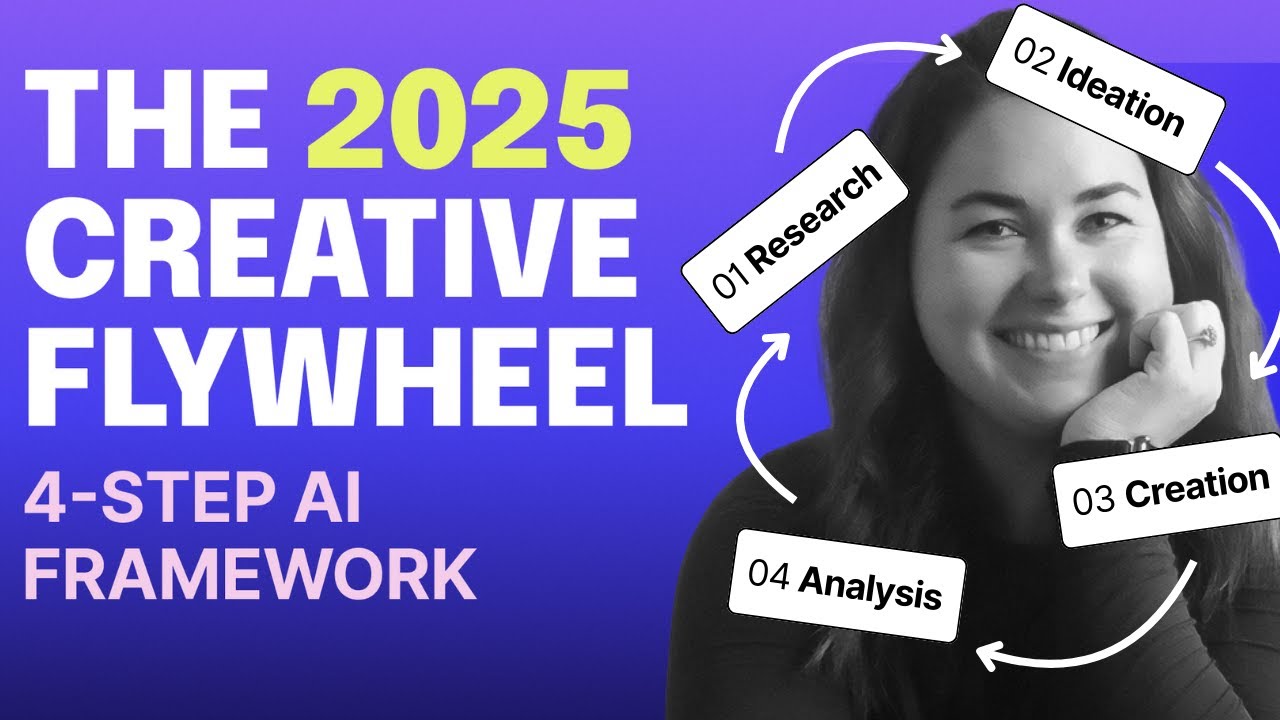
Seven-step cycle Alysha used at Kulin and still references: Research → Ideation → Briefing → Content Creation → Evaluation → Launch → Creative Analysis. Post-AI, each step has been redefined (analysis became pattern-identification, research became LLM context documentation, ideation became ad-family design, content creation became MVP asset generation) but the underlying loop is unchanged.

  1. Research
  2. Ideation
  3. Briefing
  4. Content Creation
  5. Evaluation
  6. Launch
  7. Creative Analysis
The framings Alysha keeps returning to

Alysha Boehm's signature questions

5 talks in Motion's library

All Alysha Boehm talks