

# Ad summary
This ad promotes Yoga-Go with a focus on weight loss using a 7-minute daily routine based on Tai-Chi. The ad features a woman who shares her 28-day journey, claiming the routine helps to shed kilos, reduces joint pain, and increases energy. The ad also includes testimonials and a call to action to try the routine via a link below.
# Brand positioning
Yoga-Go is presented as a fitness solution for weight loss, flexibility, and overall well-being. The brand promotes itself as a flexible offering to workout that can be done anywhere. It challenges the norms of traditional gym workouts by offering an accessible, effective alternative that can be completed in just 7 minutes daily. The brand aligns with values of convenience, simplicity, and positive body transformation, focusing on both functional benefits like weight loss and emotional benefits such as increased energy and reduced joint pain.
# Product
Yoga-Go is a fitness app featuring a 7-minute daily routine based on Tai-Chi. The app is for individuals seeking an accessible, stress-free approach to weight loss and fitness. The app has multiple features that are shown in the add such as daily plans, and series workouts. Its key USP lies in its short duration, effectiveness, and emphasis on gentle movements. The app addresses purchase barriers by offering a flexible workout solution that requires minimal time and can be done anywhere, making it ideal for busy individuals seeking weight loss and relief from joint pain.
# Visual style
The ad features a hybrid aesthetic, blending UGC-style testimonials with polished product shots and graphics. The editing style incorporates quick cuts during testimonial segments to maintain engagement, transitioning to static shots for demonstrations and app displays. Pacing is moderate, with a consistent rhythm of cuts timed to the music and voiceover. The production quality is a mix, with raw selfie-style footage alongside professionally lit studio segments.
# Benefits
- [object Object]
- [object Object]
- [object Object]
- [object Object]
# Features
- [object Object]
# Call to action
Klick auf den Link unten und starte noch heute deine eigene Transformation.
# Point of view
- [object Object]
- [object Object]
# Storyline
- 00:00–00:03 A woman asks another woman how long she had to go to the gym to look like that.
- 00:03–00:06 The second woman says that she is 61 years old and does not go to the gym.
- 00:06–00:11 The second woman continues and says that she started by doing 7 minutes of Tai Chi per day and says she was ready for the summer after one month.
- 00:11–00:25 The video cuts to a mirror selfie of the second woman taking a photo of herself and says that she is 61 and has tried walking, Pilates, and fasting, but nothing has helped her lose weight. She points out that she will be trying the 28-day Tai Chi challenge.
- 00:26–00:34 The video cuts to day 7 of her challenge and she is surprised, saying that she has so much more energy when waking up, and the best part is the joint pain in her knees has decreased.
- 00:34–00:42 The video cuts to day 14 of her challenge. She says the kilos are really falling off and she hasn't spent hours in the gym. She has only completed 7 minutes of gentle movements in the morning and it works.
- 00:42–00:49 The video cuts to day 21 of the challenge and the woman says she saw her reflection today and feels 10 years younger, and she hasn't moved this lightly in decades.
- 00:50–01:00 The video cuts to day 28 and she says that she has completed the challenge, lost the kilos, feels great in her joints, and is full of energy.
- 01:00–01:04 The video cuts again and the woman says that if you want to change your body without stress you need to try this 7 minute Tai Chi routine.
- 01:05–01:09 The woman ends the video by saying click the link below and start your transformation today.
- 01:09–01:12 The video cuts to a woman doing Tai Chi and text states that this Monday they are starting the Tai Chi program for beginners.
- 01:12–01:18 The video cuts to other women doing Tai Chi and text states to build up strength and lose 10kg of belly fat with only 7 minutes daily.
- 01:19–01:28 The video cuts to more women doing Tai Chi and text states that in one week you will feel it and in 2 weeks you will see it. They follow up with stating that by bathing suit season you will have all eyes on you. To end they state to start this Monday and ask if the viewer is in.
- 01:28–01:33 The video shows the logo and app store download links for the product Yoga-Go.

How Yoga-Go: Yoga For Weight Loss Advertises on Meta
Refreshed 4 months ago · Weekly refresh cadence
Yoga-Go: Yoga For Weight Loss runs 666 active ads on Meta, shipping ~149 new creatives per week. Their library leans on Demo18%, Transformation10%, and Before and After10%. Recently, Yoga-Go is going all in on Tai Chi as their primary product offering, positioning it as the anti-aging, low-impact alternative to punishing gym routines specifically for women over 50. The messaging centers on transformation in just 7 minutes a day over 28 days, promising weight loss, increased energy, and joint pain relief without dieting or strenuous exercise. There's a strong emotional through-line around reclaiming vitality and visibility after menopause, framing Tai Chi as permission to move differently and feel 20 years younger without the shame or strain of conventional fitness.
Indexed by Motion's Inspo Library.
The 20 Most Recent Yoga-Go: Yoga For Weight Loss Ads on Meta
# Ad summary
This ad for Yoga-Go promotes their tai chi program to women over 50. The ad features an interview-style dialogue between a woman in her 50s and the Yoga-Go instructor. The ad addresses common pain points such as feeling invisible or unfit after the age of 50, and promises that consistent Tai Chi practice with Yoga-Go can help women get their bodies back.
# Brand positioning
Yoga-Go positions itself as a wellness and fitness brand offering easy and accessible yoga and tai chi programs for all. The brand presents itself as a solution for women over 50 who are looking to regain their bodies and improve their overall well-being with only a few minutes of exercise each day. They set themselves apart from traditional fitness programs by offering workouts specifically designed for the needs and abilities of older adults.
# Product
The featured product is Yoga-Go's tai chi program specifically designed for women over 50. The program aims to help users reclaim their bodies, increase their energy levels, build strength, and improve their overall well-being. The ad emphasizes that only 7 minutes a day for one month is needed to see results. The program is easily accessible through the Yoga-Go app, encouraging users to 'click on the link' and 'start tomorrow'.
# Visual style
The ad combines polished footage with an interview-style to convey authenticity. The editing style features simple cuts between the speakers. The first shot of the ad is very polished and shows a beautiful garden. The interview shots are less polished, but still filmed in a professional studio. The editing rhythm is medium, with cuts occurring primarily between speakers.
# Benefits
- [object Object]
- [object Object]
- [object Object]
- [object Object]
# Features
- [object Object]
- [object Object]
# Call to action
Klick auf den Link.
# Point of view
- [object Object]
- [object Object]
# Storyline
- 00:00–00:10 00:00–00:10 The female instructor stands in a garden and promotes the Tai-Chi-Challenge for beginners from 50 years onwards.
- 00:11–00:16 00:11–00:16 The female interviewee expresses the pain point that everyone on Facebook looks great, but that she sees herself as an 'Oma' at 54 and simply rejects going out.
- 00:17–00:24 00:17–00:24 The instructor responds to the interviewee that she should not reject going out and instead do Tai Chi for seven minutes a day over a month, and she will look better than everyone else. She reassures that she is serious about that.
- 00:25–00:26 00:25–00:26 The interviewee questions if that is possible.
- 00:26–00:33 00:26–00:33 The instructor responds that it is developed exactly for women over 50 who want their body back.
- 00:33–00:34 00:33–00:34 The interviewee asks if one month is enough.
- 00:35–00:39 00:35–00:39 The instructor responds that one month is absolutely enough and that your body reacts faster than you think.
- 00:40–00:41 00:40–00:41 The interviewee says that she hasn't done any sports since her twenties.
- 00:42–00:45 00:42–00:45 The instructor responds that that is perfect because her body is craving exercise.
- 00:45–00:46 00:45–00:46 The interviewee questions when she will see results.
- 00:47–00:54 00:47–00:54 The instructor responds that she will see results after two weeks: more energy, more strength, and everyone will ask you for your secret.
- 00:55–00:56 00:55–00:56 The interviewee asks if only seven minutes a day is enough.
- 00:56–01:06 00:56–01:06 The instructor confirms that only seven minutes a day is enough, because it was specifically developed for that body type.
- 01:07–01:12 01:07–01:12 The interviewee questions how to start and the instructor responds to click on the link, start tomorrow, and that she will rock the class reunion in a month.
# Ad summary
This ad promotes Yoga-Go, highlighting a 28-day Tai Chi challenge. It begins with a woman asking another how long she had to work out at the gym to look like that. The second woman responds that she is 61 years old and she just started doing Tai Chi for 7 minutes a day and was ready for summer in a month. The video then transitions to show the 61-year-old woman taking the 28-day Tai Chi challenge.
# Brand positioning
Yoga-Go presents itself as an accessible and effective platform for achieving health and fitness goals, particularly for individuals seeking alternatives to conventional, high-intensity workouts. The brand emphasizes simplicity and convenience, positioning itself as a solution for those who may have struggled with traditional exercise methods like gym workouts, walking, pilates, or fasting. By focusing on short, manageable Tai Chi routines, Yoga-Go appeals to those looking for a low-stress, time-efficient way to transform their bodies, reduce joint pain, and feel more energetic. The brand aligns with a lifestyle of holistic wellness, aiming to empower users to improve their physical and mental well-being through gentle yet impactful movement.
# Product
Yoga-Go is presented as an app or platform that offers a 28-day Tai Chi challenge, specifically designed for beginners. The program involves performing a seven-minute Tai Chi routine daily, which is promoted as an effective way to transform one’s body without the stress of traditional workouts. It is marketed toward individuals aiming to lose weight, reduce joint pain, and increase energy levels. The product addresses common barriers to exercise, such as time constraints and the physical strain of high-impact activities. It offers a convenient, accessible solution that can be easily integrated into daily routines, making it appealing for those seeking a simple and gentle approach to fitness and well-being.
# Visual style
The video quality is high with bright, natural lighting and clear imagery. Editing is a mix of static shots and quick cuts, paced to maintain engagement and highlight transformation. The aesthetic feels authentic, blending UGC-style testimonials with polished product displays to build trust and showcase the app's appeal. Jump cuts are used frequently.
# Benefits
- [object Object]
- [object Object]
- [object Object]
- [object Object]
- [object Object]
- [object Object]
- [object Object]
- [object Object]
# Features
- [object Object]
- [object Object]
- [object Object]
# Call to action
Click the link below and start your own transform motion today.
# Point of view
- [object Object]
- [object Object]
# Storyline
- 00:00–00:02 00:00–00:02: A woman asks another woman how long she had to go to the gym to look like that. This sets up the problem of lengthy gym workouts as a barrier to fitness.
- 00:02–00:10 00:02–00:10: The second woman replies that she is 61 and started doing Tai Chi for 7 minutes a day, and was ready for summer in a month. This is the unexpected solution.
- 00:11–00:25 00:11–00:25: The second woman says she is 61 and that she has tried walking, pilates, and fasting, but nothing really helped her to lose that stubborn weight, so she is trying a 28-day Tai Chi challenge. She is then heard saying, "Let's see how it goes." She is taking the audience along with her on her journey.
- 00:26–00:33 00:26–00:33: The second woman says, "Day 7, I am genuinely shocked. I have so much more energy waking up. And the best part? The joint pain in my knees is actually fading." The audience is experiencing the positive effects with her, which reinforces her credibility.
- 00:34–00:41 00:34–00:41: The second woman says, "Day 14, the weight is actually coming off. I haven't spent hours at the gym. Literally just seven minutes of these gentle flows every morning. It's working." The audience sees the positive effects she is experiencing, which reinforces her credibility and creates belief.
- 00:42–00:49 00:42–00:49: The second woman says, "Day 21. I caught my reflection today and realized, I feel ten years younger. I haven't moved with this much lightness in decades." The audience sees the positive effects she is experiencing, which reinforces her credibility and creates belief.
- 00:50–01:04 00:50–01:04: The second woman says, "Day 28 I finish the challenge. The weight is down, my joints feel amazing and I am full of life. If you want to transform your body without the stress, you have to try this seven minute Tai Chi routine. Click the link below and start your own transform motion today." This beat reinforces that the Tai Chi challenge is the solution.
- 01:05–01:23 01:05–01:23: A voiceover begins, "This Monday, we're starting the Tai Chi program for beginners. Build strength and lose up to 23 lbs of belly fat with just 7 min a day. In one week you'll feel it. In two weeks you'll see it. By beach season you'll be turning heads. Start this Monday, you in?" The audience is given the solution and a reason to act quickly.
- 01:24–01:29 01:24–01:29: The Yoga-Go branding is shown, and it is indicated that it is available on Google Play and the App Store. This is the brand signoff and call to action.
# Ad summary
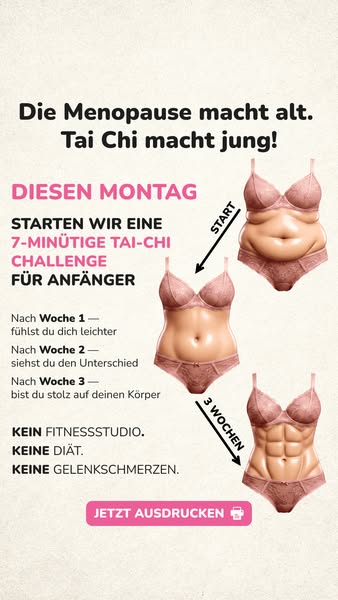
This ad promotes a 7-minute Tai Chi challenge for beginners, suggesting that menopause makes you old and Tai Chi makes you young. It shows a transformation of a woman's body over a 3-week period, claiming that after week 1 you will feel lighter, after week 2 you will see the difference, and after week 3 you will be proud of your body. The ad emphasizes that it requires no fitness studio, no diet, and causes no joint pain, with a call to action to print it out.
# Brand positioning
This ad positions Tai Chi as a natural, accessible, and gentle solution for women experiencing the aging effects of menopause. It presents Tai Chi as a way to regain youthfulness and body confidence, contrasting it with the undesirable effects of menopause. By highlighting that the program requires no fitness studio, diet, or strenuous exercise, the brand aims to appeal to individuals seeking a low-impact, sustainable approach to fitness and well-being. The brand emphasizes that it offers a quick and easy to do workout that can easily be integrated into their daily routine.
# Product
The featured product is a 7-minute Tai Chi challenge designed for beginners. It promises to provide noticeable changes in body feel and appearance within three weeks. This workout program addresses purchase barriers by highlighting the benefits without requiring a gym membership, dieting, or causing joint pain, making it accessible to individuals seeking a gentle fitness routine. The program focuses on feelings of lightness in week 1, visual differences in week 2, and body pride in week 3. The ad aims to convey that this Tai Chi challenge is an effective and convenient way to regain body confidence and improve overall well-being through short, simple exercises.
# Visual style
The ad features a transformation demo with a clean layout and a focus on visual progress. The production quality appears moderately polished, with smooth skin and subtle digital alterations. The use of arrows and labels creates a clear progression narrative, while the pink accents and straightforward typography maintain a friendly tone. The layout is simple and designed for easy readability.
# Hooks
Headline: Die Menopause macht alt. Tai Chi macht jung!
# Benefits
- [object Object]
- [object Object]
- [object Object]
# Features
- [object Object]
- [object Object]
# Call to action
JETZT AUSDRUCKEN 🖨
# Point of view
- [object Object]
# Storyline
- The ad begins by stating that menopause makes you old, while Tai Chi makes you young. This juxtaposition is from the brand and establishes the central theme of the ad: Tai Chi as a solution to aging.
- The ad announces that this Monday, viewers can start a 7-minute Tai Chi challenge for beginners. This is from the brand and serves as a direct invitation to engage with the featured product and highlights its accessibility and ease of integration into daily routines.
- The ad highlights the benefits of the Tai Chi challenge by showing a transformation of the body over three weeks. This section illustrates a clear progression of positive changes, appealing to the viewer's desire for self-improvement.
- The ad presents an image depicting a woman's body at three different stages: 'Start,' '3 Wochen' (3 Weeks). This visualization is from the brand, showing a gradual transition from a less toned physique to a more toned one, reinforcing the tangible benefits of the challenge.
- The ad addresses potential barriers by noting that it requires no fitness studio, no diet, and causes no joint pain. This message is from the brand, appealing to viewers who may have reservations about traditional fitness methods, making the challenge more accessible and appealing.
- The ad concludes with a call to action to print it out. This is from the brand and encourages immediate action, providing a tangible step for viewers to start the challenge, making it easy and actionable.
# Ad summary
An ad for Yoga-Go with the message that Tai Chi can transform your body with just seven minutes a day. It also features a woman's 28-day journey with the product, showing how she lost weight and gained energy and mobility.
# Brand positioning
Yoga-Go presents itself as an accessible and convenient fitness solution that defies traditional workout norms. The brand aligns with a lifestyle that values well-being and body transformation without the stress. It offers Tai Chi programs for beginners, promoting strength building and weight loss in just seven minutes a day. The brand directly addresses common barriers such as time constraints and joint pain, and positions itself as a low-impact alternative to conventional workouts, making it attractive for those seeking ease and simplicity.
# Product
Yoga-Go is a fitness app offering a seven-minute Tai Chi program designed for beginners seeking to transform their bodies without the stress of conventional workouts. It aims to build strength and help users lose up to 23 pounds of belly fat. The program is designed to be low-impact, alleviating joint pain and increasing energy levels. The app is promoted for its ease of use and convenience, allowing users to feel results in just one week and see them in two. It is intended for those who want to turn heads by beach season and start a personal transformation without extensive time commitments.
# Visual style
The ad has a UGC feel. The production quality is polished with smooth transitions. The ad has quick cuts and the cuts are timed to the beat of the music.
# Benefits
- [object Object]
- [object Object]
- [object Object]
- [object Object]
- [object Object]
- [object Object]
# Features
- [object Object]
- [object Object]
# Call to action
Click the link below and start your own transform motion today.
# Point of view
- [object Object]
- [object Object]
# Storyline
- 00:00–00:07 An Asian woman in a blue bikini is at a waterpark with another woman. She gestures to the other woman's body as she introduces the product.
- 00:08–00:22 The scene changes to a woman in a black sports bra and leggings, standing in front of a mirror. She is about to start a 28-day Tai Chi challenge.
- 00:23–00:30 She records a video, reporting that on Day 7 of the challenge, she is genuinely shocked at how much energy she has in the mornings, and how the joint pain in her knees is actually fading.
- 00:31–00:38 She records another video, reporting that on Day 14 of the challenge, the weight is coming off, with just seven minutes of the gentle flows every morning. She says it's working.
- 00:39–00:46 She records another video, reporting that on Day 21 of the challenge, she feels ten years younger and has more lightness.
- 00:47–01:01 She records another video, reporting that on Day 28 of the challenge, she has finished, the weight is down, her joints feel amazing, and she is full of life. She encourages the viewer to try this seven-minute Tai Chi routine and click the link below to start.
- 01:02–01:10 The woman from the beginning is now in Tai Chi clothing and shows the viewer the Tai Chi movements. The message is that the viewer can build strength and lose up to 23 lbs of belly fat.
- 01:11–01:20 More people are shown doing the Tai Chi movements. The message is that in one week, you'll feel it; in two weeks, you'll see it; by beach season, you'll be turning heads. The woman asks, 'Start this Monday. You in?'
- 01:21–01:25 The Yoga-Go app is shown, which is Yoga for All: Flex, Flow, Grow, and is a Yoga For Weight Loss app.
# Ad summary
The ad shows a before and after of a woman who participates in a 28 day Tai Chi challenge. Her husband begins by commenting on how his wife wants to try Tai Chi to get in shape before their vacation. The woman is then shown doing a 28 day challenge where she is taking photos of herself in the mirror each day. She then talks about the benefits of the Tai Chi challenge and how it can help you feel 10 years younger, have more energy, and lose weight. The ad finishes with another individual showing the movements needed for the Tai Chi program for beginners and states you can build strength and lose belly fat with 7 minutes a day.
# Brand positioning
Yoga-Go is presented as a health and wellness app that offers plans adapted to your needs with easy-to-follow exercises. The brand emphasizes improving wellness through physical activity. The brand does not seem to push against the market, instead following category norms and focusing on a functional approach, such as simplicity.
# Product
Yoga-Go offers a 7-minute Tai Chi routine that helps transform your body. The ad mentions that with Yoga-Go you can lose up to 23lbs of belly fat. The program helps with joint pain and makes you feel 10 years younger with more energy and you can move with lightness. The product has easy-to-follow exercises, plans adapted to your needs, and classic yoga, chair yoga, and wall Pilates.
# Visual style
The ad's overall aesthetic is a mix of personal and commercial. The first part of the video appears as UGC and then transitions to a commercial feel. The ad's rhythm is quick cuts. The production quality is a hybrid. The video has quick cuts, about 40 cuts per minute, and appears to sync with the background audio.
# Benefits
- [object Object]
- [object Object]
- [object Object]
- [object Object]
- [object Object]
- [object Object]
- [object Object]
# Features
- [object Object]
- [object Object]
- [object Object]
- [object Object]
# Call to action
None used.
# Point of view
- [object Object]
- [object Object]
# Storyline
- 00:00–00:04 A man states he and his wife have 28 days until vacation.
- 00:04–00:07 The man states his wife decided to try Tai Chi to get in shape.
- 00:08–00:13 The ad then cuts to the man and his wife on vacation. The man states it's his wife and he can't believe it's really her.
- 00:14–00:17 A woman is shown in a mirror as she states she's 61 and wants to feel confident in her body.
- 00:17–00:24 The woman states she has tried walking, Pilates, and fasting, but nothing has helped her lose weight, so she's trying this 28 day Tai Chi challenge.
- 00:24–00:27 The woman then states 'Let's see how it goes'.
- 00:27–00:35 The ad then fast forwards and the woman mentions it is day seven and she is shocked because she has so much energy and her knee pain is fading.
- 00:36–00:44 The ad cuts to day 14 where the woman says the weight is actually coming off and she hasn't spent hours at the gym only 7 minutes of gentle flows every morning.
- 00:44–00:46 The woman states its working and she still has time before summer.
- 00:47–00:51 The woman then fast forwards to day 21 where she states she caught her reflection and realized she feels 10 years younger.
- 00:51–00:56 The woman continues and states she hasn't moved with this much lightness in decades and can't wait to wear her summer dresses again.
- 00:57–01:04 The ad fast forwards to day 28 where the woman states she finished the challenge, the weight is down, her joints feel amazing, and she is full of life right on time for summer.
- 01:05–01:10 The woman states if you want to transform your body before summer hits, you have to try the seven minute Tai Chi routine.
- 01:11–01:14 The ad cuts to other individuals in different settings while the text overlay states that this Monday, they're starting the Tai Chi program for beginners.
- 01:15–01:17 The text overlay states you can build strength and lose up to 23 pounds of belly fat.
- 01:18–01:26 The text overlay states that with just 7 minutes a day, in one week you'll feel it, in two weeks you'll see it, and by beach season you'll be turning heads.
- 01:26–01:29 The ad ends with the text overlay stating, start this Monday, you in?
- 01:30–01:33 The Yoga-Go app and store logos are shown.
# Ad summary
The ad promotes Yoga-Go as a solution for women over 50 to lose weight, relieve joint pain, and increase energy through a 28-day Tai Chi challenge that involves only 7 minutes of gentle movements each morning. It highlights the benefits of Tai Chi in activating deep muscles and the lymphatic system, which cardio might not achieve after 50. The ad features before-and-after visuals and testimonials, suggesting significant weight loss and an improved sense of well-being.
# Brand positioning
Yoga-Go is presented as an accessible and effective fitness solution, particularly for women over 50, offering easy-to-follow exercises adapted to their needs. The brand promotes a holistic approach to wellness, focusing on flexibility, flow, and growth. It positions itself against the norm of intense workouts and strict diets, instead advocating for gentle, daily routines that can be seamlessly integrated into a busy lifestyle. This functional and emotional approach provides a simple way to regain energy, lose weight, and alleviate joint pain, catering to those seeking a balanced and sustainable fitness journey.
# Product
Yoga-Go's featured product is a 28-day Tai Chi challenge specifically designed for women over 50, promising weight loss, joint pain relief, and increased energy through 7 minutes of daily gentle movements. The program is presented as an alternative to strenuous workouts and restrictive diets, addressing the purchase barrier of time and physical strain. It activates the deep musculature and lymphatic system in a way that cardio might not achieve after 50. The product is user-friendly, requiring no special equipment or location, making it accessible to anyone, anywhere, every morning. The ad emphasizes the value of simplicity and effectiveness, offering a gentle yet powerful means to achieve significant health benefits.
# Visual style
The ad uses a blend of polished and UGC-style footage. The editing is quick and cuts are timed to the audio. The tone is uplifting and encouraging, with a clear focus on simplicity, natural movements and visible transformation. The pacing remains consistent throughout the ad, creating a rhythm that emphasizes accessibility and positive outcomes. It uses a bright and clean aesthetic, enhancing the message of well-being and ease.
# Benefits
- [object Object]
- [object Object]
- [object Object]
- [object Object]
- [object Object]
- [object Object]
- [object Object]
- [object Object]
# Features
- [object Object]
- [object Object]
- [object Object]
- [object Object]
# Call to action
Klicke auf den Link unten und starte noch heute deine 7 Minuten Tai Chi Challenge. (Click on the link below and start your 7 minute Tai Chi Challenge today.)
# Point of view
- [object Object]
- [object Object]
# Storyline
- 00:00–00:05 A woman points to another woman's midsection
- 00:05–00:12 An instructor is talking to the viewer
- 00:12–00:18 The instructor continues to talk to the viewer.
- 00:18–00:20 The instructor continues speaking.
- 00:20–00:24 A woman in a bedroom is seen stretching.
- 00:24–00:27 The instructor talks directly to the camera
- 00:27–00:32 A rendered image of a fat woman is shown changing into a muscular woman.
- 00:32–00:34 An instructor talks to the viewer
- 00:34–00:36 A woman does Tai Chi moves in the yard.
- 00:36–00:38 Another woman does Tai Chi moves by a pool.
- 00:38–00:41 The instructor speaks again.
- 00:41–00:45 A woman looks at herself in the mirror.
- 00:45–00:49 The instructor talks directly to the camera again.
- 00:49–00:55 A split screen shows day 1 and day 28 of the program.
- 00:55–01:02 The instructor addresses the camera
- 01:02–01:06 A phone shows the app and details about it.
# Ad summary
This video promotes a 7-minute Tai-Chi routine from Yoga-Go. The video begins with an older Asian woman standing between two other women (identical twins), to make the claim that tai chi allows you to lose weight faster. The video transitions to a woman chronicling her experience doing the 28-day Tai-Chi challenge from Yoga-Go. The woman does a mirror selfie every week to demonstrate her weight loss success and other benefits.
# Brand positioning
Yoga-Go is a wellness app that seeks to make yoga and weight loss accessible through short daily practices. The brand’s tone is very friendly, encouraging and positive, presenting a functional product that delivers performance, simplicity and is targeted toward an older consumer base.
# Product
Yoga-Go is a yoga and weight loss app with different programs and daily routines that help you change your body without stress. One program specifically highlighted in this ad is the 7-Minute Tai-Chi routine, which the brand claims will allow you to build strength and lose up to 10 kg of belly fat with only 7 minutes a day. The ad targets consumers who are looking for weight loss programs that are accessible, and quick, and don't require going to the gym or hours of training. By documenting a woman's experience with the 28-day Tai-Chi challenge, the ad presents the product as an opportunity to kickstart your own transformation.
# Visual style
The ad has a hybrid visual style, combining UGC elements from the customer testimonial and b-roll stock footage that is highly polished. The production quality is high-end, with smooth transitions and a consistent pace of about 15-20 cuts per minute. Text and product actions are timed to the music beats or voiceover lines.
# Benefits
- [object Object]
- [object Object]
- [object Object]
- [object Object]
- [object Object]
# Features
- [object Object]
- [object Object]
# Call to action
Klicke auf den Link unten und starte noch heute deine eigene Transformation!
# Point of view
- [object Object]
- [object Object]
# Storyline
- 00:00–00:05 00:00–00:05 A woman stands between two other women and introduces them as twins Marie and Kate. She poses the question: Let's see which of them loses weight faster.
- 00:05–00:14 00:05–00:14 The twins offer their fitness backgrounds: One has been training at the gym for three hours a week, losing 8 pounds in one month. The woman standing between them says she has done 7 minutes of Tai Chi every day, and lost 23 pounds.
- 00:14–00:28 00:14–00:28 A woman states that she is 61. She has tried walking, Pilates, and fasting, but nothing has helped to get rid of stubborn weight. So now she is trying the 28-day Tai-Chi challenge. The intention of the message is to empathize with the viewers who may be feeling the same challenges, while establishing credibility for Tai-Chi.
- 00:28–00:35 00:28–00:35 The woman documents her experience with the challenge, starting with day 7. She admits she is shocked and that she has so much more energy in the morning.
- 00:35–00:39 00:35–00:39 The woman continues her testimonial by saying that her joint pain in her knees has actually subsided.
- 00:40–00:49 00:40–00:49 Transition to day 14. The woman states the pounds are really tumbling. She has not spent hours in the gym, but only does 7 minutes of gentle movements each morning. She claims: It works!
- 00:51–00:59 00:51–00:59 Transition to day 21. She says that when she looked in the mirror today, she felt 10 years younger. She has not moved this easily in decades.
- 01:00–01:17 01:00–01:17 Transition to day 28. She is celebrating finishing the challenge and claims the pounds are down, the joints feel great, and she is full of energy. She encourages viewers to try this 7-minute Tai-Chi routine. She states if you want to change your body without stress, you must try this 7-minute Tai-Chi routine.
- 01:17–01:36 01:17–01:36 Transition to B-roll footage that shows different women doing the Tai-Chi routine, while on-screen text highlights its benefits: starting the Tai-Chi program for beginners, building strength, losing up to 10 kg belly fat, with only 7 minutes a day.
- 01:36–01:42 01:36–01:42 The video ends by showing an image of the app with a call to download the app.

# Ad summary
This ad is for Tai Chi for women. The ad highlights that in one week you'll feel a change in your body. In two weeks you'll see a perfect difference, and in one month you will be blooming.
# Brand positioning
This ad does not focus on a specific brand, but implies Tai Chi is for anyone who wants to feel changes in the body. The ad positions Tai Chi as a means of improving well-being and promoting a sense of blooming, suggesting it's aligned with values of self-care and personal growth. It targets individuals who seek physical and mental balance.
# Product
The ad promotes Tai Chi, a form of exercise, for women. It is a series of movements done for 7 minutes at home. By doing this you will feel a change in your body in one week. In two weeks, you will see the perfect difference and in one month you will be blooming. The ad is addressing purchase barriers by showing the ease of printing out the program and doing Tai Chi at home.
# Visual style
The ad has a UGC production quality, with a filter over the entire image to alter the color palette. The text is big and bold to capture the viewer's attention.
# Hooks
Headline: START TAI CHI FOR WOMEN
# Benefits
- [object Object]
- [object Object]
- [object Object]
# Features
- [object Object]
# Call to action
JUST PRINT IT NOW
# Point of view
- [object Object]
# Storyline
- The ad starts with a question, posing it from the brand's perspective to the consumer, asking if it is too late to get ready for summer. This is likely included to connect with the viewer who is feeling behind on their self care goals.
- Next, the ad introduces the offer by encouraging the viewer to start Tai Chi, promoting that it's specifically for women. This part of the story comes from the brand. This is included to explain the service being offered to the consumer.
- The brand tells the consumer that you can do 7 minutes of Tai Chi at home and encourages the viewer to join starting May 18*.
- Lastly, the ad focuses on the positive results of partaking in Tai Chi. The brand tells the consumer that in one week you'll feel the change in the body, in two weeks you'll see the perfect difference, and in a month you will be blooming.

# Ad summary
This ad promotes a Tai-Chi program for women who want to look and feel 20 years younger. It highlights the program's ability to reverse signs of aging, lose belly fat, and tone the body, promising visible results in a month. The ad encourages users to print the program and start this Monday.
# Brand positioning
The brand is presented as a provider of accessible wellness programs focused on anti-aging and fitness, particularly for women. It positions itself as a solution to help women feel like their younger selves again, emphasizing strength, lightness, and energy. The brand deviates from the norm by focusing on holistic wellness rather than aggressive fitness routines, promoting a gentle approach to physical and mental well-being. The brand's positioning is both functional (weight loss, body toning) and emotional (feeling younger, regaining energy).
# Product
The featured product is a Tai-Chi program designed to help women look and feel 20 years younger. It's a 7-minute challenge aimed at reversing signs of aging, losing up to 11 kg of stubborn belly fat, and toning the body by summer. The program is intended for women who want to regain their energy, feel better in their clothes in two weeks, and achieve a more youthful appearance in a month. The ad addresses purchase barriers by promising quick and visible results, emphasizing ease and accessibility with a 7-minute daily commitment.
# Visual style
The ad uses a handcrafted, collage-style visual aesthetic with a felt material motif. It features a soft color palette and muted lighting, giving it a gentle and approachable feel. The typography is integrated to mimic a handwritten note, enhancing the personal touch. The overall design contrasts sharply with typical, highly polished health and fitness ads, creating a disruptive, lo-fi effect designed to grab attention in the feed.
# Hooks
Headline: Tai-Chi-Programm
# Benefits
- [object Object]
- [object Object]
- [object Object]
- [object Object]
- [object Object]
- [object Object]
# Features
- [object Object]
# Call to action
JETZT AUSDRUCKEN
# Point of view
- [object Object]
# Storyline
- The ad starts by announcing an AUSDRUCKBAR Tai-Chi program designed to help women look and feel 20 years younger, setting the stage for the core offering. This message conveys the intention of attracting the target audience and clearly presenting the main benefit. The brand is telling the story.
- The ad emphasizes that it's about feeling like oneself again - strong, light, and full of energy. This message aims to resonate emotionally with viewers by highlighting the return to a more vibrant self. The brand is telling the story.
- The ad highlights the starting date as "DIESEN MONTAG" and outlines the program's benefits: reversing aging, losing belly fat (up to 11kg), and toning the body. This message intends to create a sense of urgency and inform viewers about the specific advantages of the program. The brand is telling the story.
- The ad continues to state what can be expected in one week, two weeks, and one month, further sweetening the pot of potential benefits. This message aims to reinforce the value proposition and create excitement about the transformative potential of the Tai-Chi program. The brand is telling the story.
- The ad closes with a call to action "JETZT AUSDRUCKEN", encouraging immediate action. This message pushes the audience to engage with the offering directly. The brand is telling the story.
# Ad summary
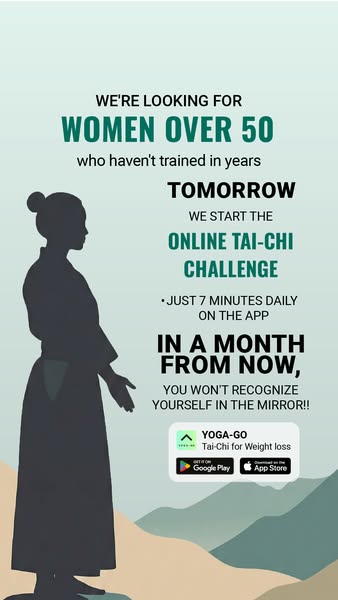
This ad promotes the Yoga-Go app, highlighting its Tai-Chi for weight loss program. It targets women over 50 who haven't trained in years, promising that they won't recognize themselves in the mirror after a month. It emphasizes the ease and accessibility of the program, noting that it requires just 7 minutes daily on the app, and encourages viewers to start tomorrow.
# Brand positioning
The brand Yoga-Go is positioned as an accessible and convenient fitness app, specializing in Tai-Chi for weight loss. The brand aims to occupy a space in the consumer's mind as a provider of easy and time-efficient workout routines. The values it promotes are centered around ease of use, accessibility through mobile devices, and the potential for noticeable results. The brand appears to push against the norm of time-consuming workout routines, offering a solution that fits into busy lifestyles, making fitness more attainable for older women. The brand positioning is functional, focusing on simplicity and performance with an emotional benefit of self-recognition and improved body image.
# Product
The product being advertised is the Yoga-Go app's Tai-Chi for Weight loss program. It is an online fitness program accessible through the app, designed for women over 50 who haven't trained in years. The ad states that the program requires just 7 minutes daily on the app. The USP is its time efficiency and the promise of significant transformation, with the tagline "YOU WON'T RECOGNIZE YOURSELF IN THE MIRROR!!" after a month. The ad highlights that the program starts tomorrow, creating a sense of immediacy and encouraging immediate action. Purchase barriers are addressed by emphasizing the short daily time commitment and accessibility through a mobile app, making it easy to integrate into daily routines. The advertisement emphasizes ease, convenience, and potential for visible results, encouraging viewers to try the program.
# Visual style
The ad features a clean and minimalist visual style, combining a silhouette illustration with a stylized mountain landscape. The color palette is soft and muted, creating a serene and calming atmosphere. The overall production quality is polished, with clear typography and a simple layout. The design mimics a modern app interface, with clearly defined sections and prominent app store badges. This style is designed to be easily scannable and attention-grabbing in a social media feed.
# Hooks
Headline: WE'RE LOOKING FOR WOMEN OVER 50 who haven't trained in years
# Benefits
- [object Object]
# Features
- [object Object]
- [object Object]
# Call to action
None used.
# Point of view
- [object Object]
# Storyline
- The ad begins by directly addressing its target audience: "WE'RE LOOKING FOR WOMEN OVER 50 who haven't trained in years." This serves to immediately capture the attention of a specific demographic and create relevance, positioning the brand as understanding the needs of this particular group. This part of the story is told from the brand's perspective, explicitly targeting their ideal customer.
- Next, the ad announces, "TOMORROW WE START THE ONLINE TAI-CHI CHALLENGE." This establishes a sense of urgency and immediacy, prompting viewers to take action now rather than later. It implies a community aspect to the challenge, making it more appealing to those who seek social support. This is again from the brand's perspective, promoting its offering.
- The ad clarifies, "• JUST 7 MINUTES DAILY ON THE APP." This aims to alleviate a common barrier to entry for fitness programs—time commitment—by showcasing the program's brevity and convenience, emphasizing ease of access and integration. This is from the brand's perspective, addressing potential concerns about time constraints.
- Finally, the ad culminates with, "IN A MONTH FROM NOW, YOU WON'T RECOGNIZE YOURSELF IN THE MIRROR!!" This is a bold, aspirational statement promising dramatic results. It appeals to the desire for self-improvement and transformation. It is from the brand's perspective, highlighting the potential impact of their program on the customer's life.
# Ad summary
This ad promotes the Yoga-Go app, specifically its Tai Chi program for beginners. It uses an attention-grabbing hook by contrasting walking with Tai Chi and highlighting benefits such as weight loss and improved well-being. The ad includes testimonials and a clear call to action to download the app.
# Brand positioning
Yoga-Go aims to be a user-friendly, accessible platform for individuals seeking to incorporate yoga and Tai Chi into their daily lives. The brand presents itself as a modern and convenient solution, emphasizing ease of use and tangible results like weight loss and stress reduction. With claims of accessible content for all levels, Yoga-Go positions itself against traditional fitness norms, offering a time-efficient approach to holistic well-being.
# Product
The advertised product is the Yoga-Go app, featuring a beginner-friendly Tai Chi program. The program promises to help users build strength and lose up to 23 pounds of belly fat with just 7 minutes a day. It's designed to reduce cortisol and stress, maintain longevity, improve flexibility, increase joint mobility, improve balance, and restore energy. Purchase barriers are addressed by highlighting its simplicity and time efficiency, suggesting that it can easily fit into a daily routine. The app offers guided Tai Chi lessons accessible on mobile devices, making it convenient for users to engage in the practice from anywhere.
# Visual style
The ad features a blend of natural outdoor settings and interior environments, suggesting that Tai Chi can be practiced anywhere. The production quality is fairly polished, creating a sense of credibility, and the editing uses quick cuts to maintain a brisk pace. The frequent display of the app interface also reinforces the product and its features. The ad cuts every 1-2 seconds. The cuts are timed with the text and music beats.
# Benefits
- [object Object]
- [object Object]
- [object Object]
- [object Object]
- [object Object]
- [object Object]
- [object Object]
- [object Object]
# Features
- [object Object]
- [object Object]
# Call to action
Download the app
# Point of view
- [object Object]
# Storyline
- 00:00–00:06 An Asian woman performs a standing yoga pose on a stone path surrounded by mountains.
- 00:00–00:06 The woman claims walking makes you old, but tai chi makes you young, so make it a habit. The perspective shifts from a natural outdoor landscape to the promise of health and longevity through this product. The tone is confident, aiming to intrigue the viewer with a contrarian statement and aspirational promise.
- 00:06–00:25 The ad transitions to scenes of various women doing tai chi in different settings, each paired with on-screen text.
- 00:06–00:16 The voiceover promotes the Tai Chi program for beginners starting on Monday May 25th, promising strength-building and weight loss of up to 23 pounds of belly fat in just 7 minutes a day. This is designed to quickly sell the benefits of Tai Chi to the target audience and entice them to sign up for the beginner program. The tone is enthusiastic and encouraging, implying that fitness is achievable for anyone, regardless of their current fitness level.
- 00:16–00:23 The ad assures viewers they'll feel the difference in one week and see it in two weeks, leading to turning heads by summer.
- 00:23–00:25 The ad encourages viewers to join the Tai Chi program starting Monday May 25th, with the question, "You in?"
- 00:25–00:31 The ad transitions to a digital interface showing the Yoga-Go app with scenes from the app.
- 00:26–00:31 A screen with the Yoga-Go logo encourages viewers to download the app, reinforcing the call to action and solidifying the product.
# Ad summary
This ad promotes Yoga-Go, framing Tai Chi as a short, calming workout designed for women who miss the energy they used to have. It highlights the benefits of feeling calmer, moving easier, and feeling steadier without the need for pushing or dieting, suggesting it is an effective and gentle fitness solution.
# Brand positioning
Yoga-Go is presented as an accessible fitness app focused on well-being, particularly aimed at women in different stages of life. The brand emphasizes gentle, calming workouts like Tai Chi, positioning itself as an alternative to high-intensity fitness programs. The brand uses a soft, nurturing tone and visuals that include nature and mature women to evoke tranquility and reassurance. This approach challenges the norm of aggressive workout culture and resonates with individuals seeking balance and self-care.
# Product
The advertised product is the Yoga-Go app, which provides access to a variety of yoga and pilates workouts, including Tai Chi. It is designed for users seeking well-being and gentle movement, particularly women who want to feel more energetic without strenuous activity. The app features easy-to-follow exercises and offers benefits like reduced cortisol, increased longevity, improved flexibility, joint mobility, and balance. The ad addresses potential purchase barriers by suggesting that the workouts are designed for different stages of life and do not require pushing or dieting, making it appealing to users who may have physical limitations or prefer a less intense exercise routine.
# Visual style
The ad has a polished commercial aesthetic. The color palette is soft and calming, dominated by blues. The editing is relatively slow with static shots and smooth transitions to support the relaxed and gentle tone. The production quality is high, lending a sense of professionalism and trustworthiness. The visuals consistently feature serene natural settings, reinforcing the theme of peace and well-being. The pacing is consistent at approximately 12 CPM.
# Benefits
- [object Object]
- [object Object]
- [object Object]
- [object Object]
# Features
- [object Object]
- [object Object]
# Call to action
Try Tai-Chi today.
# Point of view
- [object Object]
- [object Object]
# Storyline
- 00:00–00:02 The ad begins by addressing women who miss the energy they used to have.
- 00:03–00:09 It suggests trying a short, calming Tai Chi workout designed for their stage of life, positioning it as a solution.
- 00:10–00:16 The ad transitions to showcasing the benefits of this practice, such as feeling calmer and moving easier.
- 00:17–00:26 It elaborates on long-term benefits like feeling steadier physically and mentally, validated by testimonials from women who feel lighter without pushing or dieting.
- 00:27–00:33 The ad concludes with a call to action to try Tai Chi today, promoting the Yoga-Go app.
# Ad summary
This ad for Yoga-Go features a woman in her 50s/60s who talks about how she doesn't try to prove anything anymore, she just moves. She had been pushing herself through workouts that didn't feel right anymore and gave herself permission to move differently and found Tai Chi and the Yoga-Go app.
# Brand positioning
Yoga-Go is presented as a solution for women in their 50s and 60s who are done with traditional, intense workouts that no longer feel right for their bodies. The brand positions itself as a supportive and understanding alternative, offering Tai Chi and yoga classes tailored to meet the unique needs of women in this age group. By focusing on gentle, slow movements and personalized plans, Yoga-Go aims to empower women to prioritize their well-being without the pressure to push themselves beyond their limits. The brand aligns with values of self-acceptance, self-care, and moving differently, pushing against the norm of rigorous, high-impact workouts often marketed to younger demographics. The brand positioning is both functional (providing customized plans and gentle exercises) and emotional (offering permission to move in a way that feels good).
# Product
Yoga-Go is a mobile app that provides customized Tai Chi and yoga plans tailored for women in their 50s and 60s. The app starts with a few simple questions to understand the user's body and goals, then builds a personalized workout plan that does not require the user to plan workouts themselves. The ad explicitly highlights the slow, gentle nature of Tai Chi, emphasizing that it is enough for where the user is now. The app is presented as a way to move differently and to stop forcing oneself through workouts that no longer feel right. Yoga-Go addresses the pain point of feeling like the problem is the user, rather than the workout, and positions itself as a solution that allows the user to simply open the app and move. It offers the value proposition of being more than just a one-time thing, becoming a consistent part of the user's lifestyle.
# Visual style
The ad has a polished and authentic aesthetic. The editing style combines quick cuts during the exercise scenes to convey struggle and static shots during reflective moments to highlight the message. The production quality is high-end commercial, with a blend of lifestyle and aspirational visuals. The pacing varies, with faster cuts during the workout scenes and slower, more deliberate shots during the Tai Chi sequences. The cuts, text, and product actions are timed to the music and voiceover lines.
# Benefits
- [object Object]
- [object Object]
- [object Object]
- [object Object]
- [object Object]
- [object Object]
# Features
- [object Object]
- [object Object]
- [object Object]
- [object Object]
# Call to action
DOWNLOAD THE APP
# Point of view
- [object Object]
# Storyline
- 00:00–00:06 00:00–00:06 The ad begins with a woman in a red dress, looking at herself in the mirror. She states that women like her, in their 50s and 60s, move differently now, and they're done pretending they don't. This establishes the brand's target audience and sets the tone for the ad, suggesting a shift in perspective and self-acceptance.
- 00:06–00:12 00:06–00:12 The scene shifts to the same woman doing push-ups in her living room. She expresses being tired of pretending everything still worked the same way and pushing through workouts that just don't feel right anymore. This highlights the frustration and pain point that the brand addresses, conveying the idea that traditional workouts may not be suitable for everyone.
- 00:12–00:24 00:12–00:24 The woman continues to struggle with weights and then sits on the couch with a painful expression, stating that for a long time, she thought the problem was her, that she just wasn't trying hard enough. She then concludes that the truth is they already carry enough, so she stopped forcing it and gave herself permission to move differently. This demonstrates a shift in mindset, acknowledging the emotional and physical challenges of aging and the need for self-compassion.
- 00:24–00:29 00:24–00:29 The woman is then seen doing Tai Chi in her kitchen, and the woman says she found Tai Chi. She then says that it is slow, gentle, and enough for where she is now. This introduces Tai Chi as a gentle alternative to traditional workouts, conveying a sense of ease and acceptance.
- 00:29–00:36 00:29–00:36 The woman is outside, doing Tai Chi, and a phone appears in the frame showcasing the Yoga-Go app and the woman states that she found an app that doesn't ask her to figure everything out. She adds that it starts with a few simple questions, just to understand her body. This introduces the Yoga-Go app as a solution that simplifies the process of finding a suitable workout plan.
- 00:36–00:43 00:36–00:43 A new scene begins where she is on the beach doing Tai Chi while the Yoga-Go app is in the foreground of the shot. The woman states that from there, it builds a plan for her. She then says that she doesn't plan workouts anymore, she just opens the app and moves. This showcases the convenience and ease of use of the Yoga-Go app, suggesting that it removes the burden of planning and decision-making.
- 00:44–00:54 00:44–00:54 The ad returns to the woman in the red dress. She states that it's not a one-time thing, it's something that stays with her because she's done restarting. She adds that she doesn't think about working out anymore, and she doesn't try to prove anything. This reinforces the idea that the app is a long-term solution, conveying a sense of consistency and freedom from pressure.
- 00:54–00:59 00:54–00:59 The woman then says that she just moves, and the ad transitions to displaying the Yoga-Go app on a white background, along with a call to action to download the app. This serves as a final push, encouraging viewers to take action and try the app for themselves.
# Ad summary
This ad showcases the Yoga-Go app and its Tai Chi program, designed specifically for women seeking to regain their energy and improve their physical and mental well-being. The ad emphasizes the calming and accessible nature of Tai Chi, contrasting it with more strenuous workout routines and diets. It offers a way for women to feel lighter, steadier, and more natural in their movements, focusing on positive emotions and overall wellness.
# Brand positioning
Yoga-Go positions itself as a wellness app for women, offering programs like yoga and pilates with a focus on overall well-being. The brand aims to occupy a space of accessible and gentle movement, especially Tai Chi, that doesn't require pushing or dieting. The brand promotes a lifestyle of feeling lighter, steadier, and more natural in movements, targeting women who miss the energy they used to have. Yoga-Go aligns with a tone of calmness, motivation, and mental wellness, pushing against the norms of strenuous workouts by offering a gentler alternative.
# Product
Yoga-Go is presented as a mobile app offering yoga, pilates, and specifically Tai Chi programs designed for women. The app's Tai Chi program aims to help women regain their energy and feel calmer, easier, and more natural in their movements. It focuses on reducing cortisol, maintaining longevity, improving flexibility, and increasing joint mobility. The app is designed for all stages of life, offering a way to feel lighter in their bodies without pushing or dieting. The unique selling points are the gentle nature of Tai Chi and its mental and physical health benefits, making it accessible for those who may not prefer intense exercise routines. The app targets potential purchase barriers by offering an exercise format that promotes well-being without strenuous exertion.
# Visual style
The ad has a polished commercial aesthetic with a blend of natural light and enhanced visuals. The editing style features smooth transitions, maintaining a calm and consistent pace, which aligns with the gentle nature of the Tai Chi. The production quality is high, giving it a professional feel. The color palette consists of warm tones from the sunset, creating a soothing and inviting atmosphere. The cuts are timed to match the flow of the voiceover, enhancing the overall message and intended calming effect.
# Benefits
- [object Object]
- [object Object]
- [object Object]
- [object Object]
# Features
- [object Object]
- [object Object]
# Call to action
Try Tai-Chi today.
# Point of view
- [object Object]
- [object Object]
# Storyline
- 00:00–00:03 00:00–00:03 A woman is seen in a Tai Chi position at sunset, establishing a calm and serene setting. The voiceover speaks directly to women who miss the energy they used to have, creating an empathetic connection and framing the ad from the audience's perspective.
- 00:03–00:09 00:03–00:09 The ad introduces a short, calming Tai Chi workout designed for the viewer's stage of life, shifting to a brand perspective that promotes their product as a tailored solution.
- 00:10–00:16 00:10–00:16 The ad shows the Yoga-Go app interface alongside the woman doing Tai Chi, illustrating the benefits. This section shifts to an educational tone, explaining that users will feel calmer and have easier, more natural movements. The ad's perspective emphasizes tangible benefits to build trust.
- 00:16–00:25 00:16–00:25 The ad continues to highlight the benefits of Tai Chi, mentioning feeling steadier physically and mentally. It introduces a testimonial-like statement that women feel lighter in their bodies without pushing or dieting. This uses a customer's perspective to build credibility and reinforce the gentle approach.
- 00:26–00:28 00:26–00:28 The woman is seen continuing the exercise along with text indicating "Try Tai-Chi today." The ad then transitions to showing the Yoga-Go app user interface and highlights the app and how it is to be used by the user.
- 00:29–00:33 00:29–00:33 The Yoga-Go app is advertised showing what to expect from the app after installation to the customer.

# Ad summary
This ad promotes a Tai-Chi program for women who want to look and feel 20 years younger. It highlights a 7-minute Tai-Chi challenge that can reverse the signs of aging, help lose stubborn belly fat, and tone the body.
# Brand positioning
This ad does not explicitly promote a specific brand. Instead, it focuses on the benefits and outcomes of practicing Tai-Chi, positioning it as a way to reverse the signs of aging and achieve a younger, more energetic self. The ad aligns with values of health, wellness, and self-improvement, seemingly targeting women who are interested in natural and holistic approaches to looking and feeling younger. It does not explicitly mention competitors, but implicitly pushes against the need for more invasive or costly anti-aging treatments, favoring a natural, accessible, and empowering approach.
# Product
The featured product is a Tai-Chi program designed for women. It is presented as a 7-minute challenge aimed at reversing the signs of aging, losing up to 11 kg of stubborn belly fat, and toning the body for the summer. The program promises to restore energy within a week, make clothes fit noticeably differently in two weeks, and make users look 20 years younger in a month. The ad addresses the purchase barriers of time commitment and skepticism by emphasizing the short duration of the challenge and the tangible results that can be achieved in a relatively short period.
# Visual style
The ad employs a paper-cut aesthetic, giving it a handcrafted and visually appealing feel. The muted color palette and layered paper textures create depth and dimension. The use of floral and avian elements adds a touch of nature and serenity. The overall effect is calming and inviting, suggesting a holistic and gentle approach to wellness.
# Hooks
Headline: Tai-Chi-Programm
# Benefits
- [object Object]
- [object Object]
- [object Object]
- [object Object]
- [object Object]
- [object Object]
# Features
- [object Object]
# Call to action
JETZT AUSDRUCKEN
# Point of view
- [object Object]
# Storyline
- The ad opens by declaring the offering as a "Tai-Chi-Programm" that is "AUSDRUCKBAR", setting the intention of offering a downloadable program. The perspective is from the brand or program provider, introducing the product and its availability.
- The ad specifies who the program is for: "FÜR FRAUEN, DIE 20 JAHRE JÜNGER AUSSEHEN UND SICH AUCH SO FÜHLEN WOLLEN", clarifying the target audience and desired outcome. This is the brand speaking, setting the promise of the program's transformative effects.
- The ad transitions into a motivational statement: "ES GEHT DARUM, SICH ENDLICH WIEDER WIE MAN SELBST ZU FÜHLEN - STARK, LEICHT, VOLLER ENERGIE", framing the program as a way to reconnect with one's best self. The perspective remains from the brand, emphasizing the emotional benefits of the program.
- The ad highlights the immediate action available: "DIESEN MONTAG" and describing the challenge by stating: "Wir starten eine 7-Minuten Tai-Chi-Challenge, um Alterserscheinungen umzukehren, bis zu 11 kg hartnäckiges Bauchfett zu verlieren und deinen Körper bis zum Sommer zu straffen", introducing the specifics of the program and its benefits. This is again the brand speaking, detailing the program's practical aspects and expected results.
- The ad emphasizes the quick benefits from use by saying: "In einer Woche kehrt deine Energie zurück In zwei Wochen sitzt deine Kleidung spürbar anders In einem Monat wirst du 20 Jahre jünger aussehen", building anticipation and demonstrating the potential timeline for achieving the advertised results. This is from the perspective of the brand, reinforcing the tangible benefits.
- Finally, the ad includes a call to action: "JETZT AUSDRUCKEN", encouraging immediate engagement with the program. The perspective remains from the brand, prompting the viewer to take the next step.
# Ad summary
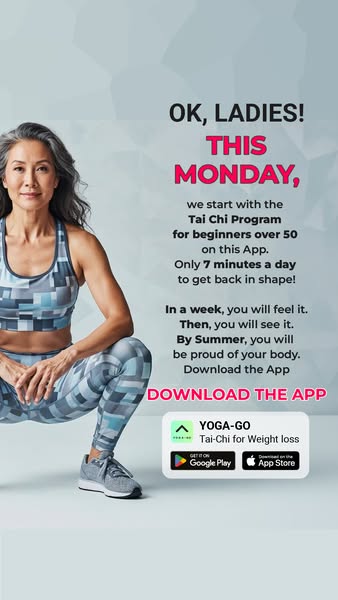
This ad promotes the Yoga-Go app, specifically highlighting a Tai Chi program designed for beginners over 50. The ad promises visible results by summer with only 7 minutes a day.
# Brand positioning
Yoga-Go is presented as a convenient and accessible fitness solution. The app provides targeted workout programs, like Tai Chi, suitable for older adults. It emphasizes ease and efficiency with short daily routines designed to fit into busy schedules. The brand aims to occupy a space in the consumer's mind as a user-friendly fitness app that delivers tangible results and promotes a healthy lifestyle. It positions itself as a modern approach to fitness that fits a senior's fitness level and lifestyle. Yoga-Go appeals to the mature target demographic's values of health, wellness, and confidence.
# Product
The advertised product is the Yoga-Go app, featuring a Tai Chi program designed specifically for beginners over 50. This program requires only 7 minutes a day to 'get back in shape.' The ad promises visible results, stating 'In a week, you will feel it. Then, you will see it. By Summer, you will be proud of your body.' The primary selling point is the combination of Tai Chi, a gentle form of exercise, with the accessibility of a mobile app, making fitness convenient and approachable for older adults. The ad addresses the common purchase barriers of time commitment and difficulty, offering a quick and easy solution to improve physical well-being.
# Visual style
The ad has a clean and simple aesthetic. The image is well-lit, with a focus on clarity and simplicity. The color palette is soft and muted, dominated by light grays and whites, with pops of color in the text and app icons. The overall impression is modern and approachable, designed to appeal to an older demographic seeking gentle and effective fitness solutions. It appears to be shot in a studio with a focus on the subject and product, and utilizes minimal background distractions to keep the focus on the product and target user.
# Hooks
Headline: OK, LADIES! THIS MONDAY,
# Benefits
- [object Object]
- [object Object]
- [object Object]
- [object Object]
# Features
- [object Object]
- [object Object]
- [object Object]
# Call to action
DOWNLOAD THE APP
# Point of view
- [object Object]
# Storyline
- The ad opens with an invitation: 'OK, LADIES! THIS MONDAY,'. The brand announces when a Tai Chi Program for beginners over 50 is set to begin. The message seeks to capture the audience's attention and create anticipation for a fitness journey that is about to start, specifically speaking directly to women. The use of 'THIS MONDAY' adds a sense of immediacy and encourages viewers to act quickly.
- The brand highlights the key features and benefits of the program: 'we start with the Tai Chi Program for beginners over 50 on this App. Only 7 minutes a day to get back in shape!'. The message intends to convey convenience and accessibility, emphasizing that the program is designed for beginners and requires a minimal time commitment.
- The brand presents a timeline for expected results: 'In a week, you will feel it. Then, you will see it. By Summer, you will be proud of your body.'. The message aims to build confidence and motivation by promising tangible improvements in a relatively short period, culminating in a positive emotional payoff by summer.
- The brand issues a direct call to action: 'Download the App'. The message prompts the viewer to take the next step and begin their fitness journey by downloading the Yoga-Go app.
# Ad summary
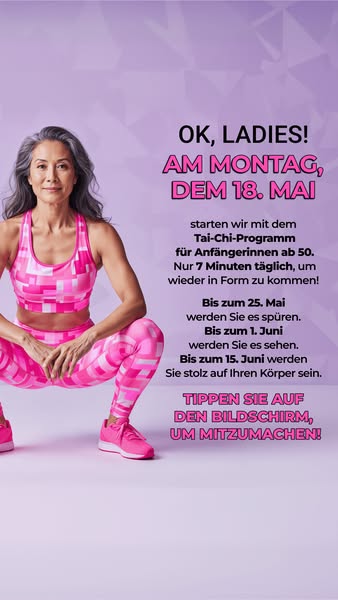
This ad promotes a Tai-Chi program for beginners over 50 years old, starting on Monday, May 18th. The ad highlights that just 7 minutes daily is needed to get back in shape and encourages users to tap on the screen to join.
# Brand positioning
This brand is positioned as a convenient and accessible fitness solution tailored for women over 50, specifically beginners in Tai-Chi. The brand presents itself as a gentle yet effective way to get back in shape with minimal time commitment. The brand aligns with a lifestyle that values well-being, ease, and positive body image, pushing against the norm of intense or time-consuming workouts often promoted in the fitness industry. The brand's positioning is both functional, emphasizing the efficiency and ease of their Tai-Chi program, and emotional, fostering feelings of pride and accomplishment in one's body.
# Product
The product is a Tai-Chi program designed for beginners over 50 years old. It is presented as a simple and time-efficient way to get back in shape, requiring only 7 minutes daily. The program aims to make users feel its effects by May 25th, see results by June 1st, and feel proud of their bodies by June 15th. The advertisement addresses potential purchase barriers by emphasizing the short daily time commitment and targeting beginners, suggesting ease of use and quick results. The ad encourages viewers to tap the screen to join the program.
# Visual style
The ad has a clean and polished studio-shot aesthetic. The visual motifs are simple and uncluttered, with a focus on clear typography and a single focal point of the woman in activewear. The image treatment includes soft, diffused lighting and color grading that leans towards pinks and purples, which helps to create a positive vibe. The typography is integrated in a large and bold style, making it highly scannable. The ad appears to mimic the current platform-native styles, designed to be easily viewed in-feed and capture attention quickly.
# Hooks
Headline: OK, LADIES!
AM MONTAG,
DEM 18. MAI
# Benefits
- [object Object]
- [object Object]
- [object Object]
- [object Object]
# Features
- [object Object]
- [object Object]
- [object Object]
# Call to action
TIPPEN SIE AUF
DEN BILDSCHIRM,
UM MITZUMACHEN!
# Point of view
- [object Object]
# Storyline
- The ad opens by directly addressing 'LADIES!' and announcing the start date of the program as Monday, May 18th. The brand is using direct communication to grab the viewer's attention and set the stage for what's to come.
- The program is introduced as a Tai-Chi program for beginners over 50, emphasizing that just 7 minutes daily is needed to get back in shape! The brand is positioning itself as a practical solution for getting back in shape with minimal time commitment.
- The ad promises specific results over time, stating that by May 25th, users will feel the effects, see results by June 1st, and feel proud of their bodies by June 15th. The brand is building anticipation for the product by creating a visual depiction of results within a defined time frame.
- The ad concludes with a call to action: 'TIPPEN SIE AUF DEN BILDSCHIRM, UM MITZUMACHEN!' The brand uses this to prompt viewers to engage with the ad and explore the program further.

# Ad summary
This Meta image ad encourages women to start taking tai chi classes. The text emphasizes that it only takes 7 minutes a day to start and that results will be seen quickly, within a week or two.
# Brand positioning
The brand is presented as offering Tai Chi classes specifically for women. There is a focus on the ease and accessibility of the classes, emphasizing that they can be done at home in just 7 minutes a day. The brand aims to position itself as a convenient solution for women looking to improve their physical and mental well-being through Tai Chi, with the claim of visible results in a short timeframe. The overall tone is encouraging and inviting, suggesting a path to personal growth and wellness through their program.
# Product
The product advertised is an invitation to join Tai Chi classes designed specifically for women. The classes are structured to require only 7 minutes of daily practice, making them accessible and easy to fit into a busy schedule. The unique selling proposition is the promise of tangible results in a short amount of time: feeling the change in the body within one week, seeing a perfect difference in two weeks, and experiencing a blooming transformation within a month. The ad directly addresses the potential barrier of time commitment by emphasizing the minimal time investment required, making the classes appealing to those who may feel they don't have enough time for traditional exercise routines.
# Visual style
The ad has a vibrant, digitally enhanced aesthetic, with blue and orange gradients giving it a modern and eye-catching look. The image appears to be studio-shot with a focus on the woman in the foreground, while the background is blurred to keep the attention on the main subject. The typography is large and bold to ensure scannability, and the overall design breaks from typical norms with its high contrast and color treatment.
# Hooks
Headline: START TAI CHI FOR WOMEN
# Benefits
- [object Object]
- [object Object]
- [object Object]
# Features
- [object Object]
# Call to action
JUST PRINT IT NOW
# Point of view
- [object Object]
# Storyline
- The ad starts with a question, "Do you think it's too late to get ready for summer?" to grab the viewer's attention and address a common concern about preparing for the summer season. The brand is asking this question to make the viewer think about their goals.
- The ad declares, "START TAI CHI FOR WOMEN." This is the core offering, highlighting the product and its specific target demographic. The brand is emphasizing its primary offering: Tai Chi classes designed for women.
- The ad explains, "Do 7 minutes of Tai Chi at home. Join us starting May 11*." This provides practical details about the program, emphasizing the convenience and the start date. The brand is conveying the ease of integrating Tai Chi into daily life.
- The ad continues with the benefits, stating, "In one week you'll feel the change in the body. In two weeks - see the perfect difference. In a month you will be blooming." This sequence promises quick and visible results, creating excitement. The brand is building anticipation for the potential positive transformations.
- The ad ends with a call to action, "JUST PRINT IT NOW," prompting immediate action. The brand is directly encouraging the viewer to take the next step and engage with the program.
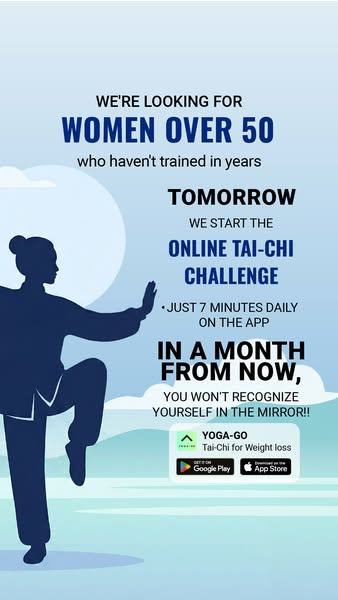
# Ad summary
This image ad promotes Yoga-Go's online Tai-Chi challenge for women over 50 who haven't trained in years. It promises that participants who dedicate just 7 minutes daily on the app will experience a transformative change, suggesting they 'won't recognize yourself in the mirror' within a month. The ad aims to encourage older women to engage in a manageable fitness routine, highlighting ease and accessibility.
# Brand positioning
Yoga-Go is presented as an accessible fitness platform, specializing in Tai-Chi programs designed for weight loss. The brand positions itself as beginner-friendly, targeting individuals—particularly women over 50—who are new to fitness or returning after a long break. With the promise of noticeable results in a short time frame, Yoga-Go focuses on convenience, ease, and empowerment through manageable daily routines. The brand distinguishes itself by offering specialized Tai-Chi programs, a niche within the broader fitness app market, which could appeal to those seeking low-impact, mindful exercise options.
# Product
The featured product is Yoga-Go's online Tai-Chi challenge, designed for weight loss, accessible via the Yoga-Go app. The challenge is presented as a beginner-friendly program for women over 50 who haven't trained in years, requiring only 7 minutes of daily commitment. The unique selling proposition (USP) lies in its short duration and accessibility, addressing potential barriers like lack of time and fitness experience. The ad creates an anticipation of transformative results within a month, promising a visible change in appearance. The product is positioned as a low-impact, convenient way to re-engage in fitness, specifically tailored for older women seeking weight loss.
# Visual style
The ad features a clean and minimalist visual style. The design uses a limited color palette and relies on flat vector graphics to communicate its message. The use of a silhouette against a soft, gradient background gives a sense of serenity and approachability, which aligns with the low-impact nature of Tai-Chi. The ad has a platform-native feel, designed to be easily scannable and eye-catching in a mobile feed.
# Hooks
Headline: WE'RE LOOKING FOR WOMEN OVER 50 who haven't trained in years
# Benefits
- [object Object]
# Features
- [object Object]
- [object Object]
# Call to action
None used.
# Point of view
- [object Object]
# Storyline
- The ad opens by directly addressing the viewer, stating, "WE'RE LOOKING FOR WOMEN OVER 50 who haven't trained in years," immediately capturing the attention of the intended audience. This message is from the brand and is designed to be relevant to the viewer.
- The ad introduces a time-bound offer, stating "TOMORROW WE START THE ONLINE TAI-CHI CHALLENGE," creating a sense of urgency and prompting immediate action. This message is from the brand and is meant to create excitement for the viewer to sign up for the challenge.
- The ad highlights the program's simplicity and convenience, emphasizing ". JUST 7 MINUTES DAILY ON THE APP," to address concerns about time commitment. This message is from the brand, and it intends to make it seem easy to the user to sign up.
- The ad promises a dramatic transformation, stating "IN A MONTH FROM NOW, YOU WON'T RECOGNIZE YOURSELF IN THE MIRROR!!," appealing to the viewer's desire for self-improvement. This message is from the brand. The message intends to convince the viewer that they will improve themselves.
How Other Sports & Fitness Brands Advertise on Meta
Peer brands in Motion's library — click any brand to see their creative strategy, live ads, and AI breakdowns.