

# Ad summary
This video is an ad for UNICEF. The ad is trying to build awareness for the brand and that the organization is seeking funding to help children around the world.
# Brand positioning
UNICEF is presented as a global humanitarian organization that has been working for over 75 years to provide life-saving services to children in crisis around the world. The ad aligns the brand with values of compassion, support, and proactive intervention to protect the rights and futures of vulnerable children. It emphasizes a functional approach focused on delivering essential resources like education, healthcare, nutrition, and clean water. By showcasing diverse initiatives and partnerships across various countries, the brand reinforces its worldwide presence and dedication to improving the lives of children in need, positioning itself as a reliable and effective entity in the humanitarian aid sector.
# Product
The ad promotes UNICEF's mission and calls for predictable, flexible, and multi-year funding. The organization has provided services around the world for over 75 years for life-saving programs that the ad shows include education, healthcare, nutrition, and clean water. The ad mentions that a lack of funds allocated to vital programs forces them to make impossible choices. By investing in girls and boys, UNICEF's mission is to build a safer and brighter future for every child.
# Visual style
The ad combines older photos and videos with new footage to showcase how long UNICEF has provided life-saving services. The ad incorporates quick cuts throughout. Production quality is very polished. Audio and video sync to the music track throughout the video.
# Benefits
- [object Object]
- [object Object]
- [object Object]
- [object Object]
# Features
- [object Object]
- [object Object]
- [object Object]
- [object Object]
- [object Object]
- [object Object]
# Call to action
None used.
# Point of view
- [object Object]
- [object Object]
# Storyline
- 00:00–00:10 00:00–00:10 The ad opens with a close-up of a person's eye before transitioning into a split-screen format. The video shows children in a classroom using tablets, juxtaposed with a man on a motorized hang glider. The speaker poses a series of impossible choices that the audience must make to live a healthy life.
- 00:10–00:18 00:10–00:18 The ad shows a series of locations and people packing aid supplies in preparation to be sent out.
- 00:18–00:30 00:18–00:30 The video shows images of crisis and devastation as a result of war.
- 00:30–00:48 00:30–00:48 The video transitions to a 16-year-old girl explaining that she was devastated to learn that her twin brother had passed away. Next, another girl, Tibyan, explains that she does not have security.
- 00:48–00:57 00:48–00:57 The ad shows images from the organization's history as it continues its life-saving work.
- 00:57–01:14 00:57–01:14 A doctor states that the budget cuts are threatening the organization's mission. The video shows more images of life-saving operations.
- 01:14–01:30 01:14–01:30 The speaker explains that with support from parents, communities, and partners, the organization will continue to build a safer and brighter future for every child.
How UNICEF France Advertises on Meta
Refreshed 6 weeks ago · Weekly refresh cadence
UNICEF France runs 60 active ads on Meta, shipping ~5 new creatives per week. Their library leans on Montage20%, Statistic13%, and Behind The Scenes8%. Recently, unicef france is pushing hard on monthly recurring donations at the €10 price point, anchoring the ask around tangible outcomes like clean water access and malnutrition treatment. They're leaning heavily on celebrity ambassadors (Beckham's 50th birthday fundraiser, Liam Neeson on South Sudan) to lend credibility and emotional weight, while geographically they're spotlighting Gaza reconstruction and broader humanitarian crises as parallel narratives of urgency and hope. The through line is systemic impact framing,positioning unicef not as ad hoc charity but as the infrastructure behind every child's recovery, with before/after proof points and scale stats (430 million children treated) to justify the recurring commitment.
Indexed by Motion's Inspo Library.
The 20 Most Recent UNICEF France Ads on Meta
# Ad summary
This ad focuses on the issue of water scarcity and unsanitary water. It uses visuals of people fetching water and then transitions to visuals of new ways to access clean water. The ad ends with an ask to donate 10 euros per month to provide drinking water access.
# Brand positioning
The ad features UNICEF, an organization that is focused on providing resources to children to ensure they have access to resources like water. The ad positions UNICEF as an organization that has the ability to provide clean water to others, and that viewers can help with only 10 euros per month.
# Product
This ad highlights access to clean drinking water. The ad shows individuals collecting water from muddy streams or dirty areas, and then contrasts these visuals with clean water being poured from a spigot. The product featured is access to this clean drinking water, and the ad is showing that UNICEF can provide this resource. The donation will help provide drinking water access.
# Visual style
The ad has a simple, straightforward aesthetic. It combines footage of the problem with a simple solution. The editing style has quick cuts and smooth transitions. The production quality has a mix of raw visuals of water collection, along with a more polished finish with the clean water and overlays. The pacing is fairly quick to keep the viewers attention. The visuals and text are timed together for maximum impact.
# Benefits
- [object Object]
- [object Object]
# Features
- [object Object]
# Call to action
None used.
# Point of view
- [object Object]
# Storyline
- 00:00–00:02 The ad starts with text stating '844 children die each day.' The text then quickly changes to '1000 children die each day.'
- 00:00–00:02 The number change is meant to shock the viewer and introduce the topic of the ad.
- 00:00–00:02 This is the brand speaking.
- 00:00–00:02 The text is in a simple font on a black background.
- 00:02–00:03 The ad then transitions to a visual of a woman collecting water from a muddy stream.
- 00:02–00:03 This visual shows the problem that the ad is aiming to solve.
- 00:02–00:03 This is a third person perspective of a woman collecting water.
- 00:03–00:04 The ad continues with text, stating '... Because of unsanitary water'.
- 00:03–00:04 This text states the cause of the child deaths.
- 00:03–00:04 The text is in a simple font on a black background.
- 00:04–00:06 The ad transitions to two children filling up yellow jugs with clean water.
- 00:04–00:06 This visual shows the clean water that can be accessed.
- 00:06–00:07 The ad shows a closer view of water being filled up, and then an overlay stating 'With 10 euros/month, give access to drinking water'.
- 00:06–00:07 This visual emphasizes that clean water is being filled.
- 00:07–00:09 The ad shifts to a woman kneeling down and helping a child fill up a water container.
- 00:07–00:09 The water is coming from a large blue drum.
- 00:07–00:09 The text overlay states 'I give 10 euros per month'.
- 00:07–00:09 This overlay is meant to encourage the viewer to donate.
# Ad summary
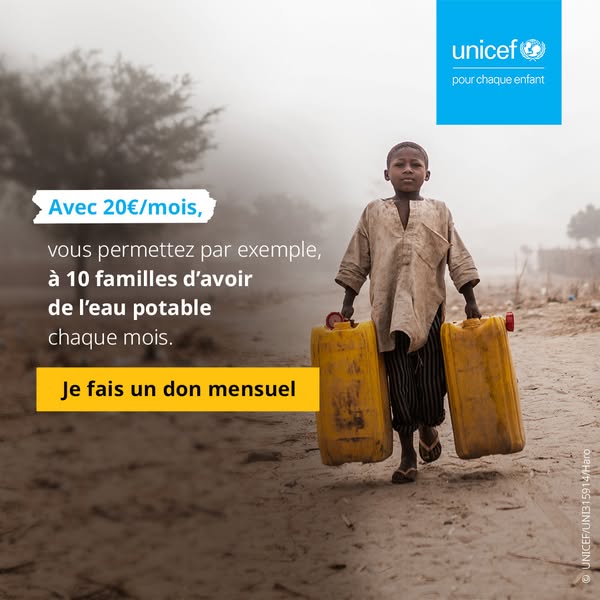
This image ad is promoting UNICEF and asking for monthly donations. The ad features a young person carrying containers of water, highlighting the importance of access to clean water.
# Brand positioning
UNICEF is presented as a global humanitarian organization dedicated to providing aid and support to children worldwide. The brand positions itself as a reliable and impactful entity that enables individuals to contribute to meaningful change. By focusing on providing essential resources like clean water, UNICEF aims to alleviate suffering and improve the quality of life for vulnerable children and families. The brand emphasizes transparency and accountability, assuring donors that their contributions will directly address critical needs and make a tangible difference.
# Product
The ad promotes monthly donations to UNICEF. By donating 20€ per month, donors enable UNICEF to provide clean water to 10 families each month. The ad aims to address the purchase barrier by showcasing the direct impact of a recurring donation.
# Visual style
The ad uses a documentary-style photograph with a slightly desaturated color palette, emphasizing the harsh environment. The UNICEF logo in the top right is clean and modern, providing a contrast to the gritty photograph. The use of a real-life image aims to convey authenticity and urgency, creating a stark contrast to the branded logo. The overall effect is designed to be impactful and encourage viewers to take action.
# Hooks
Headline: Avec 20€/mois, vous permettez par exemple, à 10 familles d'avoir de l'eau potable chaque mois.
# Benefits
- [object Object]
# Call to action
Je fais un don mensuel
# Point of view
- [object Object]
# Storyline
- The ad begins by stating that with 20€/month, a donor enables 10 families to have clean water each month. This message is intended to show the direct impact of a monthly donation from the perspective of UNICEF.
- The ad encourages viewers to take action by providing a button that reads, "Je fais un don mensuel" (I make a monthly donation). The intention here is to make it easy for users to become monthly donors, presented from the brand's perspective.
# Ad summary
This ad features a man standing in a ravaged area of Gaza. He speaks about the devastation but is optimistic and highlights the progress being made to rebuild schools and medical facilities to aid the people of Gaza.
# Brand positioning
UNICEF is presented as an organization that provides essential services to children in need. The ad highlights UNICEF's efforts to rebuild schools and healthcare facilities in Gaza, emphasizing the organization's commitment to helping children in crisis situations. The brand aims to occupy a space of trust and reliability in the consumer's mind, aligning with values of compassion, hope, and positive change. UNICEF positions itself as a functional and emotional brand by providing tangible aid while also fostering a sense of hope and community.
# Product
The product being advertised is UNICEF's humanitarian work in Gaza. The ad showcases the organization's efforts to rebuild schools and healthcare facilities for children and families affected by conflict. It emphasizes providing essential services like education, maternal healthcare, child health, and immunization. The primary USP is that these rebuilt facilities are the only ones available in Jabalia, northern Gaza. The ad targets potential donors by highlighting the urgent need for support to continue providing these services and ensure the well-being of the people of Gaza. It addresses the purchase barrier of uncertainty by showing tangible progress and a clear need for continued support.
# Visual style
The ad has a documentary-style aesthetic. The production quality is raw, with handheld camera shots and natural lighting, giving it a sense of authenticity. Editing is straightforward with simple transitions between shots, maintaining a consistent pace throughout. The visual style supports the tone by creating a sense of urgency and reality, emphasizing the need for support.
# Benefits
- [object Object]
- [object Object]
- [object Object]
- [object Object]
# Features
- [object Object]
- [object Object]
# Call to action
FAITES UN DON
# Point of view
- [object Object]
# Storyline
- 00:00–00:02 00:00–00:02 The ad opens with a wide shot of a demolished city. A man acknowledges the devastation but hints at upcoming progress.
- 00:02–00:04 00:02–00:04 A bulldozer clears rubble, and men carry construction materials. The ad presents the beginning stages of reconstruction.
- 00:04–00:07 00:04–00:07 The man stands with the destruction in the background, and describes what progress with UNICEF looks like.
- 00:07–00:10 00:07–00:10 A shot of tents with destroyed buildings in the background. The man talks about classrooms serving thousands of children.
- 00:11–00:16 00:11–00:16 An indoor shot of people in a tent. The man discusses maternal and child health, as well as immunization.
- 00:17–00:23 00:17–00:23 The man stands with destruction in the background, and mentions that these are the only classrooms and healthcare in northern Gaza.
- 00:23–00:27 00:23–00:27 Men in Gaza work together to rebuild. The man states that they will continue to build with the people of Gaza.
- 00:28–00:35 00:28–00:35 Text on a black background describes the need for essentials in Gaza.
- 00:35–00:39 00:35–00:39 A mouse clicks on a blue button that says, "Faites un don."
- 00:39–00:45 00:39–00:45 The UNICEF logo appears on a blue background.
# Ad summary
This UNICEF ad features David Beckham as he reflects on his 50th birthday and how he has had many opportunities and experiences that have shaped him. Beckham announces that he is launching a fundraising appeal and has asked his friends, family, and partners to get involved. He shares stories from some of the girls UNICEF has supported, and their hopes for the world in their own words, because they deserve to be seen and heard. Beckham asks viewers to help children around the world dream bigger, and give them the opportunity to make those dreams a reality.
# Brand positioning
This ad positions UNICEF as an organization dedicated to helping children around the world, especially girls, have access to education, safety, health, and opportunities. It communicates that UNICEF's values align with providing support to vulnerable children and helping them to see their dreams come to fruition. UNICEF is presented as pushing against the norms of a global funding crisis and hoping to make a change in the lives of vulnerable children by providing support.
# Product
This ad is promoting donations to UNICEF to help vulnerable children around the world. The ad does not include information about the specific mechanics of how the donations are used, but focuses on making sure girls are seen and heard and are given the opportunity to make their dreams a reality. The ad implies that a contribution to UNICEF can provide children access to education, safety, health, and opportunities. The ad encourages the audience to give so that children are able to dream bigger and have the opportunity to make their dreams a reality.
# Visual style
This ad has a polished feel, with a mix of close-up shots of girls and David Beckham speaking to the camera. There are quick cuts and smooth transitions that transition between him speaking and footage of vulnerable children. The pacing is consistent and works well with the audio.
# Call to action
None used.
# Point of view
- [object Object]
# Storyline
- 00:00–00:08 00:00–00:08 This is David Beckham standing in front of a grey background talking about how this year he turned 50, which has made him reflect on the opportunities he's had.
- 00:08–00:17 00:08–00:17 Beckham transitions to talking about how the world is a very tough place for children, more children are in need and at risk than any time in recent history.
- 00:17–00:26 00:17–00:26 Beckham is heard stating that girls who are already struggling are now facing even greater obstacles to education, safety, health, and opportunity.
- 00:26–00:32 00:26–00:32 Beckham goes on to state that we are in the midst of a global funding crisis and the most vulnerable children are shouldering the burden.
- 00:32–00:38 00:32–00:38 Beckham is now seen in front of a grey background where he announces that he's launching a fundraising appeal and has asked his friends, family, and partners to get involved.
- 00:38–00:48 00:38–00:48 Beckham is now heard stating that he'll be sharing stories from some of the girls UNICEF have supported, and their hopes for the world in their own words, because they deserve to be seen and heard.
- 00:48–00:56 00:48–00:56 Beckham concludes by saying that he wants to help children around the world dream bigger, and give them the opportunity to make those dreams a reality. The ad ends with the UNICEF logo displayed.
# Ad summary
This ad for UNICEF features Liam Neeson discussing the need for UNICEF in South Sudan. He shares the story of a mother and her child that was recovering from malnutrition, and points out that every child that recovers has a system in harmony behind them. He asks viewers to donate to UNICEF because they save lives.
# Brand positioning
UNICEF is an international non-profit organization dedicated to providing humanitarian aid and developmental assistance to children worldwide. The organization positions itself as a global leader in advocating for children's rights, providing essential services such as healthcare, nutrition, education, and protection from violence and exploitation. The ad highlights UNICEF's commitment to delivering supplies, care, and support to help children survive and recover from crises. The organization aligns with values of compassion, social responsibility, and global citizenship, aiming to create a world where every child has the opportunity to thrive, regardless of their circumstances or location. UNICEF exists to combat the systems and practices that put children at risk, especially in places with few resources.
# Product
The ad promotes charitable donations to UNICEF. The donation provides supplies, care, and support that children need to survive and recover from famine, disease, and displacement. UNICEF provides health, nutrition, and water services to families in need around the world, and every donation helps to save lives by supporting these services. The ad's focus is to convince viewers to donate.
# Visual style
The overall aesthetic of the ad is a hybrid of polished commercial and documentary-style footage. The production quality is high, with clear visuals and well-composed shots. The editing rhythm is relatively smooth, with occasional quick cuts to maintain viewer engagement. The pacing shifts slightly across the ad, with slower moments during personal stories and quicker cuts during montages of UNICEF's work. There are no noticeable audio-visual sync effects.
# Benefits
- [object Object]
- [object Object]
- [object Object]
# Features
- [object Object]
- [object Object]
- [object Object]
- [object Object]
- [object Object]
- [object Object]
# Call to action
Donate today
# Point of view
- [object Object]
# Storyline
- 00:00–00:07 Liam Neeson introduces himself and states that it is difficult to explain what it feels like to be in South Sudan.
- 00:07–00:18 Neeson states that South Sudan is an area where complex crises are unfolding, where children are facing sickness, hunger, and displacement.
- 00:18–00:35 Neeson discusses Ajiier, a mother who was relieved that her baby was recovering from severe malnutrition. Ajiier said that she wants her child to grow up healthy and be educated.
- 00:35–00:48 Neeson discusses Ruth, the UNICEF head of nutrition, who stated that behind every healed child, there is a system that is working in harmony with health, nutrition, and water services.
- 00:48–00:57 Neeson states that every single donation makes a difference. He says that he's seen it, felt it, and believes in it.
- 00:57–01:04 Neeson says you're giving a child another chance, and you are giving a mother hope.
- 01:04–01:19 Neeson closes by saying you're helping UNICEF deliver supplies, care, and support that children need to survive and recover. He asks that people donate today, because a donation really helps to save lives.
# Ad summary
This ad by UNICEF brings awareness to the importance of clean drinking water for children around the world and encourages viewers to become monthly donors.
# Brand positioning
UNICEF is presented as a humanitarian organization dedicated to helping children around the world. The brand strives to make a difference in the lives of children, particularly those in areas where clean water is scarce. The brand is associated with providing essential resources to children in need and encourages viewers to support their mission. The positioning is emotional and functional, highlighting the importance of clean water for children's health and well-being.
# Product
The ad focuses on clean drinking water for children in areas where it's scarce. It highlights the importance of clean water for preventing the spread of diseases and emphasizes that access to it can significantly change lives. The ad also showcases a purification tablet as a simple solution to make water safe for drinking. It encourages viewers to support UNICEF's efforts to provide clean water to children by becoming monthly donors. The ad aims to address the barrier of accessibility to clean water by presenting purification methods and rallying viewers to support the cause.
# Visual style
The ad has a documentary-style feel. It has clear transitions between cuts. The production quality looks like a hybrid between UGC and a polished commercial. The pacing of the ad is quick.
# Benefits
- [object Object]
# Features
- [object Object]
# Call to action
je fais un don mensuel
# Point of view
- [object Object]
# Storyline
- 00:00–00:05 00:00–00:05 The ad opens with footage of children in different regions carrying containers of water.
- 00:05–00:08 00:05–00:08 The ad shows close-up shots of the containers of water.
- 00:08–00:11 00:08–00:11 The ad displays a water purification tablet being dropped into a container of water.
- 00:11–00:14 00:11–00:14 A child is shown drinking water from a metal cup.
- 00:14–00:17 00:14–00:17 Children wash their hands at a water spout.
# Ad summary
This ad shows a series of quick shots of children in need being helped by UNICEF. The ad encourages viewers to make a monthly donation to support UNICEF's efforts to provide healthcare, nutrition, education, and other essential services to vulnerable children around the world. The ad uses a combination of visuals, text overlays, and music to convey its message and create an emotional appeal.
# Brand positioning
UNICEF is presented as a global organization dedicated to protecting children's rights and well-being. The brand aligns with values of compassion, humanitarianism, and social responsibility. UNICEF occupies a space in the consumer's mind as a trusted and impactful charity that directly addresses the needs of vulnerable children worldwide. The brand promotes a functional approach by providing resources, while also appealing to the emotional desire of viewers to make a difference in a child's life.
# Product
The ad promotes monthly donations to UNICEF to support their global efforts to aid vulnerable children. These donations provide access to crucial resources like healthcare, nutrition, education, protection, and access to clean water for children. The advertisement highlights the affordability of contributing, noting that a small monthly donation can have a significant positive impact. The ad suggests that donations can offer tangible improvements to children's lives, addressing potential purchase barriers by framing the cost as manageable and the impact as substantial.
# Visual style
The ad has a polished commercial aesthetic that is intended to convey its message effectively. The ad combines scenes of children in need with minimal editing, punctuated by clear text overlays on a clean, bright blue background. The pacing is quick to maintain attention, with cuts timed to the music.
# Benefits
- [object Object]
- [object Object]
- [object Object]
# Features
- [object Object]
- [object Object]
- [object Object]
- [object Object]
- [object Object]
- [object Object]
# Call to action
JE FAIS UN DON RÉGULIER
# Point of view
- [object Object]
# Storyline
- 00:00–00:01 A finger presses the corner of a laptop to open it up.
- 00:01–00:05 00:01–00:05 UNICEF volunteers are shown helping children in impoverished areas with education, medical care, and nutrition.
- 00:05–00:08 00:05–00:08 A blue screen appears with white text that reads, “Un petit geste chaque mois, de grands effets chaque jour,” highlighting the impact of monthly contributions.
- 00:08–00:14 00:08–00:14 Shots of children in difficult circumstances are interspersed with a blue screen that provides information about the amount and impact of a donation.
- 00:14–00:25 00:14–00:25 The ad ends with a plea to donate, showing images of vulnerable children and the UNICEF logo, reinforcing the call to action and reminding viewers who they are supporting.
# Ad summary
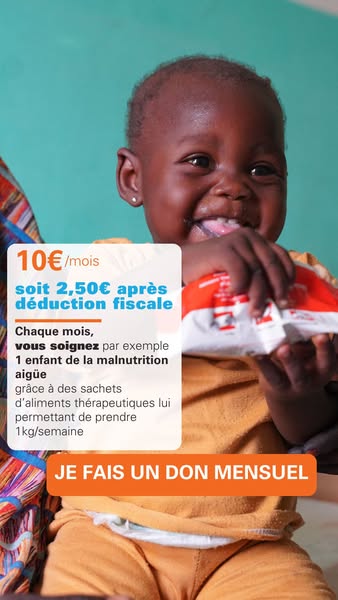
This ad shows a happy child holding a packet of food. The ad states that with 10€/month the customer can help a child with malnutrition.
# Brand positioning
This ad presents a charitable brand focused on helping children with malnutrition. The brand positions itself as a solution to malnutrition, providing therapeutic food through donations. The brand promotes values of compassion and social responsibility, appealing to those who want to make a tangible difference in a child's life. The brand stands against the inaction or perceived inadequacy of addressing global hunger issues, aiming to provide a direct and effective way for individuals to contribute to solving this problem.
# Product
The ad features sachets of therapeutic food, designed to combat acute malnutrition in children. These specially formulated food packets provide the necessary nutrients to help a child gain 1kg per week. The product is designed for children suffering from malnutrition. The ad focuses on the effectiveness and impact of these food sachets, emphasizing their ability to help malnourished children gain weight and improve their health. The ad directly addresses the issue of child malnutrition and positions the therapeutic food as a practical solution.
# Visual style
The ad utilizes a direct and emotionally engaging visual style. The production quality appears to be authentic. The image employs a single dominant image of a child. The typography is clean and legible against a solid background panel to ensure scannability. The overall style is intended to be native and straightforward, aiming to capture attention and convey a clear message efficiently.
# Hooks
Headline: 10€/mois soit 2,50€ après déduction fiscale
# Benefits
- [object Object]
- [object Object]
# Features
- [object Object]
# Call to action
JE FAIS UN DON MENSUEL
# Point of view
- [object Object]
# Storyline
- The ad opens by highlighting that with a donation of 10€/month, a customer can treat a child with malnutrition. This introduces the core value proposition from the brand's perspective: affordability and direct impact.
- The ad continues, noting that for 10€/month, after tax deduction, the amount is 2.50€. The brand is highlighting how affordable and effective the program is.
- The ad closes with a call to action button for customers to start a monthly donation. This represents the brand's invitation to the viewer to directly participate in the solution, completing the narrative by enabling immediate action.
# Ad summary
This ad by UNICEF sheds light on the millions of children in need of humanitarian assistance. It opens with a shot of a crying girl in a destroyed city and then transitions to a montage of children from different countries dealing with hunger, lack of water, and other circumstances. The ad emphasizes UNICEF's constant presence and the possibility of creating a world where all children have equal opportunities through collective action.
# Brand positioning
UNICEF is presented as a global humanitarian organization dedicated to providing aid and support to children in need around the world. The brand positions itself as a constant and reliable presence in the lives of vulnerable children, working to ensure they have the same opportunities to thrive. UNICEF aligns with values of compassion, equality, and social responsibility, aiming to create a world where every child has the chance to grow up healthy, educated, and protected. The brand operates by addressing the urgent needs of children affected by conflict, poverty, and lack of access to basic resources like food and water.
# Product
The product being advertised is UNICEF's humanitarian aid and support programs for children in need. This includes providing food, water, healthcare, education, and protection to children affected by conflict, poverty, and other crises. The ad highlights the scale of the problem, mentioning the millions of children who require assistance, and positions UNICEF as a solution through its consistent presence and actions. By showcasing the positive impact of UNICEF's work, such as providing access to clean water, medical care, and education, the ad aims to reduce the barrier to donation and encourage viewers to contribute to UNICEF's mission. The ad conveys that supporting UNICEF is a tangible way to improve the lives of vulnerable children and create a more equitable world for them.
# Visual style
The ad has a documentary-style aesthetic, with a mix of raw, unfiltered footage and carefully composed shots. The editing rhythm is smooth, with seamless transitions between scenes. The production quality varies, with some shots appearing to be professionally filmed while others have a more UGC feel. The pacing is moderate, with cuts timed to the music and voiceover. The overall visual style supports the ad's emotional tone and aims to evoke empathy and compassion in the viewer.
# Benefits
- [object Object]
- [object Object]
- [object Object]
- [object Object]
# Features
- [object Object]
- [object Object]
- [object Object]
- [object Object]
- [object Object]
# Call to action
Je fais un don
# Point of view
- [object Object]
- [object Object]
# Storyline
- 00:00–00:02 The ad opens with a young girl crying, standing amidst the ruins of a destroyed building. This image immediately conveys a sense of loss, fear, and vulnerability, highlighting the devastating impact of conflict on children. The audience experiences the girl's perspective through her emotional distress and the bleakness of her surroundings, setting a somber tone for the rest of the ad.
- 00:02–00:04 The ad transitions to a scene of a family living in a refugee camp, underscoring the widespread need for humanitarian assistance among children. This moment expands the narrative to include the experiences of other displaced families and their struggles for survival. It aims to evoke empathy and compassion, prompting viewers to recognize the magnitude of the problem and the urgent need for support.
- 00:04–00:06 The scene shifts to a hospital setting where a father is embracing his child with assistance from medical staff. This moment illustrates UNICEF's role in providing healthcare and comfort to children affected by conflict or disaster, showing the direct impact of humanitarian aid on individual lives. The ad continues to build the case for financial support by associating the brand with hope and healing.
- 00:06–00:08 The ad transitions to a woman and child in front of a tent, visually illustrating the challenges faced by families living in poverty and displacement. This reinforces the need for UNICEF's support in providing basic necessities such as shelter and food, furthering the sense of urgency and responsibility. This moment builds on the previous beat by showing a different type of hardship and demonstrating the wide range of challenges UNICEF addresses.
- 00:08–00:10 The ad shows a child being examined by a healthcare professional, underscoring the issue of malnutrition and the importance of medical interventions. The audience views the scene from an observer perspective, seeing the vulnerability of the child and the expertise of the healthcare worker. This moment connects to the overall narrative by illustrating another aspect of UNICEF's mission: ensuring children's health and well-being.
- 00:10–00:12 The ad shows a group of women and children gathered in a dry, barren landscape, highlighting the lack of access to clean water and the impact on communities. This visual emphasizes the severity of the environmental challenges faced by vulnerable populations and the need for sustainable solutions. This connects to the larger theme by showing the impact of environmental factors on children's lives and the importance of addressing these challenges through humanitarian aid.
- 00:12–00:14 The ad cuts to parched earth, visually representing the impact of drought and water scarcity on the environment. This further drives home the point made in the previous beat, emphasizing the dire consequences of environmental challenges on children's lives. It prompts viewers to recognize the interconnectedness of environmental issues and humanitarian crises.
- 00:14–00:17 The ad shows two children walking away from the camera amidst the ruins of a destroyed city, conveying a sense of hope and resilience in the face of adversity. This visually connects back to the opening scene but offers a contrasting tone, suggesting that there is still hope for a better future despite the challenges. It subtly connects to the overall message of the ad by implying that even in the midst of destruction, there is still the possibility of recovery and growth.
- 00:17–00:19 The ad features a portrait of a young girl looking directly at the camera, conveying a sense of determination and strength. This moment shifts the focus back to the individual child, emphasizing their resilience and the importance of supporting their potential. The line, "L'UNICEF est là. Encore et encore," reinforces UNICEF's commitment to being a constant presence in the lives of vulnerable children.
- 00:19–00:21 The ad features a shot of a UNICEF worker sitting and laughing with a child in front of a destroyed building. This moment shifts the focus to show care and support for the impacted children. The shot connects back to the opening scene and provides hope.
- 00:21–00:24 The ad shows UNICEF workers hugging people alongside a UNICEF vehicle, then shifts to a group of children smiling with UNICEF backpacks, visually representing the positive impact of the organization's work and support. This moment instills a sense of optimism and possibility, reinforcing the belief that collective action can make a difference in the lives of children. The line, "Car chaque action nous rapproche d'un monde où tous les enfants auront les mêmes chances," emphasizes the idea that every contribution brings the world closer to a more equitable future.
- 00:24–00:27 The ad shows a woman holding a baby. Both are smiling, visually representing a caring and supportive tone. The line, "de bien grandir et de mieux vivre," reinforces UNICEF's commitment to being a constant presence in the lives of vulnerable children.
- 00:27–00:31 The ad shows the faces of children from different countries looking directly at the camera. The text overlay reads, "Avec vous, plus que jamais, c'est possible. Je fais un don." This personalizes the appeal and empowers viewers to take action, framing their contribution as essential to making a difference.
# Ad summary
This UNICEF ad highlights the organization's commitment to reaching every child, regardless of the challenges they face. Through compelling visuals and powerful text overlays, the ad showcases the various obstacles overcome to deliver essential aid. The ad concludes with a call to action, encouraging viewers to donate to UNICEF's emergency kits, reinforcing the message that every contribution helps bring hope to children in need.
# Brand positioning
The ad showcases UNICEF as a humanitarian organization dedicated to reaching children in need, no matter the dangers or challenges involved. UNICEF is positioned as a relentless force for good, overcoming obstacles to deliver life-saving aid to children in vulnerable situations. The brand's tone is serious, determined, and compassionate, emphasizing its unwavering commitment to every child. The brand aligns with values of humanitarianism, resilience, and hope, implicitly pushing against complacency and inaction in the face of global crises. The brand positioning is both functional, in terms of delivering aid, and emotional, in terms of providing hope and support to children in need.
# Product
The advertised product is UNICEF's emergency kit, which contains essential supplies for children in crisis situations. The kit is implied to include items such as medicine, food, and clean water, as evidenced by the visuals of pills and water bottles being delivered. The ad emphasizes the difficulty and danger involved in delivering these kits to children in need, highlighting the lengths UNICEF goes to in order to reach every child. The kits are for children and families facing emergency situations, such as those living in conflict zones or areas affected by natural disasters. The ad addresses the barrier of accessibility by showing how UNICEF overcomes various logistical challenges, such as traversing rough terrain, crossing bodies of water, and navigating dangerous environments, to ensure that these kits reach those who need them most. The ad conveys that these kits are not just supplies but also a symbol of hope and a lifeline for vulnerable children.
# Visual style
The ad has a documentary-style aesthetic with a mix of raw, shaky footage and clear, polished shots. The editing style consists of quick cuts to emphasize the urgency and pace of UNICEF's work. The production quality varies, with some shots appearing to have a UGC feel, adding authenticity, while others are more polished, maintaining a professional image. Visual motifs include recurring shots of people overcoming obstacles and delivering supplies. The pacing is fast, with cuts happening frequently, creating a sense of momentum and urgency.
# Benefits
- [object Object]
- [object Object]
- [object Object]
# Features
- [object Object]
- [object Object]
- [object Object]
- [object Object]
# Call to action
J'OFFRE UN KIT URGENCE
# Point of view
- [object Object]
# Storyline
- 00:00–00:02 00:00–00:02 The ad opens with a truck driving on a rough, dusty road. The visual is shaky, simulating the difficult conditions, paired with the text "ACHEMINER." This conveys the message that UNICEF is always on the move to get supplies to kids in need.
- 00:02–00:03 00:02–00:03 A close-up shot of hands assembling pill packages is shown. The text overlay reads, "L'AIDE HUMANITAIRE." This underscores that UNICEF is always providing humanitarian aid.
- 00:04–00:06 00:04–00:06 People walk across dry, rough terrain. The text overlay reads, "MALGRÉ LES DANGERS." This conveys that UNICEF faces dangers to get to children.
- 00:06–00:09 00:06–00:09 The ad shows a boat traversing a body of water, followed by the image of people being transported over a ravine, with the text overlay reading, "C'EST TRAVERSER." This highlights the lengths UNICEF goes to in their mission.
- 00:09–00:10 00:09–00:10 A person is shown trudging through deep snow. The text overlay reads, "LES PIRES DANGERS." This shows the dangerous conditions UNICEF encounters.
- 00:10–00:13 00:10–00:13 The ad shows a truck driving through a forest and across a makeshift bridge. The text overlay reads, "POUR ATTEINDRE." This is a continuation of the previous message that UNICEF faces many dangers to reach its goals.
- 00:14–00:16 00:14–00:16 A group of children is seen carrying water. The text overlay reads, "CHAQUE ENFANT." This emphasizes that UNICEF is fighting for all children.
- 00:16–00:19 00:16–00:19 A shot of a smiling baby cuts to children raising water bottles. The text overlay reads, "et apporter plus qu'un kit URGENCE DE L'ESPOIR." This portrays what the end result is for UNICEF's work.
- 00:21–00:24 00:21–00:24 A hand holds up a water bottle. The text overlay reads, "Grâce à vous, allons toujours plus loin pour chaque enfant." This calls back to the viewer and emphasizes that this is all possible because of them.
- 00:24–00:27 00:24–00:27 The text overlay reads, "J'OFFRE UN KIT URGENCE #KitUrgenceKitDeVie." This is a call to action, which emphasizes what the viewer can do to help.
# Ad summary
UNICEF ad featuring Liam Neeson talking about how donations can help save lives in South Sudan.
# Brand positioning
UNICEF is presented as an essential organization that provides health, nutrition, water services, supplies, care, and support to children in crisis situations. The ad reinforces UNICEF's position as a global leader in humanitarian aid by highlighting their on-the-ground presence in areas with complex crises. It aims to create a sense of urgency and highlights the tangible impact that donations can have on children's lives, emphasizing the functional aspect of providing resources and the emotional value of giving children and mothers hope.
# Product
The ad promotes monetary donations to UNICEF to help provide supplies, care, and support to children in South Sudan who are facing sickness, hunger, and displacement. The ad conveys the idea that these children are facing multiple crises at once. The ad promotes the idea that every single donation makes a difference and is helping to save lives.
# Visual style
The ad has a polished commercial aesthetic with natural lighting and a hybrid feel. It utilizes quick cuts and smooth transitions to maintain a consistent pace, enhancing the message's impact. Cuts seem to be timed to the voiceover.
# Benefits
- [object Object]
- [object Object]
- [object Object]
# Features
- [object Object]
- [object Object]
- [object Object]
- [object Object]
- [object Object]
- [object Object]
# Call to action
Donate today
# Point of view
- [object Object]
# Storyline
- 00:00–00:11 Liam Neeson introduces himself and sets the stage by mentioning how difficult it is to explain being on the ground where complex crises are unfolding.
- 00:11–00:18 Neeson explains the crises that children are facing, including sickness, hunger, and displacement. A woman measures a child's arm with a tool.
- 00:18–00:35 Neeson recalls the words of Ajiier, a mother who was proud and relieved that her baby was recovering from severe malnutrition, and who told Neeson all she wanted was for her baby to grow up healthy and be educated.
- 00:35–00:48 Neeson introduces Ruth, UNICEF's head of nutrition, who explains that behind every healed child is a system that's working in harmony with health, nutrition, and water services.
- 00:48–00:52 The ad shows a child using clean water from a water tap connected to a large yellow water tank.
- 00:52–00:58 Neeson notes that every donation makes a difference, that he has seen it and felt it, and believes in it more than ever.
- 00:58–01:03 The ad shows a child in school reading a book. Neeson states that with a donation, you're giving a child another chance and giving a mother hope.
- 01:03–01:11 The ad shows a woman caring for a child in a hospital. Neeson notes that you're helping UNICEF deliver the supplies, care, and support children need to survive and recover.
- 01:11–01:19 Neeson requests the viewer donate today because when you donate, you are helping save lives.
# Ad summary
This ad conveys how UNICEF is helping children and families in need around the world. It shares the facts and figures of how many people they have helped and urges people to donate so that they can help even more people.
# Brand positioning
UNICEF is presented as a global organization committed to helping children in need around the world by providing food, medical assistance, and clean water, especially in conflict zones. The brand aims to occupy the space of a leading humanitarian aid provider, aligning with values of compassion, action, and making a tangible difference in the lives of vulnerable children. They directly address the problem that there is still so much work to be done and so many children in need of support. Their tone is urgent and compassionate, and the visuals showcase beneficiaries from various cultural backgrounds.
# Product
The product being advertised is UNICEF's humanitarian aid services, delivered to children and families in need around the world. These services include providing food, clean water, medical care, and protection from conflict and disease. The ad emphasizes the scale of UNICEF's impact, highlighting that they have helped 190 million children in humanitarian crises in the last 35 years. It showcases UNICEF's commitment to continuing this work by stating they have treated 430 million children in 2023 alone. The ad visually features the product in action, showing aid workers providing care, children accessing clean water, and families receiving food and medical assistance. The core message conveyed is that UNICEF's efforts are crucial and that continued support is needed to reach even more vulnerable children.
# Visual style
The ad has a hybrid visual style, combining footage of professional quality with unpolished clips of children and families, giving it an authentic feel. The editing includes quick cuts between shots, creating a sense of urgency. Many static shots are used and there aren't very many transitions. The pacing is fast. The turquoise background is a consistent visual element.
# Benefits
- [object Object]
- [object Object]
- [object Object]
- [object Object]
- [object Object]
# Features
- [object Object]
- [object Object]
- [object Object]
- [object Object]
- [object Object]
# Call to action
Je fais un don
# Point of view
- [object Object]
- [object Object]
- [object Object]
# Storyline
- 00:00–00:03 00:00–00:03 The ad opens with white text on a turquoise background, stating, "Because actions speak louder than words, we act," establishing the brand's ethos as action-oriented and highlighting a commitment to tangible results over mere promises.
- 00:03–00:11 00:03–00:11 The ad continues with a montage of visuals, showing children and families in crisis situations alongside statistics, such as "190 million children rescued in humanitarian crises in the last 35 years" and "34 million births cared for in 2023," conveyed with an adult male voiceover and a child repeating part of the narration. This shows the scale of UNICEF's impact while highlighting the severity and breadth of need.
- 00:11–00:21 00:11–00:21 The ad continues with the ongoing montage, highlighting the figures "154 million children vaccinated for 50 years" and "More than 2.1 billion people having access to safe water in 20 years."
- 00:21–00:24 00:21–00:24 A text overlay appears on the turquoise screen which says, "ACT EVEN MORE" with the voiceover "Today, we must act even more."
- 00:24–00:33 00:24–00:33 The montage returns, showcasing more images of children in crisis along with voiceover narration mentioning specific children: "For Janna who faces war. For Fatima who worries about the birth of her daughter. For Naba who cannot protect himself from diseases."
- 00:33–00:37 00:33–00:37 A young girl speaks directly to the camera, saying, "As long as there are lives at stake," reinforced by a turquoise screen with text overlays. This highlights the ongoing need for UNICEF's work, focusing on the urgency and moral imperative.
- 00:37–00:41 00:37–00:41 The ad concludes with the male voiceover stating, "We will act to save even more with you, more than ever, it's possible." This emphasizes a call to action by appealing to viewers to join UNICEF in their efforts, portraying them as essential partners in creating positive change.
- 00:41–00:47 00:41–00:47 On the turquoise screen is displayed the Unicef logo to indicate the end of the ad.
# Ad summary
This ad highlights the work that UNICEF does to help children in need around the world.
# Brand positioning
UNICEF is a global humanitarian aid organization focused on providing aid to children around the world. The brand works to combat the dangers children may face in countries that need it most. The ad works to remind the audience that without UNICEF’s work and the help of volunteers, the children would not have what they need.
# Product
This ad promotes UNICEF’s emergency kits. They include basic survival essentials such as clean water, food, and medical supplies. The ad emphasizes that these kits provide more than just immediate relief; they offer hope for a better future. The kits are provided for children around the world.
# Visual style
The ad combines documentary-style footage with dynamic text overlays. The editing is fast-paced, with quick cuts to create a sense of urgency. The production quality varies, with some shots appearing more professional and others having a raw, UGC feel. The visuals are timed to the music beats. The use of real footage adds authenticity and emotional impact.
# Benefits
- [object Object]
- [object Object]
# Features
- [object Object]
- [object Object]
- [object Object]
- [object Object]
# Call to action
J’OFFRE UN KIT URGENCE
# Point of view
- [object Object]
# Storyline
- 00:00–00:02 00:00–00:02 The ad begins with a driving shot of a vehicle on a dirt road. The text reads, "ACHEMINER," emphasizing the idea of delivering aid.
- 00:02–00:03 00:02–00:03 This cuts to a close-up of someone’s hands assembling medical kits, highlighting the process of preparing humanitarian aid.
- 00:03–00:06 00:03–00:06 Text appears that says, "L’AIDE HUMANITAIRE," and the scene shifts to people walking through a dry, desolate landscape, emphasizing the delivery of aid amidst challenging conditions.
- 00:06–00:12 00:06–00:12 The message continues as the ad shows footage of a UNICEF boat traveling on a river. The message being conveyed is that aid is delivered despite dangers, showing different modes of transportation and challenging terrains, to reinforce UNICEF’s commitment.
- 00:12–00:16 00:12–00:16 A transition to a scene with a group of children holding boxes that say "AQUA DELTA." The message is that the aid is reaching "CHAQUE ENFANT," or "EVERY CHILD."
- 00:16–00:19 00:16–00:19 Next, the ad shows a baby smiling, followed by kids holding water bottles, emphasizing the positive impact of the aid, showing that UNICEF provides more than just emergency kits.
- 00:19–00:24 00:19–00:24 The screen reads "DE L’ESPOIR", meaning "OF HOPE". The ad displays a shot of a man handing a water bottle to a child, symbolizing the hope that the kits provide.
- 00:24–00:28 00:24–00:28 The screen displays a call to action: "J’OFFRE UN KIT URGENCE," which translates to "I DONATE AN EMERGENCY KIT."
# Ad summary
This ad for Unicef shows a child before and after treatment for malnourishment. The text overlay states that Unicef treated over 430 million children in 2023.
# Brand positioning
UNICEF is a global organization dedicated to advocating for the protection of children's rights, helping to meet their basic needs and expanding their opportunities to reach their full potential. This ad communicates UNICEF's role in directly providing care for children suffering from malnourishment and offers the viewer a chance to donate so they can help more children.
# Product
The ad showcases UNICEF's role in providing care and treatment for malnourished children. The ad shows a child before and after receiving treatment, with the goal of showing that malnourishment is a problem that can be solved. The product being offered to viewers is the opportunity to donate to UNICEF.
# Visual style
The ad is a standard commercial with cuts between scenes of children and adults. The cuts are timed to the music. The production quality is medium.
# Call to action
Je fais un don
# Point of view
- [object Object]
# Storyline
- 00:00–00:04 The ad opens with a split screen showing a child's face. The left side shows the child after treatment. The right side shows the child with a bandage around their head and a feeding tube. Text overlay states "Muna et sa maman pourront être sauvées de la malnutrition." This beat is intended to showcase the need for UNICEF's services and to introduce Muna and her mother.
- 00:04–00:10 The visual transitions to a full-screen shot of Muna smiling as her mother feeds her. Text overlay states "Comme les 430 millions d'enfants diagnostiqués et traités par l'UNICEF en 2023." This beat is intended to build trust and highlight the scale of UNICEF's work.
- 00:12–00:15 The visual transitions to a shot of a child being measured and given care. Text overlay states, "Il y a encore tant de vies à sauver..." This is a call for donations from the viewer.
- 00:15–00:19 The visual transitions to another shot of a child receiving care. Text overlay states, "Avec vous, plus que jamais, c'est possible. Je fais un don". This is a CTA for the viewer to donate to UNICEF.
- 00:19–00:25 The ad ends with UNICEF's logo.
# Ad summary
This UNICEF ad shows a child standing among the rubble of bombed-out buildings in Gaza. She explains that she wants to live a beautiful life like any other child in the world. The ad asks viewers to offer hope to children in need and donate.
# Brand positioning
This UNICEF ad showcases the brand's commitment to providing humanitarian aid to children across the globe. The brand aligns with the values of global citizenship and care for others. UNICEF pushes against apathy by spotlighting children in desperate need of help.
# Product
This ad is promoting donations to UNICEF, a non-profit organization that aims to provide aid to children across the globe. The ad illustrates that donating will give children in Gaza a beautiful life. The language addresses purchase barriers by suggesting that it is possible to give hope to children who need it.
# Visual style
The ad has a UGC feel, with dark lighting and natural camera angles. The video utilizes static shots and smooth transitions. The production quality aligns with a documentary aesthetic, which helps to convey the seriousness of the subject matter. The pacing is slow.
# Benefits
- [object Object]
# Features
- [object Object]
# Call to action
JE FAIS UN DON
# Point of view
- [object Object]
- [object Object]
# Storyline
- 00:00–00:05 00:00–00:05 The video opens with a shot of a young girl carrying a toddler through a bombed-out building. This opening is intended to establish a tone of sadness and loss.
- 00:05–00:07 00:05–00:07 The girl addresses the camera and says, "I ask the world to help us." This moment is intended to convey a personal message, placing the audience into her perspective.
- 00:07–00:15 00:07–00:15 The girl is shown holding a teddy bear in the rubble as she says she wants to live like other children and to have a beautiful life. This statement is intended to show the normalcy of her desires and to encourage the audience to want to help her achieve her goals.
- 00:15–00:19 00:15–00:19 The video shows text that says, "Offer hope to children who need it." This is an appeal to the audience's humanity.
- 00:16–00:19 00:16–00:19 The video has the call to action: "I donate," encouraging the audience to donate.
- 00:19–00:25 00:19–00:25 The UNICEF logo is shown, reinforcing the brand's association with helping children.
# Ad summary
This UNICEF ad features a young girl in Gaza sharing her wish to live like any other child in the world and asking for help. The ad ends with a call to action encouraging viewers to donate.
# Brand positioning
UNICEF is portrayed as a global humanitarian organization dedicated to advocating for and protecting the rights of children worldwide. The brand’s mission is to provide assistance and support to children in need, ensuring their well-being and access to basic necessities such as healthcare, education, and protection from violence and exploitation. The brand positions itself as a champion for children's rights, seeking to create a world where every child has the opportunity to thrive and reach their full potential. UNICEF is taking a functional approach by showing the need for a safe environment for children.
# Product
The ad promotes charitable giving. The product is the act of donating to UNICEF, which in turn provides aid and support to children in Gaza. The product is for anyone who wants to help children in need by providing hope for children who need it.
# Visual style
The ad has a somber, documentary-like aesthetic. It appears to be filmed in a war zone with a desaturated color palette. The production quality is raw and unpolished to convey a sense of authenticity. It features static shots and smooth transitions. The pacing is slow.
# Benefits
- [object Object]
- [object Object]
# Features
- [object Object]
- [object Object]
# Call to action
JE FAIS UN DON
# Point of view
- [object Object]
# Storyline
- 00:00–00:04 The ad opens with a shot of two children amidst the rubble of destroyed buildings.
- 00:04–00:07 A young girl directly addresses the viewer, asking the world to help them. This is presented from the girl's perspective.
- 00:07–00:15 The girl walks through rubble, speaking about her desire to live like other children, expressing hope and a longing for normalcy.
- 00:15–00:25 The ad concludes with a black screen featuring white text in French, urging viewers to offer hope to children in need and providing a call to action button labeled “JE FAIS UN DON” (I make a donation). The Brand’s official name is displayed.
# Ad summary
This ad highlights UNICEF's efforts in Tawila, Soudan, to aid displaced children and families facing horrific conditions. It focuses on the organization's provision of essential services, including protection, education, water, sanitation, and nutrition, and its dedication to reuniting separated children with their families.
# Brand positioning
UNICEF (United Nations Children's Fund) is presented as a global humanitarian organization committed to providing aid and protection to children in need. The ad emphasizes UNICEF's presence in challenging environments, showcasing its work in providing essential services such as healthcare, education, nutrition, and family reunification. UNICEF positions itself as a crucial actor in safeguarding children's rights and well-being in crisis situations, aiming to alleviate suffering and ensure a brighter future for vulnerable populations. The brand aligns with values of compassion, social responsibility, and dedication to global child welfare, operating as a leading force in humanitarian aid and child advocacy.
# Product
The ad focuses on UNICEF's comprehensive aid package for children and families in Tawila, Soudan, including protection services to safeguard their well-being in displacement camps, which are greatly needed. It highlights the establishment of safe learning spaces where children can play and catch up on their education. The ad also features the provision of water, sanitation services, and nutrition, including therapeutic foods to help children recover. Additionally, UNICEF aids in the reunification of children separated from their families during displacement. These products and services aim to address the immediate needs of vulnerable populations and ensure their long-term recovery and well-being.
# Visual style
The video uses a documentary style with natural lighting, aiming for authenticity and emotional impact. Quick cuts and smooth transitions create a steady pace, highlighting various aspects of UNICEF's work. The production quality is polished, enhancing the credibility of the message. The editing rhythm is consistent, maintaining viewer engagement and emphasizing the urgency and importance of the issues at hand.
# Benefits
- [object Object]
- [object Object]
# Features
- [object Object]
- [object Object]
- [object Object]
- [object Object]
- [object Object]
- [object Object]
# Call to action
Je fais un don.
# Point of view
- [object Object]
# Storyline
- 00:00–00:03 The ad opens with Annmarie Swai, representative of UNICEF au Soudan, who is introduced via text overlay, stating her immediate reaction upon arriving in Tawila.
- 00:03–00:11 00:03–00:11 She highlights the size of the displacement camp and the inadequacy of services available.
- 00:11–00:15 00:11–00:15 Swai emphasizes the critical need for protection services for the children.
- 00:15–00:21 00:15–00:21 The representative notes that children have endured horrific conditions for an extended period.
- 00:21–00:34 00:21–00:34 Swai explains that in addition to health, UNICEF works to provide specialized support to help children, families, and women recover from their experiences. She notes they envision creating safe learning spaces.
- 00:34–00:41 00:34–00:41 UNICEF is supporting the provision of water and sanitation.
- 00:41–00:59 00:41–00:59 She mentions her visit during a measles and rubella vaccination campaign, where hundreds of children were vaccinated.
- 00:59–01:17 00:59–01:17 Swai visited several health sites where primary health care is supported, such as the provision of nutrition support to children through therapeutic food that will help them to recover.
- 01:17–01:24 01:17–01:24 She discusses that many of the children arrived unaccompanied or were separated during the journey.
- 01:24–01:43 01:24–01:43 Partnered with UNICEF, the goal is to identify the children to place them with relatives or families temporarily, to place them within a family unit.
- 01:43–01:53 01:43–01:53 Swai concludes by reinforcing the importance of humanitarian actors and partners working to help these displaced children and families.
- 01:53–01:56 01:53–01:56 A screen appears that reads “Les enfants ont besoin de vous” followed by a CTA for donations.
# Ad summary
string
# Brand positioning
UNICEF is a humanitarian aid organization focused on providing aid to children around the world. In this ad, UNICEF is presented as an organization that is currently working in Lebanon to help children affected by the war. The ad aligns the brand with values of compassion, peace, and social responsibility. It promotes an emotional connection with viewers by showing the devastating impact of war on innocent people, especially children.
# Product
This ad is promoting donations to UNICEF to help them protect children affected by the war in Lebanon. The ad highlights the urgent need for assistance by showing the destruction caused by the war and the impact on the lives of teachers, doctors, nurses, and children. It addresses the purchase barrier of apathy or lack of awareness by bringing attention to the ongoing conflict and the vulnerable population that it effects. The ad is telling the viewer that donations are worth giving because they will help protect children and provide them with the resources they need to survive and rebuild their lives.
# Visual style
The ad has a raw, documentary-style aesthetic with handheld camera shots and natural lighting. The editing style includes quick cuts between the speaker and the rubble. The production quality has a UGC feel to support the authenticity and seriousness of the message. The pacing is consistent, with cuts timed to the speaker’s words.
# Benefits
- [object Object]
- [object Object]
- [object Object]
# Features
- [object Object]
- [object Object]
- [object Object]
# Call to action
FAITES UN DON.
# Point of view
- [object Object]
# Storyline
- 00:00–00:01 The video begins with James Elder, a spokesperson for UNICEF, standing in the rubble of a destroyed building in Lebanon.
- 00:01–00:11 He emphasizes the importance of remembering those killed in the strikes and identifies the destroyed building as the home of a preschool teacher.
- 00:11–00:20 He expresses grief over the fact that everywhere he looks, all that remains are the vestiges of the family home of a teacher.
- 00:20–00:29 He underscores the need to remember those killed in the attacks, who include teachers, doctors, nurses, and children.
- 00:29–00:35 He reveals that the teacher who lived in the destroyed house lost her three-year-old boy in a strike.
- 00:35–00:41 He emphasizes that the ceasefire must hold and that the war should never have happened.
- 00:41–00:45 The video ends with a call to action, urging viewers to help UNICEF protect children by making a donation.
# Ad summary
This ad for UNICEF aims to raise awareness for children in need of humanitarian aid. It opens with a shot of a young girl crying in a war-torn environment, then shows children in refugee camps, children being treated for malnutrition, and a community drawing water from a well. The ad closes with a child looking directly at the camera with a warm smile.
# Brand positioning
UNICEF is presented as a global organization committed to aiding children affected by war, displacement, malnutrition, and lack of access to clean water. The brand is positioned as a consistent and reliable source of support, working towards a world where all children have equal opportunities to thrive. It aligns with values of compassion, equity, and hope, pushing against the norm of indifference in the face of global crises. The positioning is both functional, providing life-saving aid, and emotional, fostering a sense of hope and possibility for a better future.
# Product
This ad is not promoting a physical product, but rather UNICEF itself as a service, as well as promoting financial donations to the organization. The ad highlights UNICEF's work in areas such as disaster relief, healthcare, nutrition, and water access for children in need. The ad clearly conveys the message that donations to UNICEF directly support these critical services, addressing the purchase barrier of uncertainty about where donations go. The ad is telling the viewer that their contribution can make a tangible difference in the lives of vulnerable children.
# Visual style
The ad has a documentary feel, with authentic and unpolished visuals. There are quick cuts between various scenes, creating a sense of urgency. The production quality is high enough to be clear but maintains a raw feel. The pacing is fast to keep the viewer engaged, and the cuts are often timed to the beat of the background music.
# Benefits
- [object Object]
- [object Object]
- [object Object]
# Features
- [object Object]
- [object Object]
- [object Object]
- [object Object]
# Call to action
Je fais un don
# Point of view
- [object Object]
- [object Object]
- [object Object]
- [object Object]
# Storyline
- 00:00–00:01 00:00–00:01 A young girl stands amid rubble, visibly upset and wiping away tears. The message conveyed is the immediate suffering of children in conflict zones, aiming to evoke empathy and urgency.
- 00:01–00:03 00:01–00:03 A group of young children stand in a camp. The ad is conveying the reality that children in need of support live in refugee camps, and aims to show how many children need aide.
- 00:03–00:05 00:03–00:05 A girl hugs a man in a hospital. The message conveyed is that UNICEF provides healthcare to those children in need of support, aiming to highlight the brand's services.
- 00:05–00:07 00:05–00:07 A woman sits with two young children. The ad is conveying the reality that children in need of support live in refugee camps, and aims to show how many children need aide.
- 00:07–00:10 00:07–00:10 A small child receives a check up. The message conveyed is that UNICEF provides nutritional aide to those children in need of support, aiming to highlight the brand's services.
- 00:10–00:13 00:10–00:13 A group of children stand near a well, as a shot of the ground is shown. The message conveyed is that UNICEF provides access to clean water to children in need, aiming to highlight the brand's services.
- 00:13–00:16 00:13–00:16 A young boy and girl walk to school. The message conveyed is that all children are deserving of an education, and aims to highlight the brand's values.
- 00:16–00:18 00:16–00:18 A young girl looks at the camera with a neutral expression. The message conveyed is the brand value of support for young girls in need.
- 00:18–00:20 00:18–00:20 A young boy smiles. The message conveyed is the brand value of support for young boys in need.
- 00:20–00:21 00:20–00:21 A woman and man hug. The message conveyed is the brand value of supporting communities in need.
- 00:21–00:24 00:21–00:24 A group of school children smile and wave to the camera. The message conveyed is the brand value of supporting education for young children in need.
- 00:24–00:26 00:24–00:26 A woman holds a baby and smiles. The message conveyed is the brand value of supporting health aide.
- 00:26–00:27 00:26–00:27 A young girl smiles at the camera. The ad aims to put a face to the people the brand is supporting.
- 00:27–00:30 00:27–00:30 A young girl smiles at the camera. The ad aims to put a face to the people the brand is supporting.